Microbes Hitch a Ride on Bubbles express
Yeast are trapped in a clear gel, like raisins in jelly. They can't move on their own, but soon they start rising to the top. The secret lies in their own homemade fizz.
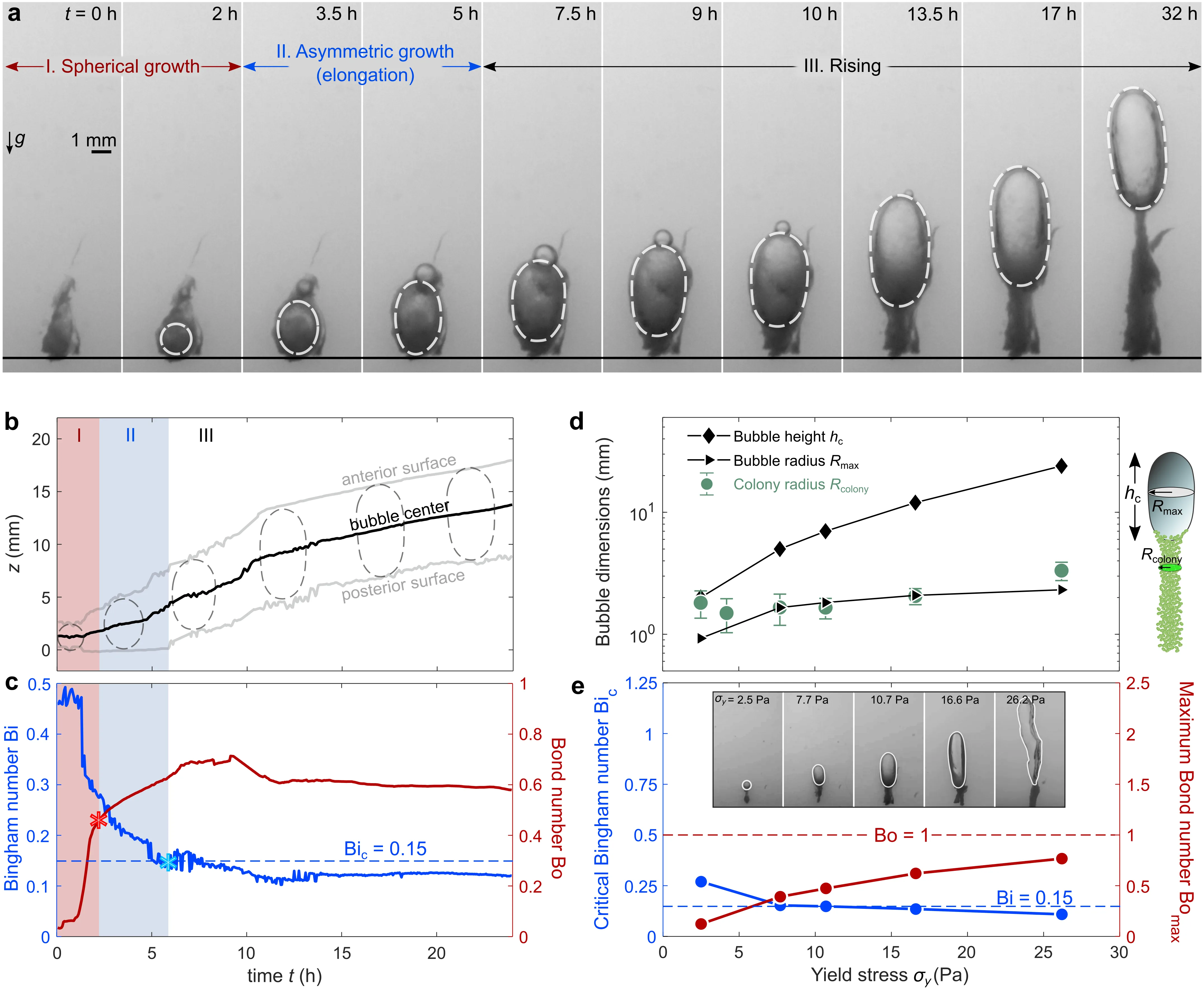
During fermentation, yeast release carbon dioxide. In a thick medium, the gas doesn't escape but accumulates until bubbles form. A bubble grows, pushes the gel aside, and floats up, dragging yeast cells with it, just like bubbles in soda lift crumbs. One bubble after another, and soon the colony stretches into a column that extends far beyond what simple cell division could achieve.
Different yeast colonies sitting nearby also communicate through carbon dioxide. Their bubbles merge, forming shared channels. Through these channels, cells from different colonies mix and even exchange genes. So non-motile microbes build roads out of their own waste.
This discovery explains how microbes spread through soil, sediments, and even bread dough. Previously, it was thought that they needed flagella to swim or slow colony growth to expand. Now it's clear: they can simply 'boil over' and ride off on bubbles.
Original abstract
as written by the authors arXiv:2604.07768
Immotile microbes inhabit nearly every environment on Earth, from soils and sediments to food matrices -- yet how they disperse through these physically confining environments is poorly understood. Here, we show that immotile microbial colonies confined in a model transparent yield-stress matrix can achieve long-range dispersal by harnessing their own metabolism. Using yeast as a model organism, we find that fermentation drives dissolved CO$$_2$$ to supersaturation, nucleating biogenic bubbles that grow, yield the matrix, and rise, hydrodynamically entraining cells vertically in their wake. Sequential bubble nucleation sculpts persistent columnar colonies extending far beyond what growth alone permits. Multiple colonies interact via their fermentation byproducts, merging and mixing genetically as they collectively sculpt self-sustaining conduit networks. Our findings reveal a third mode of microbial dispersal, distinct from the canonical mechanisms of motility and growth, with implications for ecology, environmental science, and biotechnology. More broadly, they exemplify a previously unrecognized class of active behavior -- Metabolically Driven Active Matter -- in which metabolic byproducts reshape the physical landscape of confinement to drive population-scale motion.
In a single cubic centimeter of yeast sediment, several hundred carbon dioxide bubbles can form in an hour — enough to lift the entire colony a centimeter upward.
In Stephen Baxter's novel 'Evolution', microbes use chemical reactions to move through alien environments — similar to how yeast harness their own bubbles.