Turbulence Speeds Up Raindrops express
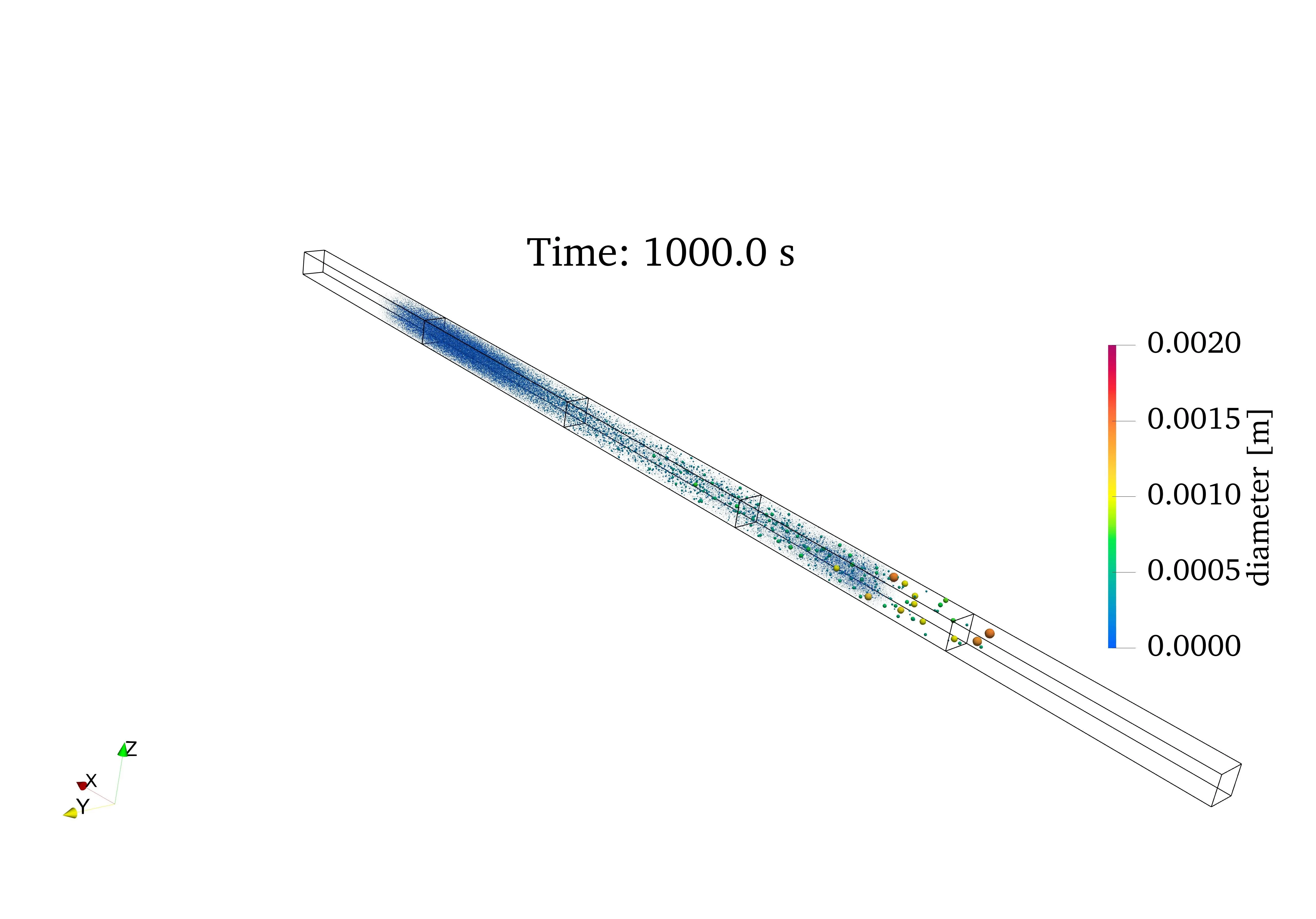
In a cloud, thousands of tiny water droplets hang in the air. For rain to fall, they need to grow: stick together into larger drops and become heavy enough to fall to the ground. But how exactly do droplets find each other in a huge cloud?
Scientists created a computer model that tracks each droplet individually, as if each one had its own little sensor. The model covers the entire column of air from the ground to the top of the cloud. Inside this column, they turned on turbulence — chaotic air eddies that constantly mix the droplets. For comparison, they ran the same model without eddies.
The result was surprising: eddies act like invisible hands that bump droplets into each other. First, droplets of the same size collide in the middle of the cloud: this is how the first large drops are born. Then these large drops, falling downward, collect smaller ones along the way, like a snowball rolling down a mountain. So in a turbulent cloud, rain starts earlier, and the first drops that hit the ground are larger than in calm air.
Original abstract
as written by the authors arXiv:2604.10564
We developed a new explicit cloud microphysical model, based on direct numerical simulation (DNS) with Lagrangian particle tracking. The model employs a vertically-elongated quasi-1D computational domain extending from the ground to the cloud top to explicitly capture the vertical structure of clouds. This allows us to simulate the all warm-cloud microphysical processes, including activation, condensation growth, collision-coalescence growth, and sedimentation. A homogeneous isotropic turbulence field is incorporated into this domain to explicitly resolve the turbulent wind fluctuations. Cloud microphysics simulations with and without turbulent wind fluctuations were performed to clarify the impact of turbulence on droplet growth. We obtained new insights into the altitude- and time-dependent microphysical statistics, which cannot be obtained through conventional DNS researches for a cubic box domain with periodic boundaries. The comparison have shown that turbulence promoted the collision-coalescence growth of droplets. During the early developing stage, where the updraft was present, turbulence promoted the collisions between droplets with similar sizes (autoconversions) in the middle layer of the cloud. In later stage, relatively large droplets produced by autoconversions actively collected smaller droplets (accretions) in the middle and lower layers. The onset of precipitation at the ground occurred earlier and the first raindrop at the ground was larger in turbulence case than that in non-turbulence case.
The first raindrop from a turbulent cloud was larger than from a calm one. The eddies seem to deliberately gather more water for it.