The Lagrangian is a function depending on the coordinates and velocities of all parts of a system. Instead of considering forces, as in Newtonian mechanics, one operates with energies: kinetic (energy of motion) and potential (energy of position). From the principle of least action it follows that the actual motion of a system occurs such that the total difference of these energies along the trajectory is minimal. This approach is particularly convenient for systems with constraints, e.g., a pendulum on an inextensible string, and allows one to derive the equations of motion (Euler-Lagrange equations).
History
First presented by Joseph-Louis Lagrange in 'Analytical Mechanics' (1788) with the goal of constructing mechanics without geometric constructions. In the 19th century, William Rowan Hamilton reformulated it into Hamiltonian formalism. Henri Poincaré developed the theory of dynamical systems. Emmy Noether in 1918 proved the theorem linking continuous symmetries of the Lagrangian to conserved quantities. In quantum field theory, the Lagrangian became the basis of the Standard Model.
How it works
For a system with generalized coordinates q_i, the Lagrangian is written as L(q, q̇, t) = T − V. The Euler-Lagrange equations are obtained by requiring the variation of the action to be zero. For example, for a particle in a potential field, L = ½ m ẋ² − V(x). Noether's theorem states: to each continuous symmetry of the Lagrangian there corresponds a conserved integral of motion (energy, momentum, etc.).
In practice
Used for calculating the orbits of planets, trajectories of rockets, optimizing mechanical devices, and in the foundations of quantum theory.
Fun fact
Lagrange's method made it possible to solve problems that were too complex for the direct application of Newton's laws, such as the motion of many-body systems with constraints.
As planets orbit the Sun, they don't just follow their paths: they give each other a slight tug. It's like a dance where each partner feels the movements of the others. Scientists set out to determine how strongly this mutual attraction alters the planets' trajectories.
It turns out there are small corrections that were previously overlooked.
Two massive bodies frozen in a quantum superposition resemble a pair of dancers trying to keep a single rhythm while an orchestra blares around them. Each gravitational wave is a musician throwing them off beat.
A Dictyostelium amoeba crawls across glass. Its path is recorded — a chain of points on a plane. But what forces are pushing it? Inside the cell, a molecular motor works: proteins pull, the membrane springs, water presses.
A pendulum in a noisy room is constantly jostled by people passing by. Its motion is a mix of regular swings and random jerks. Something similar happens with weak gravitational waves against the backdrop of an expanding universe. In Einstein's general relativity, these waves are tiny ripples in spacetime.
The early universe was less like a calm pond and more like a boiling cauldron. Matter flowed, collided, and swirled against the backdrop of rapid spatial expansion. To understand how stars and galaxies emerged from this hot soup, physicists build digital simulations.
This new work is the third part in a series on lattice-based cosmological modeling. The first two focused on fields; this one deals with fluids.
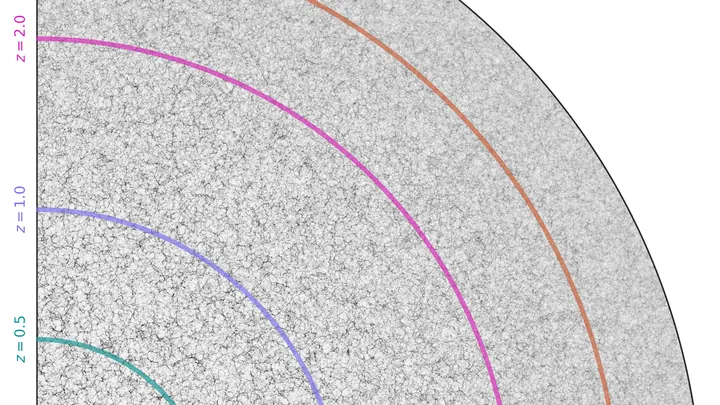
In a dark room, music plays. Powder is scattered on the floor — fine, almost invisible. Low frequencies make it gather into intricate patterns: filaments, clumps, voids. In much the same way, gravity over billions of years weaves galaxies into the cosmic web — except here, attraction does the work instead of sound waves.
A tiny magnetized sphere floats in a vacuum, held by invisible fields. It starts to spin around the axis of the magnetic field, just like a top that's been given a gentle nudge. That's precession. But when the sphere becomes really small, quantum laws come into play.
Researchers took 16 everyday activities — from washing dishes to squatting — and broke the movements down into elementary components, much like a spectroscope splits light into a spectrum. Comparing three approaches, they found an unexpected key to recognition: a single averaged snapshot is enough. Only nine joints out of dozens carried the crucial information — the rest hardly mattered.
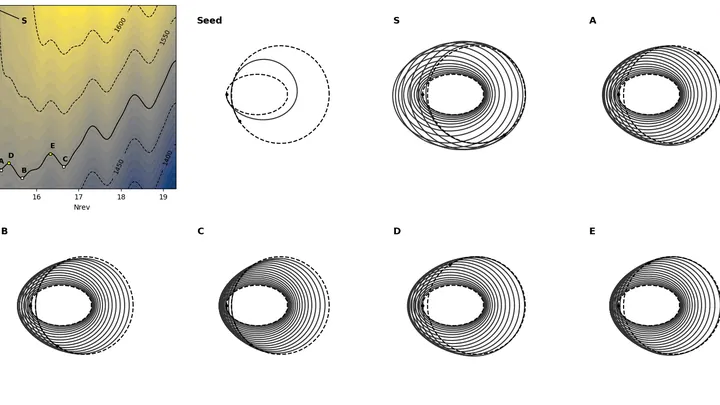
A space tug with an ion engine accelerates slowly, but it sips fuel. To get from one orbit to another, you have to solve a tricky problem: how long to fire the engine and where to point it. Usually, the goal is to find the fastest transfer for a given spacecraft mass.
A handful of sand falls onto a table: each grain rolls down until it rests in a hollow. That's how a potential works: the table's surface tells the grains where to go. But in a river with whirlpools, there's no single basin everything flows into. Water swirls, returns, and meanders. For such systems, the usual map of 'pits and hills' doesn't apply.
A crowd at a metro station during rush hour. Some hurry toward the escalator, others slow down at the departure board, still others weave around a column. Each step is not merely a reaction to what's right in front of your nose. A person estimates in advance where a neighbor will be a second from now and adjusts their route accordingly. Physicists call this forward-looking behavior anticipatory.
An orchestra plays without a conductor, and you hear the tempo speeding up and slowing down. All you have is a recording of the sound, not the score. Can you tell from that recording which string to pluck to make the whole orchestra play more steadily?
The shape of a riverbed precisely follows the equation describing the growth of a universe with negative curvature. In the lab, water flowing over sand spontaneously carves a cross-section that matches the solution for the Anti-de Sitter model.
A river tends toward a shape that maximizes bottom friction.
A magnetic field in plasma resembles a stretched soap film: pressure from inside pushes it out, while surface tension pulls it in, giving it shape. Here too, magnetic pressure and tension forces balance each other.
The Universe's expansion is accelerating, and maybe gravity doesn't work the way we think. Physicists come up with alternative theories, but to test them, they need to calculate how ripples after the Big Bang grew into galaxies. Such calculations involve long equations with hundreds of terms, where it's easy to get lost.
A flashlight beam in a dark room can hold a dust mote almost still: that's how optical tweezers work. But light doesn't just push the particle; it also jostles it with random kicks. Each absorbed photon strikes it like an invisible hammer. The authors of the new study have devised a light trap of a special shape.
When a person breathes, air doesn't flow in a steady stream but in waves. Previously, doctors and scientists only looked at overall numbers: how much air entered per breath, what the peak flow was. But within a single breath, there are nuances — small variations that speak to the workings of nerves and muscles. The new approach breaks a breath into parts, much like a musician breaks a chord into individual notes.
A drop of ink in a glass of water spreads evenly, but in a cup with chunks of fruit jelly, the ink will take winding paths — sometimes getting stuck, sometimes slipping through. Similarly, molecules in living cells or porous materials don't move on a smooth field but through a disordered medium: denser in some places, thinner in others.
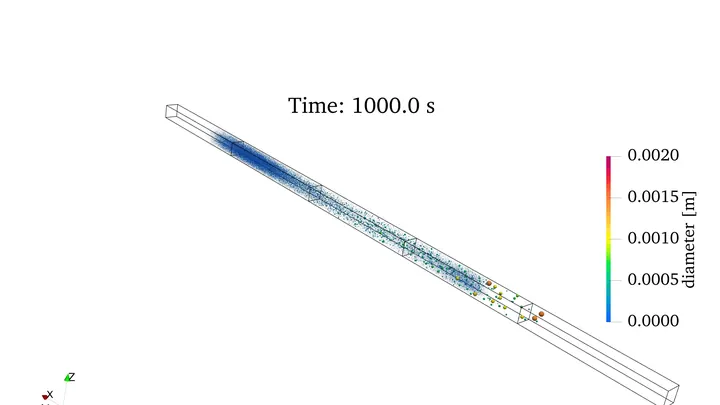
In a cloud, thousands of tiny water droplets hang in the air. For rain to fall, they need to grow: stick together into larger drops and become heavy enough to fall to the ground. But how exactly do droplets find each other in a huge cloud?
Scientists created a computer model that tracks each droplet individually, as if each one had its own little sensor.
Physical systems can compute. If you build a landscape of hills and valleys so that the lowest point corresponds to the answer, the system will roll there by itself, like a ball. The problem is that the bottom is often flat, and the ball crawls around for a long time before settling.
The authors propose nudging the ball to the right place before it even starts.
To avoid losing a fast soccer player in the frame, a drone doesn't need a bright beacon — recognizing the silhouette is enough. Similarly, a neural network now tracks microbes: the algorithm analyzes an ordinary microscope image and instantly finds a bacterium in a drop of water.
An optical tweezer is a beam of light that holds and moves tiny objects like bacteria or dust grains. If you need to carry a particle from point A to point B, you could simply pull it straight there. But that would consume more energy than a cleverly chosen detour.
An active particle is a microscopic object that propels itself forward, like a tiny swimmer.
When a typical computer searches for a law of nature from data, it tries to guess a complete formula in one go. It's like a cook who, without knowing the recipe, dumps all the ingredients into a pot at once and hopes for soup. Most often, the result is an inedible mess: the formula is long but meaningless, and it fails on new data.
A tiny particle floats in a laser beam like a speck of dust in a flashlight's glow. Water molecules constantly jostle it — randomly, from all sides. Usually these bumps are a nuisance: the particle twitches, and precise measurements turn into a lottery. But physicists have figured out how to turn the interference into an advantage.
The heart doesn't contract all at once but as a wave: an electrical signal travels through the muscle, and behind it, like ripples spreading on water, a contraction rolls through. In arrhythmia, this wave goes awry: it stalls in one spot, loops in another, and the pump starts working in a disorganized way.
A charged particle spiraling in a magnetic field doesn't stay silent: it emits light. This light is called synchrotron radiation, and it shows up everywhere — from distant galaxies to laboratory accelerators.
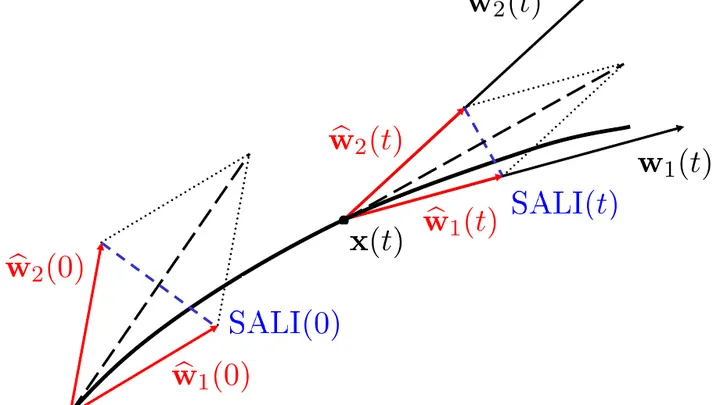
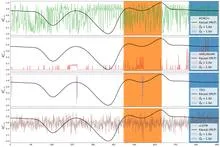
Drop a stone into a calm pond — the ripples spread evenly. Drop it into a churning stream — the water swirls unpredictably. Scientists have long wrestled with a similar question: how can you tell from a single particle's path whether its motion is chaotic? Previously, this meant comparing the particle's path with neighboring ones, which is complicated and time-consuming.
Picture a translator at a meeting where everyone speaks an unfamiliar language. They don't know the words, but they notice: when one person raises their voice, another starts nodding a minute later. At first it seems like coincidence, but over time the translator learns to understand who influences whom.
A translator learns not from a dictionary but from speech. They listen to native speakers and pick up rules that are written in no textbook. Similarly, a new method for forecasting complex systems such as climate or turbulence does not require knowing their equations. Instead, it looks at data and learns to predict their behavior.