A Black Hole Without a Horizon: What Next-Generation Telescopes Will See express
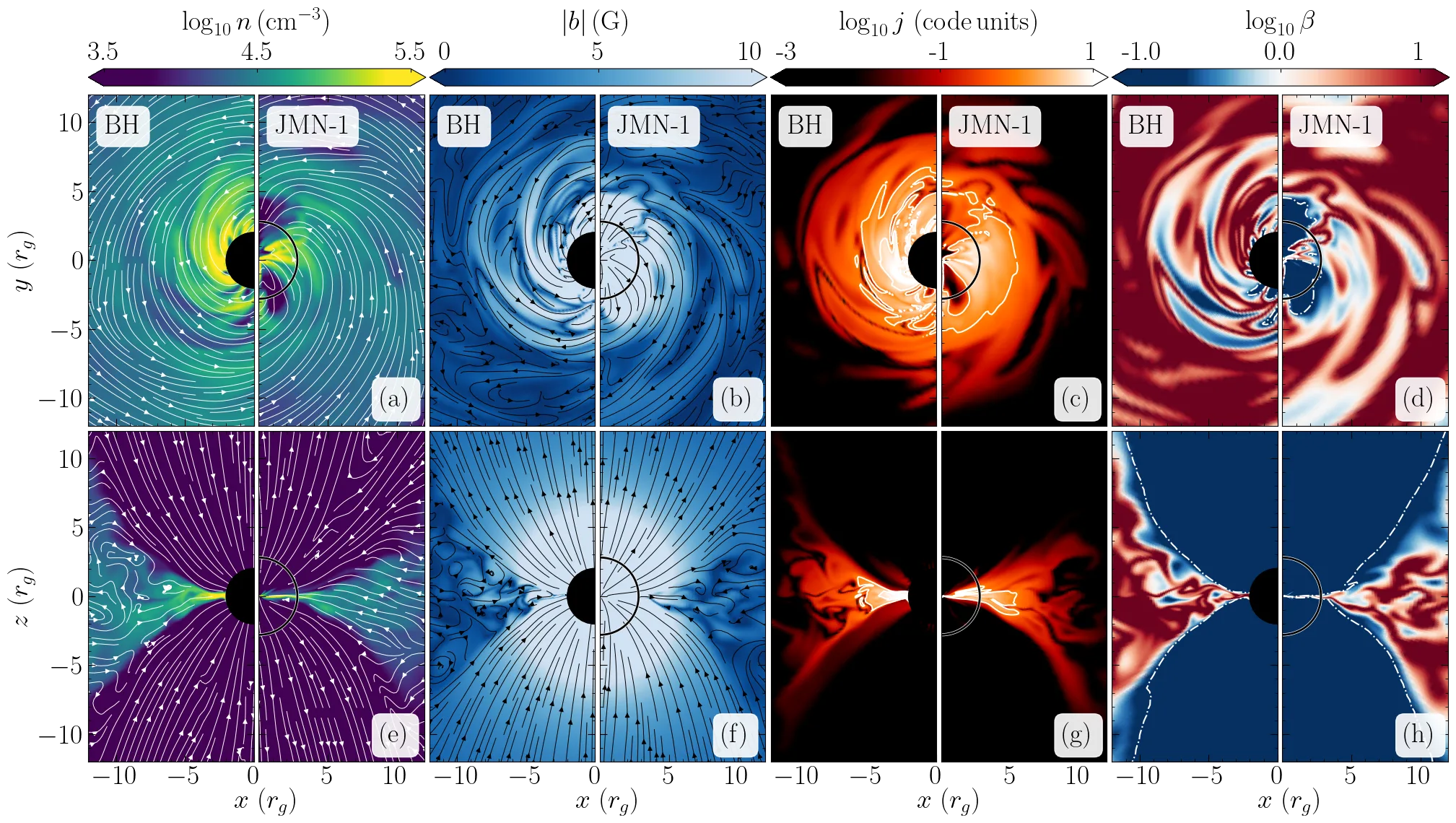
A bottomless well, but not quite. An ordinary black hole has a boundary, the event horizon, beyond which nothing returns. But what if you remove that boundary? That's exactly the kind of object, dubbed JMN-1, that astrophysicists modeled: a massive body born from stellar collapse, but without the impenetrable veil. Instead of a horizon, there's a naked singularity — a point where matter falls in and where the known laws of physics break down.
In the simulation, they aimed a stream of plasma at JMN-1, just like at the black hole in the center of galaxy M87. Around the singularity swirled a scorching disk threaded with magnetic fields, just like the ones astronomers see around real black holes. Matter didn't pile up outside or get flung away; it calmly made its way to the center. The accretion rate was about three millionths of the maximum possible — the same as predicted for a black hole of the same mass.
Today, this light is too dim for our instruments, but next-generation radio interferometers will be able to catch it. Then astronomers will have a reliable test: if something flickers at the center of the shadow, we're not looking at a black hole but at its bold lookalike without a horizon. So nature may have left us a clue on how to peer beyond the edge of our usual ideas — into that very well that turned out not to be bottomless.
Original abstract
as written by the authors arXiv:2604.15430
We present the first three-dimensional general relativistic magnetohydrodynamic simulation of sustained accretion onto a horizonless singularity in which matter reaches the central object rather than being accumulated outside of it or expelled in outflows. We consider a Joshi-Malafarina-Narayan (JMN-1) spacetime, a well-motivated black hole mimicker that arises from gravitational collapse with anisotropic pressure in general relativity, and adopt a compactness parameter for which the central singularity is null. We find that the system evolves into a sustained magnetically arrested disk state. For parameters appropriate to the low-luminosity active galactic nucleus M87*, we obtain an accretion rate of $$\sim(3.0 \pm 0.5)\times 10^{-6} \dot{M}_{\rm Edd}$$, in full agreement with estimates based on black hole models and, in particular, comparable to that of our reference Schwarzschild black hole simulation. Synthetic ray-traced images at $$230\,{\rm GHz}$$, computed using polarized general relativistic radiative transfer, are broadly consistent with the Event Horizon Telescope observations of M87*. We identify a key observational discriminant between a black hole and JMN-1: the presence of detectable brightness inside of the ``observable" shadow of JMN-1. This emission originates very close to the central singularity, in a region that would be hidden behind the event horizon in a black hole spacetime. Although this signature is beyond the reach of current observations, it falls within the projected imaging dynamic range of next-generation radio interferometric instruments, offering a robust test of the black hole paradigm.
The object JMN-1 gets its name from the initials of three physicists (Joshi, Malafarina, and Narayan) who came up with this exotic type of spacetime within standard general relativity.
The idea of a naked singularity is explored in William Sleator's novel "Singularity," where characters try to prevent such an object from appearing near Earth.