Carbon Beam Under Control: How to Catch a Gamma-Ray Flash express
When a carbon ion beam enters the body, it doesn't release energy all at once but rather at the end of its path, like a runner who gives their all on the final stretch. Doctors need to know this finish point to avoid damaging healthy tissue. But how can you look inside the body without making an incision? Physics itself provides the answer: when ions collide with atomic nuclei, brief flashes of gamma radiation are produced.
The idea is simple: if you record the moment an ion enters and the moment a gamma-ray flash arrives, the time difference tells you how deep the collision occurred. This is like an echo in the mountains — by the delay of the sound, you can tell how far away the cliff is. Scientists have tested this method for the first time on a carbon ion beam at the Italian CNAO center. They irradiated a plastic target 30 centimeters thick and caught the gamma rays with a detector placed to the side of the beam.
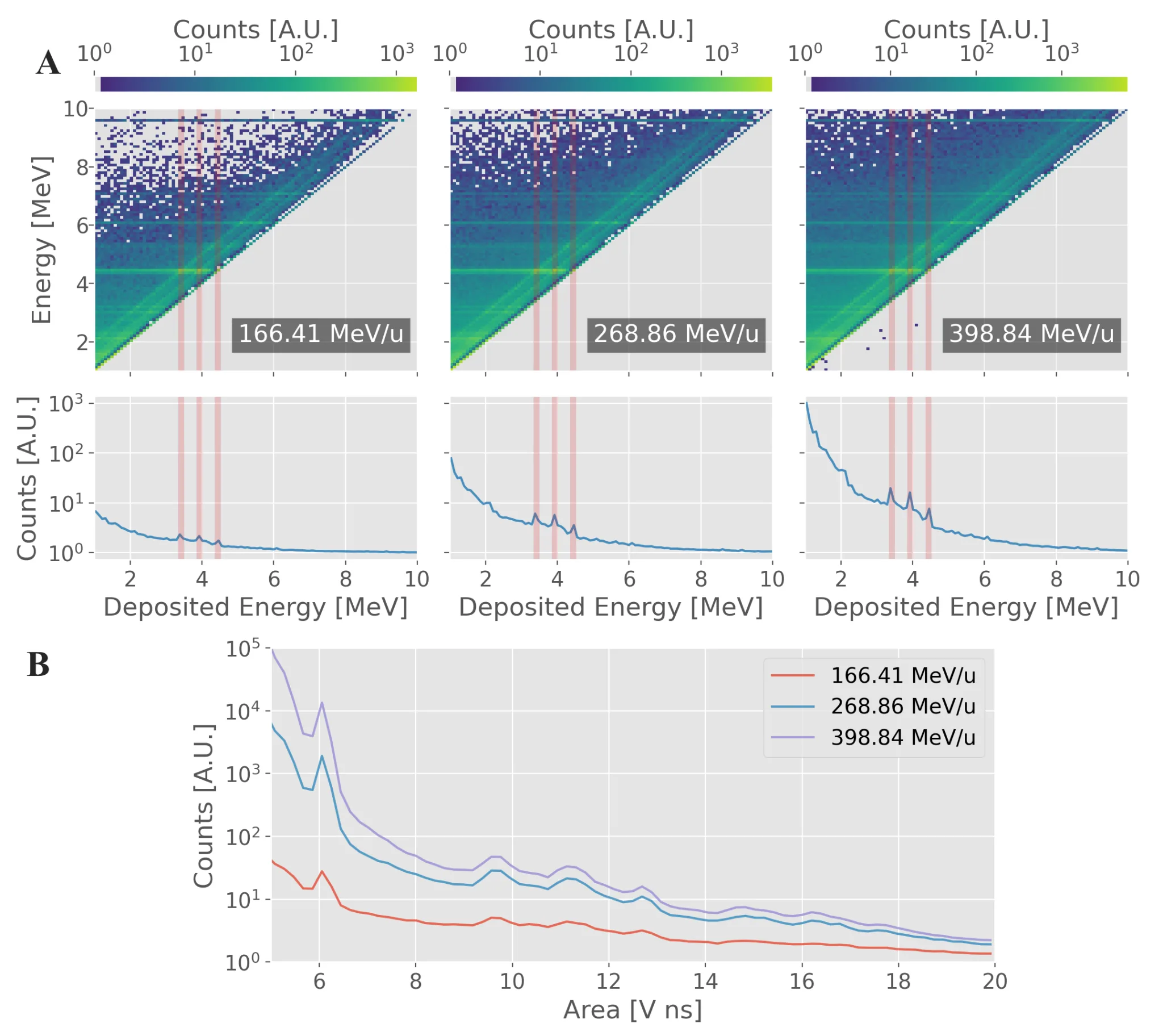
Experiments at three different beam energies showed that calculations and reality match almost perfectly. For the lowest energy, there was no discrepancy; for the middle energy, less than one percent; and for the highest energy, up to eight percent in the worst case. Moreover, the signal was clean: it was mostly gamma quanta, not interfering neutrons or nuclear fragments. This means the method can be trusted.
Why is this needed? Today, when treating with particle beams, doctors rely on calculations, but the patient's body is not perfectly uniform, and the beam may stop slightly earlier or later. If we can learn to track the depth in real time, treatment will become more precise and safer. For now, this is a laboratory experiment, but it proves that the echo from gamma-ray flashes could become a reliable compass for radiation therapy.
Gamma-ray flashes from carbon irradiation occur within billionths of a second after the ion hits — faster than the blink of an eye.