Gamma-ray detection is the set of techniques used to observe and measure gamma radiation, the most energetic form of electromagnetic radiation, with photon energies typically above 100 keV. Because gamma rays are produced by some of the most violent processes in the universe—supernovae, black hole accretion, gamma-ray bursts, and possibly dark matter annihilation—detecting them lets astronomers probe extreme physics that cannot be replicated on Earth. In the laboratory, gamma-ray detection is essential for nuclear physics, medical imaging, and radiation safety.
History
The field began in the early 20th century with the discovery of gamma rays by Paul Villard in 1900, but practical detection emerged with the Geiger counter and later the scintillation counter developed by Hartmut Kallmann and Robert Hofstadter in the 1940s. The first cosmic gamma-ray detection came from the Explorer 11 satellite in 1961.
How it works
Gamma rays are detected indirectly because they have no charge and pass through most materials. Detectors rely on gamma-ray interactions with matter: in scintillation detectors, gamma photons excite atoms in a crystal (like sodium iodide), which then emit visible light that photomultiplier tubes amplify. Semiconductor detectors, such as high-purity germanium, measure the ionization produced by gamma rays as electrical pulses, offering high energy resolution. For cosmic sources, space-based telescopes like Fermi use pair-conversion trackers, where gamma rays convert into electron-positron pairs in thin foils, and the particle tracks reveal the photon's direction and energy.
In practice
Gamma-ray detection is used in medical imaging (SPECT and PET scans), nuclear security screening, and monitoring radioactive materials in industry and environmental science.
Fun fact
The Fermi Gamma-ray Space Telescope detects about one gamma ray per minute from the entire sky, despite the universe being full of gamma-ray sources.
Gamma rays are the most energetic light in the Universe. But one part of them, the medium-energy range, long remained invisible: instruments couldn't catch them, leaving a gaping hole in the sky. Scientists call it the "MeV gap," named after the unit of energy these rays carry.
The new camera works like a three-layer detective.
Imagine a huge stadium packed with people dressed in black. You're standing outside, trying to figure out what's happening inside, even though you can't see a single person. But if two people bump into each other and exchange bright T-shirts, you'd spot a flash of color.
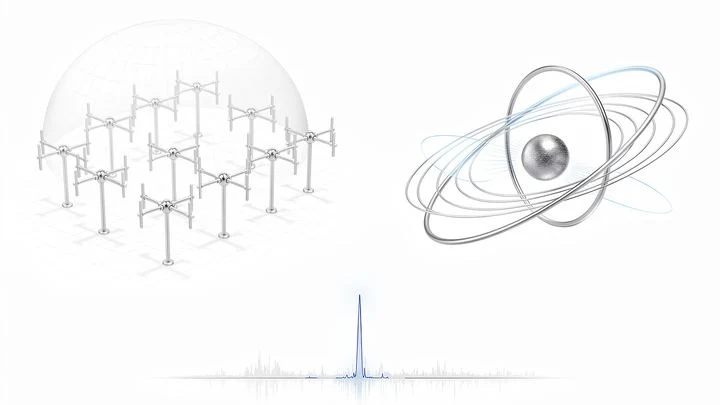
Listening to the cosmos requires patience and a finely tuned ear. Astronomers chose the most sensitive low-frequency instrument for this: the OVRO–LWA antenna array — 352 dipole antennas scattered across two and a half kilometers of California desert.
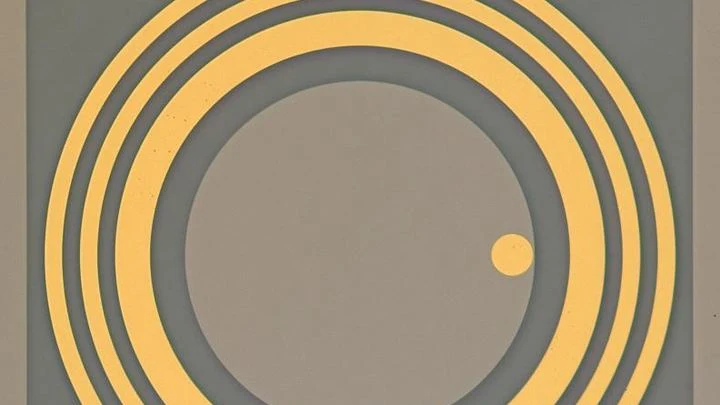
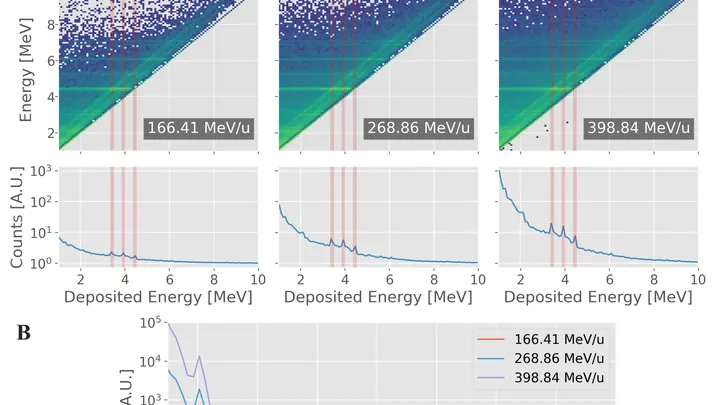
An alpha particle is a helium nucleus that flies out when heavy atoms decay. When it hits a gallium nitride crystal, it deposits its energy and creates an electrical pulse. The pulse height tells you how much energy the particle had.
At the very heart of the Milky Way, something is continuously glowing in gamma rays. This light is special: its energy is exactly 511 thousand electronvolts. Such energy is produced when an electron meets its antimatter counterpart, a positron, and they annihilate, leaving behind a flash of light.
When a carbon ion beam enters the body, it doesn't release energy all at once but rather at the end of its path, like a runner who gives their all on the final stretch. Doctors need to know this finish point to avoid damaging healthy tissue. But how can you look inside the body without making an incision?
Imagine a balance scale with identical weights, yet one pan always tips lower. In the world of elementary particles, this imbalance is called CP violation: particles and their mirror twins (antiparticles) behave slightly differently.
The Fermi telescope spent 17 years recording gamma rays from the active nuclei of galaxies with giant black holes at their centers. The glow of their jets resembles a chaotic cacophony: it constantly changes.
A pebble dropped in a pond creates curved ripples, but from far away they appear as straight lines. Gamma-ray flashes from an evaporating black hole behave the same: a distant burst sends flat waves, while a nearby one arrives curved.
Laser light is like a perfectly aligned row of soldiers on parade: all waves oscillate in the same plane. Such light is called polarized. In a new study, physicists have for the first time produced polarized gamma rays by colliding electrons with a powerful laser pulse.
A gamma-ray burst is like a shot from a cosmic cannon: a brief but dazzling flash that outshines an entire galaxy for a few seconds. But when observed in the hardest gamma-ray band (photons with energies above a gigaelectronvolt), the signal often gets lost in the noise, like a whisper in a noisy hall.
In October 2022, the cosmos put on a fireworks show that every detector on Earth noticed. The explosion, named GRB 221009A, was so bright that it was called the brightest ever observed. It's a gamma-ray burst — a short but incredibly powerful flash that releases as much energy in seconds as the Sun will produce in its entire lifetime.
A radiation sensor in the city is like a street musician: it has to hit the right notes even when fingers go numb from cold or the instrument is baked by the sun. Usually, such devices are kept in greenhouse conditions, with heating or cooling, otherwise the energy scale (which distinguishes harmless potassium in concrete from dangerous cesium) starts to lie.
In underground laboratories where dark matter or neutrinoless double beta decay is sought, detectors are surrounded by silence. But even in this silence, radioactive dust quietly settles on their walls. One source is radon, an invisible gas that seeps from rocks. Its short-lived progeny stick to surfaces and spoil measurements.
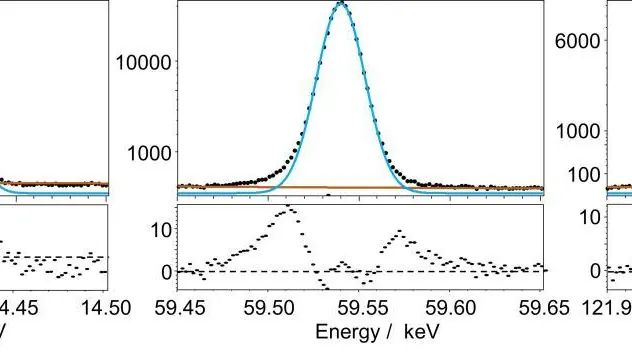
Gamma rays are the most energetic flashes of light born deep within atoms. Their energies are like fingerprints: each radioactive element has its own pattern. But measuring that pattern with high precision is like weighing a grain of sand on a scale sitting on a vibrating truck.
The new setup works like an ultra-sensitive thermometer.
In a particle accelerator, electrons race around a ring at nearly the speed of light. When such an electron collides with a photon, a particle of light, the photon bounces off like a ball hitting a moving truck and flies away with much greater energy.
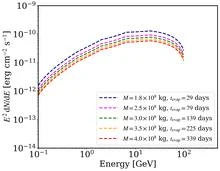
In 2017, the LIGO and Virgo gravitational detectors caught ripples in spacetime from the merger of two black holes 540 megaparsecs away. The event was named GW170814. But what remained after this cosmic collision? Besides distorted space, tiny black holes, or 'crumbs', might have been born.
On the night of March 9–10, 2024, a cloud of plasma ejected by the Sun raced away from the star. It had already passed a distance of five solar radii when a ground-based array of 352 antennas in California's Owens Valley caught a brief radio signal from it.
Detecting a single quantum emitter is like tuning a piano on a factory floor full of screaming machines: the pure tone drowns in noise. But the tuner doesn’t try to outshout the racket — he picks up a tuning fork and listens for beatings. That’s how even a barely audible echo becomes clear.