Why Black Holes 'Refuse' to Weigh 45 Suns express
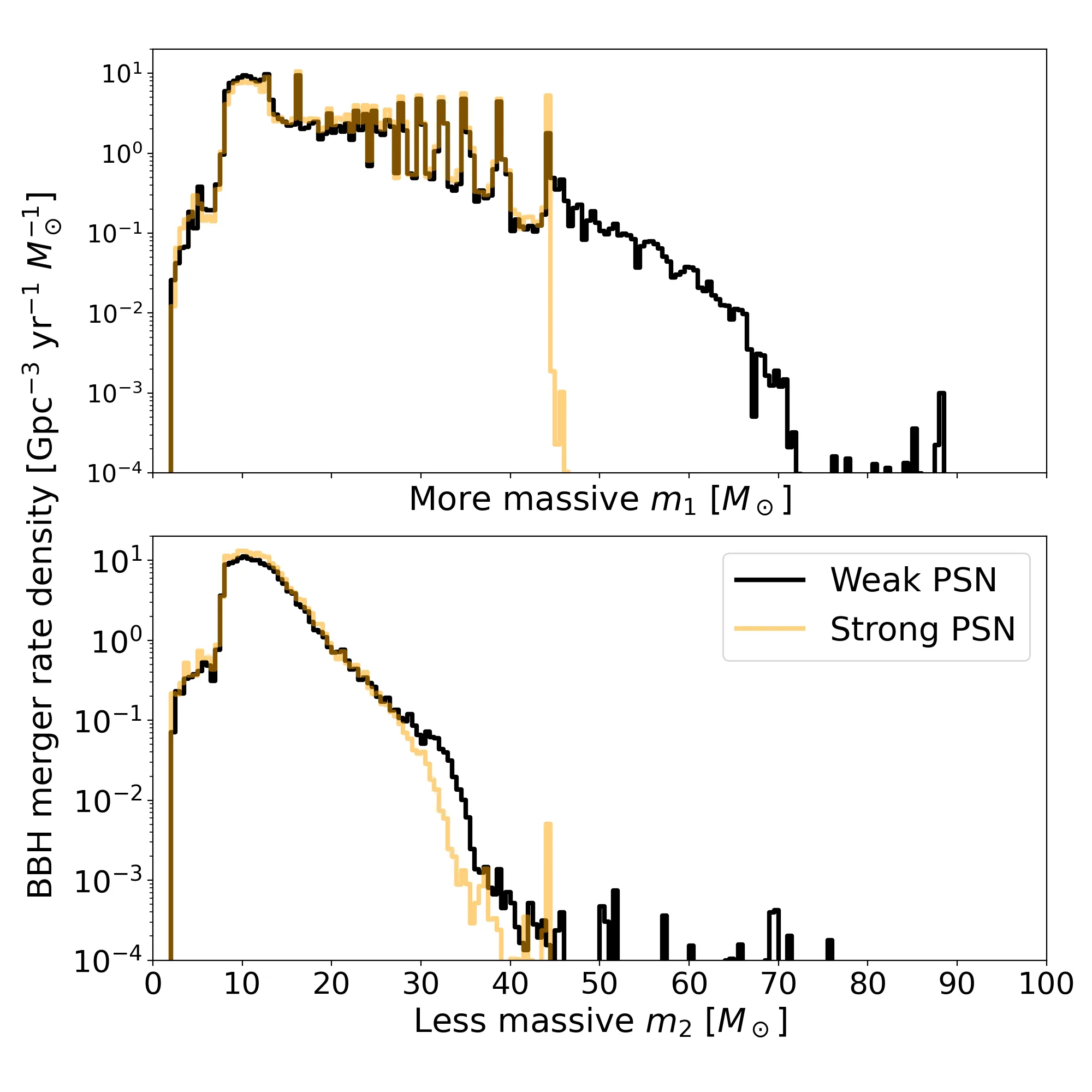
The latest crop of gravitational waves brought a puzzle. The LIGO, Virgo, and KAGRA detectors caught dozens of signals from merging black holes, and the mass plot shows a glaring gap: objects heavier than 45 Suns are almost absent, and the few that exist spin suspiciously fast. Some say giant stars explode too 'cleanly,' leaving nothing behind. But there's another idea: black holes lose weight before they're even born, in a tight dance with a companion.
Two stars orbit close together, like figure skaters holding hands. One puffs up, and its outer layers spill onto the companion. If the transfer is generous, more than half the material goes, the first star is left as a bare core. It then collapses into a black hole, but a lightweight one: not 50 Suns, but maybe 30 at best. The second act is a reverse transfer, but stingy, with almost no losses. The second star gains mass, but its ceiling is set by another law: that same 'suicide explosion' that leaves nothing heavier than 45 Suns.
In the end, a pair rarely produces two heavy black holes. The smaller one rarely exceeds 45 Suns: it was 'eaten' in childhood. The larger one can grow to the limit, but not beyond. This creates a false 'mass gap' that looks just like the signature of special explosions. Future signals will help distinguish the scenarios: if black holes with fast, aligned rotation or, conversely, lazy rotation are found in the gap, then it's not about explosions but about how the stars shared their matter.
Original abstract
as written by the authors arXiv:2604.18676
The recent O4a release from the LIGO-Virgo-KAGRA collaboration, which significantly increased the number of gravitational-wave (GW) detections, reveals features with potentially important astrophysical implications. One notable example is a hint of the so-called pair-instability mass gap. In particular, the observed decline in the number of black holes (BHs) with mass above 45 Msun, together with indications of possibly higher spins for BHs above this threshold, has been interpreted by Antonini et al. and Tong et al. as evidence for pair-instability supernovae. In this work, we investigate whether mass transfer in binary systems can produce BH components' mass distribution that mimics the pair-instability limit. We use both the population synthesis code StarTrack and a simple semi-analytical framework to highlight the impact of mass transfer efficiency on the BH masses. We find that efficient mass transfer (over 50%) during the first Roche-lobe overflow, followed by a highly non-conservative second mass transfer phase, naturally limits the mass of the first-born BH and produces a cutoff that mimics a mass gap. While the upper mass limit for the more massive BH is increased through accretion during the first mass-transfer phase and is ultimately set by the pair-instability limit, the less massive BH is limited to the stripped primary mass. As a result, the fraction of systems in which the less massive BH exceeds 45 Msun is negligible. While the pair-instability mass gap is a plausible interpretation of current GW data, similar features can naturally arise from binary evolution. Future detections will help distinguish between these scenarios. In particular, a predominance of positive effective spins or low-spin events within the gap would challenge the pair-instability interpretation and instead support a binary-interaction origin for high-mass BHs.
The mass gap between 45 and 60 solar masses is called the 'pair-instability gap': in this range, a star gets so hot before death that its core doesn't just collapse: it blows itself apart completely.