LIGO, Virgo, and KAGRA form a global network of ground-based gravitational wave observatories that detect ripples in spacetime caused by catastrophic cosmic events. These observatories use laser interferometry to measure minuscule changes in the distance between mirrors, changes that are typically thousands of times smaller than a proton's diameter. The network's combined data allows scientists to pinpoint the location of gravitational wave sources in the sky and to study the properties of black holes and neutron stars with unprecedented precision.
History
The first direct detection of gravitational waves was made by LIGO in September 2015, announced in February 2016, confirming a prediction of Einstein's general relativity made a century earlier. Virgo joined the network in 2017, and KAGRA in 2020.
How it works
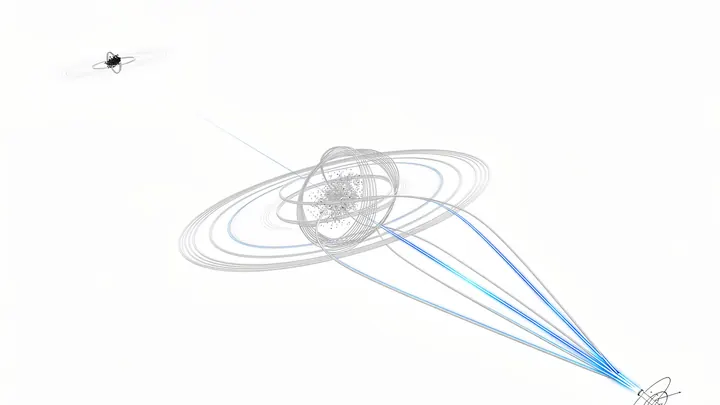
Each observatory consists of two long vacuum tubes, typically 3–4 kilometers long, arranged in an L-shape. A laser beam is split and sent down each arm, reflecting off mirrors at the ends. When a gravitational wave passes, it stretches one arm while compressing the other, causing the two light beams to travel slightly different distances. This creates an interference pattern that reveals the wave's signature. By correlating signals from multiple observatories, scientists can distinguish genuine gravitational waves from local noise and triangulate the source's position.
In practice
The network enables multi-messenger astronomy, where gravitational wave events are correlated with electromagnetic observations, as demonstrated in the 2017 neutron star merger GW170817.
Fun fact
The LIGO mirrors are so sensitive that they can detect a change in distance equivalent to one-thousandth the width of a proton, and the observatories must account for quantum noise arising from the very light particles used to measure the waves.
Imagine an interpreter distracted by every rustle in the hall, turning a one-hour meeting into two. That's roughly how gravitational wave detectors behaved when analyzing long signals: each turn of the Earth added noise to the calculations, and processing a day-long neutron star merger threatened to stretch into weeks.
Gravitational-wave detectors are like extremely sensitive ears: they pick up the trembling of space when black holes or neutron stars collide somewhere in the universe. But even the most sophisticated "ears" cannot hear everything. The new LIGO A# project is like replacing the eardrum with a thinner, more sensitive membrane.
Drop two stones of different shapes into a pond — the ripples will tell you which one was smooth and which was jagged. Gravitational waves work the same way: when two ultra-dense objects merge, the trembling of spacetime carries details about their inner workings.
A noisy café. You're trying to make out two quiet conversations: one from the table by the window (black hole mergers), the other a barely audible whisper from the far corner (echoes of the universe's birth). But the hiss of the espresso machine and street noise (detector jitter) drown everything out. New work teaches a computer to separate these sounds.
In the first moments of its life, the universe resembled a boiling cauldron. Matter wasn't spread evenly — clumps and voids were brewing within it, and their violent motion gave rise to a trembling of space itself: gravitational waves.
For a whole year, LIGO, Virgo, and KAGRA listened to the trembling of spacetime. Thousands of mergers of black holes and neutron stars left clear signatures. But hidden among them was another signal — a barely audible whisper.
You're listening to the faint whisper of stars, and nearby someone keeps moving a chair. In gravitational wave telescopes, that role is played by scattered light: it reflects off trembling surfaces and creates false signals.
A huge bowl of water. Drop a stone into it — ripples spread across the surface. The fabric of spacetime works much the same way: when two massive stars merge, they create ripples — gravitational waves. These waves travel to Earth and are picked up by giant detectors like LIGO and Virgo.
In August 2019, the LIGO and Virgo detectors picked up gravitational waves from the merger of two compact objects in a binary star. One weighed 23 solar masses — a standard black hole. The other came in at 2.5–2.67 M⊙.
A spinning top that makes a hundred turns per second suddenly starts losing speed dramatically — much faster than any known top. That's exactly what pulsar J0435+3233 is doing. It's a dead star, crushed to the size of a city, but whirling at a furious rate.
In 2019, the LIGO facility recorded a gravitational waves, a ripple in the fabric of spacetime, whose time-frequency map resembled a strange comb. Each such signal from a black hole merger leaves a unique pattern, like a fingerprint.
In May 2020, the LIGO and Virgo detectors picked up a gravitational-wave burst known as GW200105. Among the many similar gravitational waves recorded, this one stood out for an oddity: the orbit of the colliding neutron star and black hole was not a perfect circle, but a stretched ellipse.
Two neutron stars spiral closer and collide. The result: a gravitational wave, a ripple in spacetime, a short gamma-ray burst, and a faint glow astronomers call a kilonova. But sometimes the signal passes by a massive galaxy.
Ever since Einstein predicted gravitational lensing, and gravitational waves were first heard by LIGO detectors, physicists have dreamed of catching the lensed echo — a repeating signal from one merger, multiplied by the gravity of a massive body.
The cosmos sets its own lenses in the path of gravitational waves. When two black holes merge, the resulting ripple travels through the universe. If it encounters a massive galaxy cluster along the way, its gravity bends the path of the waves — much like glass focuses light.
In pursuit of gravitational waves, ripples in spacetime left by black holes and neutron stars, detectors like LIGO pump their arms with light of dazzling intensity.
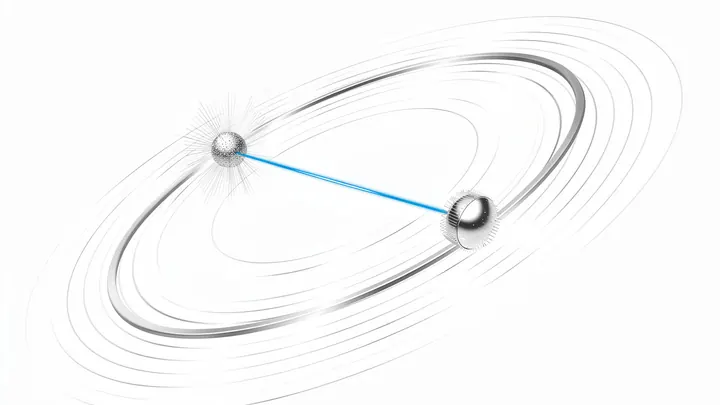
A pair of neutron stars, locked in a gravitational embrace, traces invisible circles in the void. A century ago, Albert Einstein described this dance as waves of curved geometry, but for a long time we could only catch glimpses — through the feverish flicker of radio pulses.
At the centers of many galaxies lurk black holes — regions with gravity so strong that even light cannot escape. Stars often orbit them, and sometimes one of those stars is a pulsar, a cosmic lighthouse sending out strictly periodic radio pulses. When such a pulsar moves behind a black hole, its signals reach us with a delay.
Two sensitive microphones are listening to the Universe. One hears a low hum, the other hears almost nothing. It's not a malfunction: it's about how they are oriented.
Gravitational-wave observatories like LIGO don't just catch loud bursts from black hole mergers.
A gravitational wave observatory is like a set of microphones scattered across the Earth. When a signal arrives from space (say, from a black hole merger or a supernova explosion) each microphone hears something slightly different.
The universe is permeated by invisible mass, dark matter, whose existence was first proposed by Fritz Zwicky in the 1930s, based on his observations of galaxies moving in clusters.
In 2015, detectors caught a gravitational wave for the first time — a ripple in space that traveled from merging black holes. Since then, such signals have become a new window into the universe for astrophysics. But gravitational waves can do more: they carry the imprint of the very theory of gravity.
A translator records a multi-hour conversation. If they try to hold the entire dialogue in their head, they're bound to garble details by the end. That's roughly how gravitational observatories work: they listen to the 'conversation' of massive bodies spiraling together.
An ultra-sensitive microphone listens not to sound, but to the trembling of space itself. That's how gravitational wave detectors work — LIGO, Virgo, KAGRA.
It was Edwin Hubble who discovered that galaxies are rushing apart, and Georges Lemaître linked this to the expansion of space. Today, the ΛCDM model, relying on dark energy and dark matter, asserts that the Universe is flat as a perfectly stretched canvas.
LIGO, Virgo, and KAGRA detectors act like giant microphones, listening in on gravitational waves — vibrations of space itself. The new GWTC-5.0 catalog recorded 161 black hole mergers, bringing the total count to 390 events.
Imagine a giant inflatable balloon with galaxies painted on it. As it inflates, the pattern stretches and neighboring dots move apart. The rate of that stretching is the Hubble constant. Astronomers usually catch light from distant stars and see how much it has reddened due to the stretching of space.
Gravitational waves are the very trembling of space, born when black holes or other massive bodies collide. Their main oddity isn't that they pass through us, but that they permanently alter the curvature of spacetime and the distances between everything they touch.
Usually, black holes inch closer gradually, circling in a tightening spiral. This dance births a long ripple of gravitational waves — a tremor in the very fabric of spacetime. Detectors LIGO and Virgo routinely catch such mergers.
But GW190521 is the exception.
Spacetime is not a passive void but a dynamic membrane capable of elastic deformation. When neutron stars (ultra-dense objects the size of a city, where matter is compressed to nuclear density or black holes) regions with gravity so strong that even light cannot escape their bounds collide, the membrane shudders, generating…
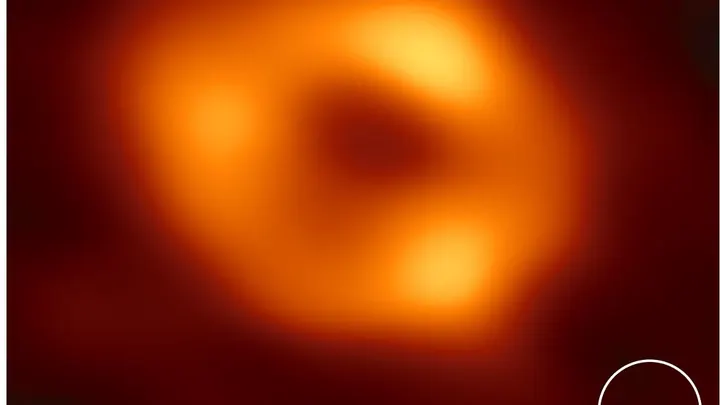
Twenty-first-century astrophysics is deafening with triumphs: we’ve caught the tremor of spacetime from the merger of invisible giants; glimpsed the 'shadow' of a supermassive monster in a distant galaxy; traced the orbits of stars dancing around a compact something at the heart of the Milky Way.
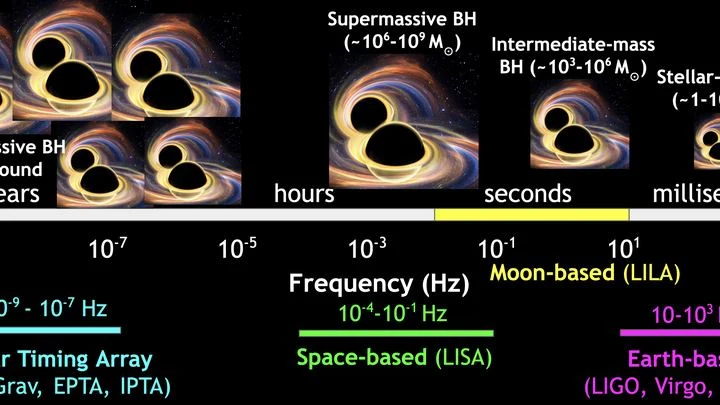
Gravitational waves are ripples in the fabric of space, like circles on water from a thrown stone. On Earth, they are drowned out by traffic, tides, and earthquakes, like a storm beating on a lake, making it impossible to notice faint splashes. The LILA project moves the detector to the Moon, where windless silence reigns.
The fabric of space bends under weight, like a stretched trampoline. Gravitational waves — ripples spreading from cosmic cataclysms, such as merging black holes. If such a ripple encounters a massive galaxy or invisible dark matter, they act like a magnifying glass: bending and amplifying the signal.
A pot of water sits on the stove. When the water boils, it suddenly turns into steam: that's a phase transition. In the first moments after the Big Bang, the Universe underwent something similar, but it wasn't liquid and gas that changed, but fundamental fields.
When two black holes merge, the resulting black hole 'rings' for a while, emitting gravitational waves — like a dying bell. This ringing is captured by giant detectors created by Rainer Weiss and Kip Thorne.
Einstein's theory of gravity explains how mass warps space and time. Its predictions have been tested near Earth, but the most grueling tests lie around black holes, where distortions reach their breaking point. Until now, astronomers saw them as blurry smudges on an underexposed photo.
When black holes or neutron stars merge, they disturb the very fabric of spacetime, producing gravitational waves — ripples predicted by Einstein in his general theory of relativity.
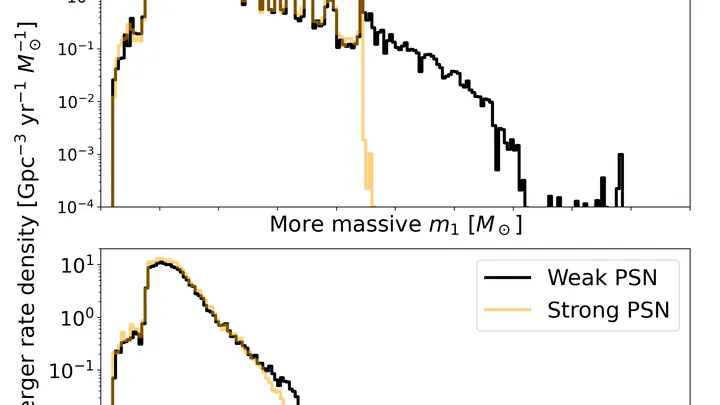
The latest crop of gravitational waves brought a puzzle. The LIGO, Virgo, and KAGRA detectors caught dozens of signals from merging black holes, and the mass plot shows a glaring gap: objects heavier than 45 Suns are almost absent, and the few that exist spin suspiciously fast. Some say giant stars explode too 'cleanly,' leaving nothing behind.