phenomenon

gravitational wave echoes

Echoes in gravitational wave signals reveal information about black hole mergers and early universe events.
104 related articles · 1 formulas

Description

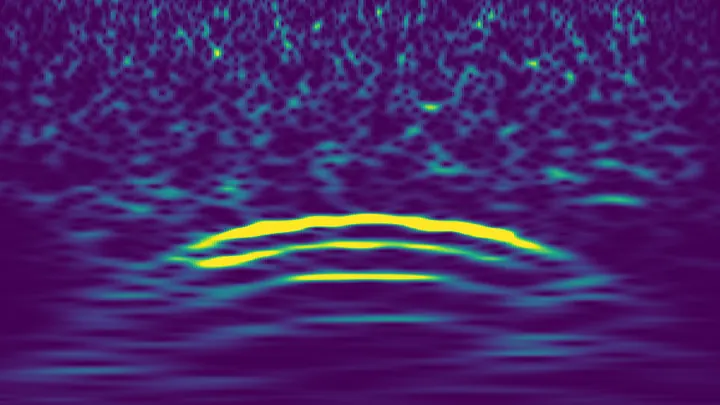
Gravitational wave echoes are hypothetical repeating signals that could follow the main gravitational wave burst from a black hole merger. While standard general relativity predicts a single 'ringdown' signal as the merged black hole settles into a stable state, some quantum gravity models suggest that the event horizon is not perfectly absorbing, causing a small fraction of the gravitational waves to reflect back and forth, producing echoes. Detecting these echoes would provide direct evidence for physics beyond general relativity and reveal the quantum structure of black holes.

History

The concept of gravitational wave echoes was proposed in 2016 by Vitor Cardoso and Paulo Pani, shortly after the first direct detection of gravitational waves by LIGO. Subsequent searches in LIGO data have reported tentative but unconfirmed signals.

How it works

In classical general relativity, the event horizon of a black hole absorbs all incoming radiation, so the gravitational wave signal from a merger decays smoothly. However, if quantum effects modify the horizon, it might act as a partially reflective membrane. Gravitational waves would then bounce between the horizon and the potential barrier surrounding the black hole, leaking out as a series of echoes with decreasing amplitude and increasing time delay. The exact timing and spacing of these echoes would encode information about the quantum structure near the horizon.

In practice

Gravitational wave echoes could serve as a tool to count primordial black holes, which might be dark matter candidates, by analyzing the echo patterns in merger signals.

Fun fact

If echoes are real, they would imply that black holes are not completely 'black' but have a quantum 'hair' that reflects information, potentially resolving the black hole information paradox.

Concept graph →

Formulas

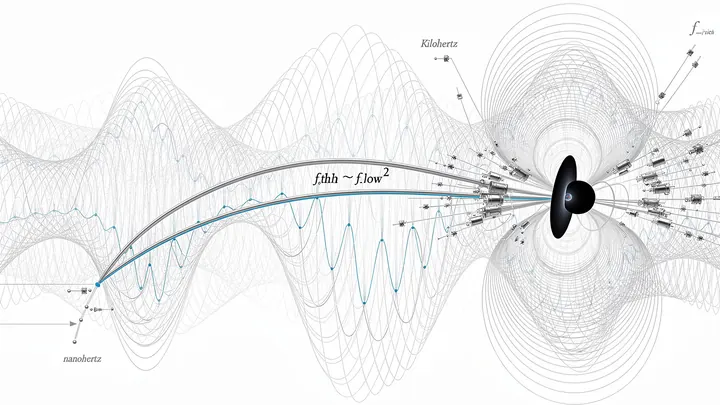
$$f_{\rm reh} \propto T_{\rm reh}$$
Gravitational wave knee frequency scales with reheating temperature.
What is in the formula
f_rehvariableGravitational wave knee frequency at reheating — frequency hertz
T_rehvariableReheating temperature — temperature kelvin
f_{\rmreh}\simeq3.8*10^{-8}(\frac{t_{\rmreh}}{\rmgev}){\rmhz} · 2605.00735v1

Related articles · 104

HEP Theory2026-08-102 minarXiv:2608.09797express
Black Hole Rings Like a Hot Bell
Drop a pebble into a pond, and ripples spread across the water. Something similar happens when a black hole merges with another: it emits gravitational waves that resemble the fading ring of a bell.
General Relativity2026-08-102 minarXiv:2608.09811express
How Light Particles Put the Brakes on Black Holes
A black hole is like a spinning top that never stops on its own. But if a cloud of ultra-light particles, bosons, forms around it, the picture changes. This "fog" acts like an invisible brake: the particles drain the hole's spin, slowing it down.
Cosmology2026-08-103 minarXiv:2608.09929
A Lottery with No Winners: Why the Gravitational-Wave Background Map Is Usually Blank
Imagine a lottery where instead of money, you win black holes. Each ticket is a random spot on the sky, and the prize is a gravitational wave from the merger of two giants. The chance of hitting the jackpot is minuscule, but if you do, the wave is heard across the entire universe.
General Relativity2026-07-291 minarXiv:2607.27129express
Chaos in the Shadow of a Black Hole
A star circles a rotating black hole like a figure skater at the center of a rink. While it is far away and can be treated as a point, the dance remains predictable: the orbit follows clear laws, like music that is easy to glide to. But as it approaches, gravity begins to act unevenly.
Galaxies2026-07-283 minarXiv:2607.26125express
How Galactic Bars Change the Dance of Black Holes
A galaxy collision is like a slow dance in which two partners gradually draw closer. Hidden at the center of each is a supermassive black hole — an invisible flywheel with a mass of millions or billions of suns.
General Relativity2026-07-272 minarXiv:2607.24144express
A Black Hole in an Invisible Cocoon
At the center of a galaxy sits a supermassive black hole, surrounded by a vast, tenuous cloud of dark matter. It doesn't shine or heat, but its gravity warps space and changes the rules of the game for everything orbiting nearby.
Four Layers of Black Holes: Gravitational Waves Reveal Merger History
Layer by layer, artifact by artifact — an archaeologist reconstructs the history of an ancient settlement. Similarly, astrophysicists sifting through 259 records from LIGO–Virgo–KAGRA saw a clear layered structure among merging black holes.
General Relativity2026-07-212 minarXiv:2607.18627express
Black Hole with a Soft Core Changes the Music of Gravitational Waves
The spiral of water draining into a sink spins faster and faster toward the center. In an ordinary black hole, that funnel ends in an infinitely sharp point — a singularity where the laws of physics break down. But this new work considers a different picture: the funnel doesn't taper to a needle but ends in a smooth, swelling bubble.
General Relativity2026-07-212 minarXiv:2607.18919express
Echo Fades into the Silence of a Black Hole
Space is full of invisible waves — ripples in the fabric of spacetime left behind by cataclysms like black hole mergers. An ordinary black hole swallows everything without a trace. But there are hypothetical exotic objects — ultradense clumps of matter without an event horizon (a surface from which not even light can escape).
General Relativity2026-07-201 minarXiv:2607.17520express
How Quantum Black Holes Shed Their Weight
A black hole is not eternal. Even in a perfect vacuum, it slowly loses energy — a process known as Hawking radiation. Quantum effects near the event horizon create pairs of particles, one of which escapes, carrying away some of the black hole's mass.
The Voice of a Neutron Star: The Song of Superdense Matter
In 2017, the LIGO and Virgo detectors recorded the spacetime tremor from the collision of two neutron star merger — event GW170817. After the initial burst came an after-ring: a kilohertz oscillation of the newly formed superdense remnant.
General Relativity2026-07-102 minarXiv:2607.09111express
A Noise Filter for Gravitational Waves
Gravitational-wave detectors are like sensitive microphones, listening for the whispers of distant cataclysms. But every now and then, a sharp crack bursts in — a brief noise spike known as a glitch.
General Relativity2026-07-091 minarXiv:2607.08570express
Gravitational Waves and the Black Hole Horizon
The LIGO detectors caught the signal GW250114—a gravitational wave from the merger of two black holes. After the main burst, a decaying 'tail' remained — direct waves from the newborn hole's horizon. It was expected that their damping would reveal the gravitational strength at the horizon's surface. But the measured value came out smaller.
General Relativity2026-07-092 minarXiv:2607.08619express
Black Holes and the Secret Whisper of New Fields
A black hole merger is not a silent impact. The newborn hole quivers and decays, emitting gravitational waves — ripples in space itself. This signal is called the 'ringdown,' and it resembles the fading chime of a bell: it has a fundamental tone and several overtones.
General Relativity2026-07-082 minarXiv:2607.07790express
Black Holes Without Singularities: A New Approach
In classical theory, a black hole is where matter collapses to a point of infinite density. Such a 'singularity' looks like an error in the equations: nature hardly tolerates infinities. Many physicists seek ways to 'smooth out' this flaw, and one idea is to modify the theory of gravity itself at small distances.
Horizon Equalizer: How the Whisper of the Abyss Was Heard in Gravitational Noise
The merger of two black holes is not just a silent dance, but a grand act after which spacetime itself vibrates for a long time. These damped oscillations — quasi-normal modes — are like the ringing of a gigantic bell. But there is another echo: barely perceptible, almost ghostly.
Echo in the Labyrinth: Why Machine Learning Only Hears Echoes
Gravitational signals from dying massive stars are whispers reaching us from the most violent laboratories in the Universe. Einstein predicted these gravitational waves over a century ago, but only today, with detectors like LIGO, are we beginning to hear them.
Cosmic Palimpsest: Gravitational Waves Reveal the Story of Ancestor Black Holes
The universe rewrites its history again and again. Where ordinary astronomy sees only a point, a black hole, gravitational waves peel back thin layers of the past, like an ancient palimpsest. The idea that black holes can grow by devouring each other, and their offspring can enter new unions, has been discussed by astrophysicists for half a century.
Galaxies2026-07-063 minarXiv:2607.05208
The Ocean of Spacetime: The Hum of Black Holes and the Precision of Simulations
In the ocean of space, every storm of birth or merger of supermassive black holes generates ripples — gravitational waves traveling at the speed of light. Over billions of years, these waves superimpose, merging into a low-frequency hum, like a distant surf.
Cosmology2026-07-023 minarXiv:2607.01818
15 Solar Masses: The Spin Frontier of Black Holes
The mergers of black holes, first predicted by Karl Schwarzschild, are the main source of gravitational waves picked up by LIGO detectors. Over the years, 259 events have accumulated, each one an encrypted birth story of a pair. But is there a hidden system in this data?
Cosmic Fountain: How Shock Waves Control the Growth of Black Holes
Observations by James Webb showed: already 500 million years after the Big Bang (at redshifts z~10), the Universe was aglow with black holes with masses of billions of solar masses. This baffles theories of gradual growth: matter would not have time to 'feed' the seeds at the required rate.
General Relativity2026-06-272 minarXiv:2606.28937express
Dancing to Gravity's Music
A figure skater spins on the ice, gradually spiraling inward. Similarly, a small star or black hole orbiting a massive black hole loses energy. It emits gravitational waves — ripples in spacetime that detectors on Earth pick up. But the dance of this pair is more intricate than it seems. The small companion isn't just a point.
High Energy2026-06-261 minarXiv:2606.27661express
X-ray Beacons in Galactic Centers
In the centers of distant galaxies, X-ray 'beacons' sometimes light up. They don't flash randomly but on a strict schedule: every few hours or days. These bursts are called quasi-periodic eruptions (repeating at nearly regular intervals).
High Energy2026-06-262 minarXiv:2606.27852express
Cosmic Scales: How Black Holes Swap Roles
Gravitational-wave detectors picked up a strange burst — the signal GW241011. Two black holes merged, but the pair looked unusual: one hole was about three times lighter than the other, and the system as a whole was spinning rapidly. Such a combination is a rare guest in the catalogs.
Gravitational Choreography: Pulsars vs. LISA
A pair of neutron stars, locked in a gravitational embrace, traces invisible circles in the void. A century ago, Albert Einstein described this dance as waves of curved geometry, but for a long time we could only catch glimpses — through the feverish flicker of radio pulses.
The Collapsar's Gravitational Boomerang: Cracking the GW190814 Anomaly
LIGO and Virgo detectors catch ripples in spacetime, but some signals force us to rewrite the scripts of stellar death. GW190814 — the merger of a black hole of 23 solar masses with a compact object of 2.6 solar masses — is a discordant chord in the symphony of standard models.
HEP Phenomenology2026-06-222 minarXiv:2606.23787express
How Black Holes Give Birth to Matter
In the first moments after the Big Bang, matter and antimatter were almost perfectly balanced. But something tipped the scales — otherwise everything would have annihilated into radiation, leaving the universe empty. One candidate for the role of "tipper" is the ultraheavy right-handed neutrino.
High Energy2026-06-162 minarXiv:2606.18241express
Gravitational Waves Reveal Black Hole Pairs
A hum resonates across the universe. It is not sound, but a trembling of space itself — the gravitational wave background. It is produced by pairs of supermassive black holes circling each other at the centers of distant galaxies. Each pair is like a bass instrument in a vast orchestra.
General Relativity2026-06-152 minarXiv:2606.16280express
How a Tiny Black Hole Plays a Cosmic Harp
A tightrope walker spirals over an abyss, each loop drawing closer to the center. Their path is not a smooth glide but a series of sharp jerks and pauses. That is roughly how a tiny black hole behaves when it is pulled toward a supermassive neighbor.
General Relativity2026-06-121 minarXiv:2606.14126express
Quantum Trick Inside a Black Hole
At the center of attention is a black hole with two points of no return: the outer and inner horizons. Beyond the outer horizon, space and time swap roles, but the journey is not over. Further in, at the inner horizon, gravity has another surprise in store.
High Energy2026-06-122 minarXiv:2606.14472express
Black Holes Are Sorted by Weight
Waves sort pebbles on a sandy beach. Small stones lie close together, nearly identical in size. Farther from shore, there's a scatter of larger and more varied ones. And right at the waterline, where the surf is strongest, the biggest and most rounded fragments pile up. Nature sorts black holes by mass in much the same way when they merge in pairs.
General Relativity2026-06-102 minarXiv:2606.11728express
High Energy2026-06-102 minarXiv:2606.12205express
The Hidden Spin of Black Holes
Two black holes spiraling toward each other resemble figure skaters in a pair spin: each rotates about its own axis, and together they weave a shared dance. This collective twist, the so-called effective spin, can be measured by astronomers from the gravitational waves rippling outward from the pair, like ripples on a pond.
Cosmology2026-06-082 minarXiv:2606.09804express
Black Holes Evaporate, but Gravitational Waves Remember
A black hole is not an eternal vacuum cleaner. Left alone in the void, it slowly disappears, radiating energy like a puddle drying on asphalt. This process, predicted by Stephen Hawking, is called evaporation.
General Relativity2026-06-082 minarXiv:2606.10175express
Black Hole Collisions: A Hum That Echoes Across the Universe
Two heavy spheres of dark emptiness hurtle toward each other and collide dead-on. This is not billiards: it's the collision of two equal black holes. The impact sends a tremor through space itself — gravitational waves. Most of this tremor is a low hum that physicists call bremsstrahlung.
High Energy2026-06-072 minarXiv:2606.08522express
Neutron Star Mergers Ring in a Single Note
Two stones fall into a pond. Ripples spread from each, but when they collide, there's a splash and a short, sharp clap. That's roughly what the merger of two neutron stars sounds like: those ultra-dense remnants of exploded stars.
General Relativity2026-06-052 minarXiv:2606.07330express
How to Hear the Dance of Two Black Holes
Imagine an orchestra where each musician plays their own part, and the conductor tries to catch a faint rhythm common to all. That's roughly how astronomers search for gravitational waves from pairs of supermassive black holes (weighing billions of suns) circling each other in distant galaxies.
Gravitational Phantoms: Domain Walls Instead of Black Holes
On May 14, 2019, LIGO detectors registered a gravitational burst that didn't fit the usual mold. Event GW190521 appeared as a collision of two black holes weighing 85 and 66 solar masses. The resulting hole of 142 solar masses landed right in the "forbidden" range — where stellar collapses leave almost no trace.