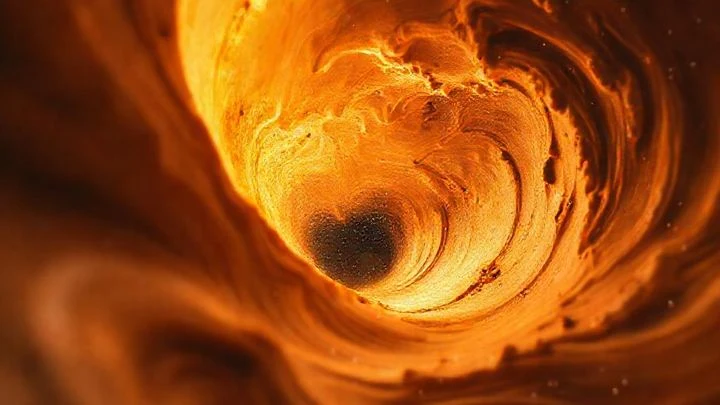
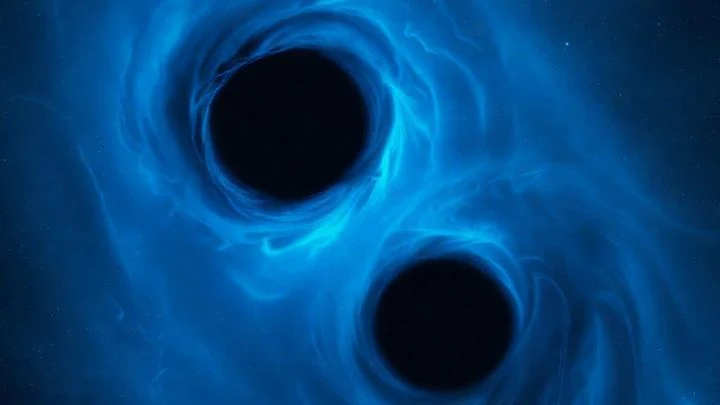
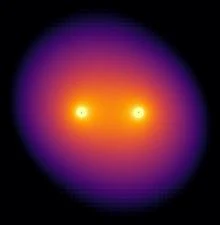
A common envelope is a phase in the evolution of a binary star system where the two stars orbit within a single shared gaseous envelope. This occurs when one star expands dramatically, engulfing its companion, and the two stars spiral inward as they drag through the envelope. The common envelope phase is crucial for producing compact binaries, such as white dwarf pairs, neutron star binaries, and black hole mergers, which are key sources of gravitational waves.
History
The common envelope concept was developed in the 1970s by astrophysicists such as Bohdan Paczyński and Ronald Webbink, who used it to explain the formation of cataclysmic variables and other compact binaries.
How it works
When a star in a binary system expands into a giant, its outer layers can engulf the companion star. The companion then orbits inside the giant's envelope, and friction with the gas causes it to lose orbital energy and spiral inward. This process transfers angular momentum to the envelope, which is often ejected, leaving behind a much closer binary system. The outcome depends on the masses and initial separation of the stars.
In practice
Common envelope evolution is essential for predicting the rates and properties of gravitational wave sources, such as merging black holes and neutron stars, observed by detectors like LIGO and Virgo.
Fun fact
During a common envelope phase, the two stars can merge entirely, potentially producing a single, rapidly spinning star with a magnetic field strong enough to power a gamma-ray burst.
At the center of a galaxy, where a supermassive black hole spins a disk of scorching gas around itself, giant stars sometimes form. They are unlike ordinary stars: the disk continuously feeds them with matter, and a star can grow to hundreds of solar masses, staying bright as long as the gas flow lasts.
Two spinning tops whirl so close they nearly touch. One is scorching blue, the other dim white. Together they complete a full orbit in twenty hours. This is the pair Feige 64: a blue star with a mass of just a third of the Sun's, and a white dwarf, the cooled core of a former star, one and a half times heavier than our Sun.
The blue star seems too hot for its mass.
Two stars circle each other like dancers who come together and drift apart. Over time, one swells, and its outer layers spill onto its neighbor. The star that receives foreign matter looks no different from a single star, but its surface remembers everything.
At the heart of our Galaxy lives the supermassive black hole Sagittarius A*. If an invisible companion orbits nearby, their dance can be spotted through the light of other stars. The pair's gravity works like a lens: as the black holes pass in front of a background star, its light briefly brightens and splits into two.
A galaxy collision is like a slow dance in which two partners gradually draw closer. Hidden at the center of each is a supermassive black hole — an invisible flywheel with a mass of millions or billions of suns.
It takes the stellar pair J05+50 nearly two months to complete one orbit around their common center. From Earth, it appears as a faint point in the constellation Hercules — 4625 parsecs away. Photometry of the binary star only captures a steady flicker of brightness, like the pulse of a giant heart.
In August 2019, the LIGO and Virgo detectors picked up gravitational waves from the merger of two compact objects in a binary star. One weighed 23 solar masses — a standard black hole. The other came in at 2.5–2.67 M⊙.
The universe rewrites its history again and again. Where ordinary astronomy sees only a point, a black hole, gravitational waves peel back thin layers of the past, like an ancient palimpsest. The idea that black holes can grow by devouring each other, and their offspring can enter new unions, has been discussed by astrophysicists for half a century.
At the center of a distant galaxy, a supermassive black hole is surrounded by a flat, rotating disk of gas and dust — a giant cosmic funnel of matter. A small compact object, such as another stellar-mass black hole, may find itself in this disk.
Two stones fall into a pond. Ripples spread from each, but when they collide, there's a splash and a short, sharp clap. That's roughly what the merger of two neutron stars sounds like: those ultra-dense remnants of exploded stars.
Detectors pick up the “ripples” of gravitational waves from mergers of black holes or neutron stars — like an echo from the kitchen where a cosmic dish was being prepared. Astronomers are trying to reconstruct the recipe: how two massive stars turned into an exotic pair and collided.
For a long time, a void yawned in the family of ultra-dense remnants of dead stars. Neutron stars, swift city-sized tops, rarely weigh more than two Suns. Black holes start at about five solar masses. Between them lies a 'gap' where for decades no object could be found.
In the crowded center of the galaxy, two stars orbit so close together that one strips the outer layers off the other, like wind blowing off a coat. What remains is a hot helium core, a star without a hydrogen envelope.
When a neutron star and a black hole merge, they send out gravitational waves — ripples in spacetime that reach Earth. These ripples carry the imprint of their final dance: the orbit before the collision is often elongated, like an ellipse.
Two black holes fly toward each other and collide head-on. In the familiar picture, their horizons (the surfaces from which not even light can escape) stretch toward each other like water droplets and merge into one smooth shape. But calculations show otherwise: before merging, a sharp beak, a cusp, extends from each horizon.
Imagine an orchestra tuning up: the violins rise in pitch: that's the familiar 'chirp' of black hole mergers in LIGO detectors. Now picture a funeral march: a sound that descends, like a fading siren. That's exactly the gravitational-wave signature a system with one negative mass should leave.
Picture a crowded hall where each person is a molecule, and their private conversation is the motion of electrons within it. Normally, everyone talks to themselves, and the overall buzz is chaotic. But if a bright spotlight is turned on in the center, it begins to conduct the crowd: people synchronize their movements, even though the light merely reflects off the walls.
Two black holes, orbiting each other, behave like a boat rowing with stars. Each passing star is flung away, like a stroke of an oar, and transfers momentum to the pair. For a long time, it was thought this simply brings the black holes closer. But new analysis has shown: by flinging stars unevenly, the system pushes itself sideways, spins, and tilts the orbit.
Be stars are rapidly rotating luminaries with bright gas disks. Usually, a companion star spins them up: mass flowing from the neighbor whirls the star like a bullet in a rifled barrel. But there are also lone Be stars without a partner: their origin long remained a mystery.
New research shows that solitaries can be born from a supernova explosion.
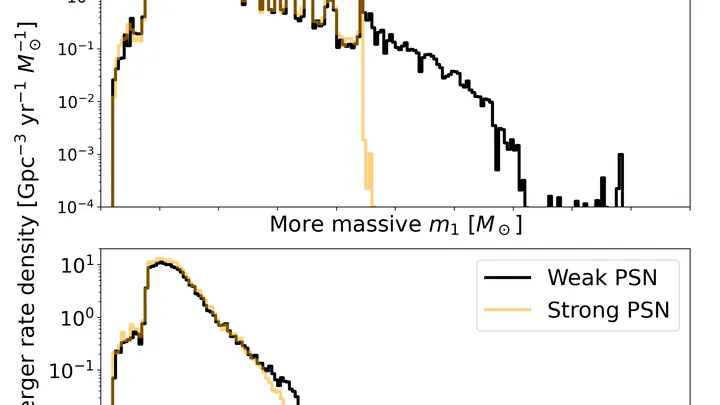
The latest crop of gravitational waves brought a puzzle. The LIGO, Virgo, and KAGRA detectors caught dozens of signals from merging black holes, and the mass plot shows a glaring gap: objects heavier than 45 Suns are almost absent, and the few that exist spin suspiciously fast. Some say giant stars explode too 'cleanly,' leaving nothing behind.
A fisherman's net is stretched across the depths of space. When a massive star dies, it leaves behind a black hole — a sinker in this net. Usually, such sinkers weigh from a few to tens of suns.
When two black holes spiral around each other and merge, they send ripples across the universe — gravitational waves. These waves carry the imprint of exactly how the objects moved before the collision. From the shape of this 'dance,' you can tell how closely the objects resemble perfect black holes.
Two stars orbit a common center, accreting gas from a surrounding cloud. Rotating disks of gas form around each star and around the pair as a whole. From these disks, jets shoot out like hoses. Inside the disks, gas is constantly churned — that's the magnetorotational instability at work.
Every 15 hours, in a constellation 57 light-years away, a miniature solar eclipse takes place. A tiny white dwarf — a star the size of Earth but heavier than the Sun — ducks behind the disk of a red dwarf. For astronomers, this is not just a pretty coincidence but a way to peek into the pair's past.
A sugar cube sits on a saucer next to a cup of hot tea. Drop it in, and it dissolves within minutes. But if you lower it slowly, the sugar melts gradually, releasing its sweetness into the drink. Something similar is happening in two newly discovered stellar pairs, except the sugar is a brown dwarf and the tea is a star.
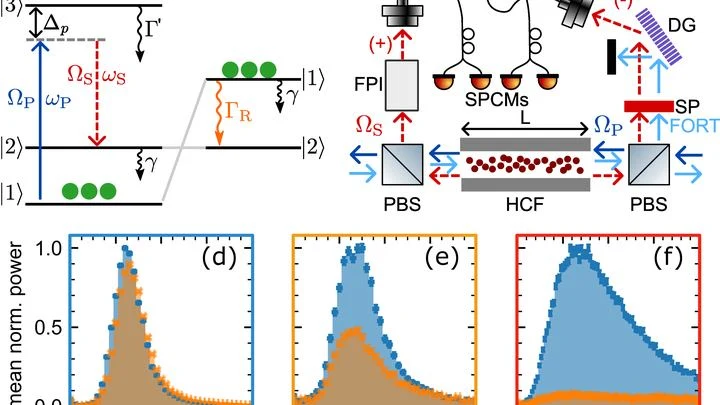
A swarm of fireflies in a night forest flashes randomly: each beetle blinks on its own, and the light scatters equally in all directions. Now imagine the fireflies agreeing to blink so that their combined light goes only north — even though they stay put and none of them turns. That's roughly what physicists did with atoms inside a thin glass tube.
In the star cluster NGC 2158, which is over a billion years old, astronomers have counted how often stars live in pairs. The Hubble telescope stared at the cluster for a long time to catch even the faintest stars: those lighter than one-third of the Sun.
In the dense core of the globular cluster NGC 6397, where stars jostle like commuters at rush hour, astronomers have spotted a peculiar pair. One star is a white dwarf with a surface temperature of 16,000 K, the scorched remnant of a star that has been cooling for billions of years, and circling it is an unseen companion.
Deep in space, there's a cloud of gas that looks like a necklace with bright beads. This is the Necklace Nebula — the remains of a star that once swelled up and swallowed its neighbor. At the center, a pair remains: a small, hot star and its bloated companion, rich in carbon.
At the centers of almost all galaxies lurk black holes — invisible giants. When two galaxies collide, their black holes become a pair doomed to dance around each other. But to merge into one, they must close the gap from vast distances to just kilometers, in the final instant unleashing a burst of gravitational waves.
In a star cluster, like on a crowded dance floor, massive stars rarely stay single. More often they whirl in pairs or triples, and the distance between them can be less than from Earth to the Sun. But how do they manage to get so close to each other?
Simulations showed: it's all about the disk of gas and dust that envelops the pair. This disk, like a drain funnel, swirls the stars and slowly pulls them inward.
Two stars whirl in a tight dance. One is a neutron star — an ultra-dense sphere the size of a city but with a mass of one and a half Suns. The other is an ordinary star that swells and spills its matter onto its neighbor. Sometimes this transfer happens too fast, and the stars become enveloped in a shared gas shell, like two spoons in one pot of boiling soup.
The early universe was an extremely hot and dense medium. In this medium, like bubbles of steam in boiling water, bubbles of a new state of space spontaneously emerged — regions where physical properties changed abruptly.
Two stars, drawing together in a cosmic dance, experience an extra wobble — a consequence of spacetime curvature (an effect predicted by Einstein). A planet orbiting them also wobbles. Sometimes the rhythms align: the gravitational tugs from the stars fall in step with the planet’s orbit, like hands pushing a swing.
Two black holes circle in a tight dance, and around them something remarkable is born: a gravitational molecule. A cloud of ultralight bosons, particles with masses below an electronvolt, envelops the pair like the electron cloud in an H2+ ion.