Bubbles Reveal Water Pollution express
An air bubble escapes from a thin needle at the bottom of a glass and shoots upward. In clean water, it behaves like a spring: it flattens, then stretches, exchanging energy between motion and shape. Add a drop of soap to the water, and the bubble immediately calms down, becomes an almost perfect sphere, and rises smoothly without trembling.
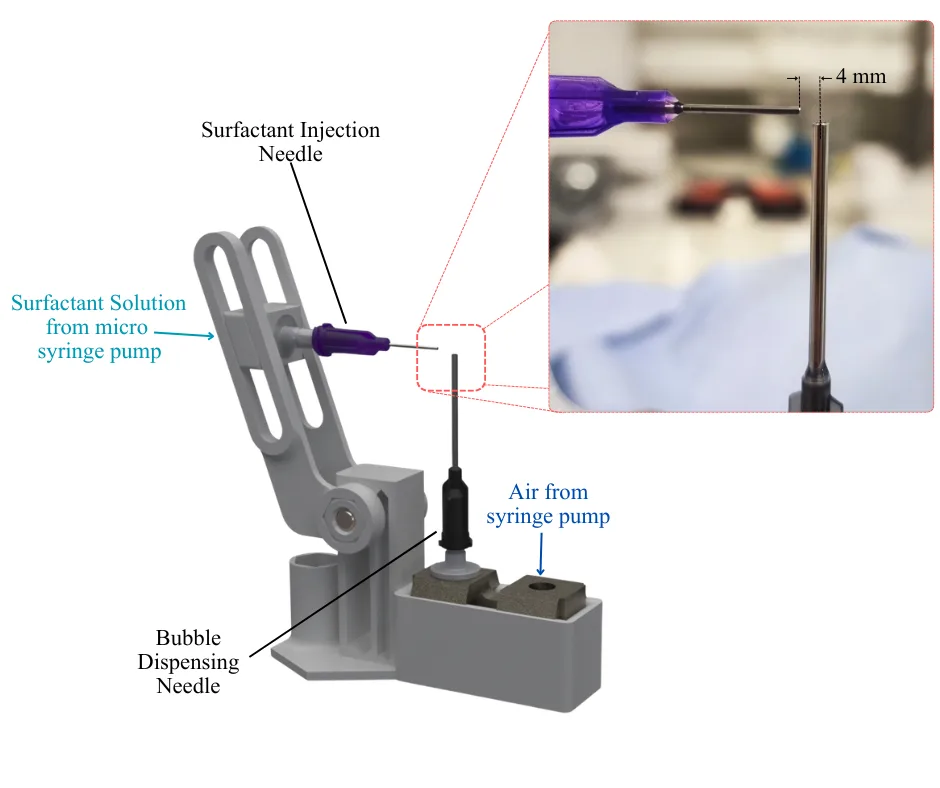
Scientists filmed such bubbles with a high-speed camera for the first 144 milliseconds after they detached from the needle — during that time, the bubble travels only 4 centimeters. From the frames, they calculated how elongated the bubble was at each moment and plotted its "breathing" curve. In clean water, the oscillation amplitude is large, while in soapy water, the oscillations almost disappear. Moreover, the more soap, the more the oscillations are damped, but only up to a limit. When soap concentration exceeds about 2.9 parts per million, the bubble becomes indistinguishable from a perfect sphere, and adding more soap changes nothing.
From the damping of the oscillations, the researchers learned to estimate how much soap is dissolved in water. They tested the method on bubbles in liquids with unknown concentrations, and the model correctly determined which waters were cleaner and which were dirtier. This approach could be useful, for example, for water quality control in factories or laboratories where solution purity is critical.
A bubble in clean water can oscillate for several seconds, while in soapy water it calms down within fractions of a second, so strongly does soap damp the surface trembling.