Ernest Rutherford, skeptical of the complex structure of the atom, tasked Hans Geiger and Ernest Marsden with bombarding gold foil with alpha particles. Everyone expected the particles to pass through, only slightly scattering. But Marsden noticed: about one in 8000 particles bounced back! Rutherford was amazed and later compared it to a 15-inch shell ricocheting off tissue paper. He realized that almost all the mass of the atom is concentrated in a tiny nucleus. In 1911, he derived a formula relating the number of scattered particles to angle, energy, and nuclear charge. This was a purely classical result, perfectly explaining the experiment; only later were quantum corrections needed for light nuclei.
History
Analyzing the experiments of Geiger and Marsden (1909–1911), Rutherford concluded that the atom contains a positively charged nucleus with a radius of ~10⁻¹⁵ m, concentrating almost all the mass. He derived the formula for elastic scattering in the field of a central force 1/r², which ideally matched the data. This disproved Thomson's model ('plum pudding'). Subsequently, the formula became the basis of Rutherford backscattering spectrometry (RBS) for non-destructive analysis of the composition and thickness of thin films.
How it works
The formula works for energies from a few keV to several MeV; at lower energies, electron screening is significant, at higher energies, relativistic effects. For 5 MeV alpha particles on gold, it works excellently. The cross-section integral diverges at small angles due to the long-range nature, so in practice a minimum scattering angle is introduced. At very small impact parameters, nuclear forces come into play.
In practice
With its help Rutherford discovered the atomic nucleus, and today the method of Rutherford backscattering controls the thickness and composition of nanofilms in microchips.
Fun fact
Rutherford recalled: 'I did not believe in backscattering until Geiger showed me the counter. Then I realized we had hit upon the nucleus.'
In the scorching core of a star, two helium nuclei approach each other like two dancers on a crowded stage. Their dance is alpha scattering, the basis of stellar helium burning. How smoothly they twirl determines how quickly the star burns its fuel.
Previously, this dance was described in simplified terms.
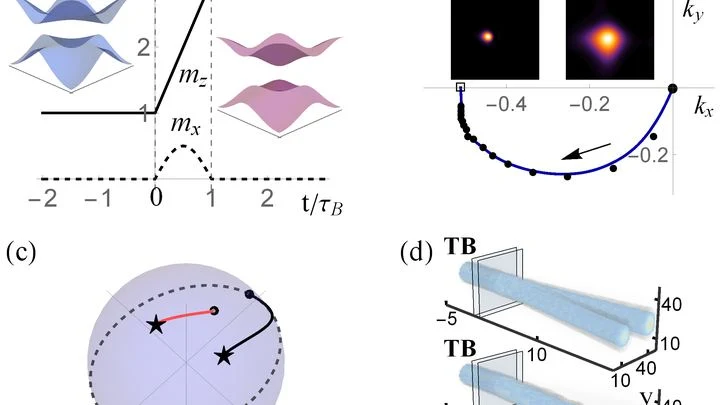
A stone falls into a pond, and ripples spread across the water. They reflect off the shore, overlap, and die out. All this motion unfolds in space. But what if the pond itself changed its depth or density for an instant — not at one point, but everywhere at once? A temporal boundary is exactly such a jump in properties over time, not space.
A big sticky ball thrown onto a dusty shelf bounces off and kicks up a cloud of dust, but if you roll it slowly, it picks up every bit. Rydberg excitons behave just like that — they're giant 'atoms' inside a crystal, named after Johannes Rydberg.
A drop of water stretches in a strong electric field. The deuterium nucleus, a bound pair of a proton and a neutron, behaves the same way, except here the field comes from a passing gamma ray, and instead of just stretching, the nucleus can simply fall apart.
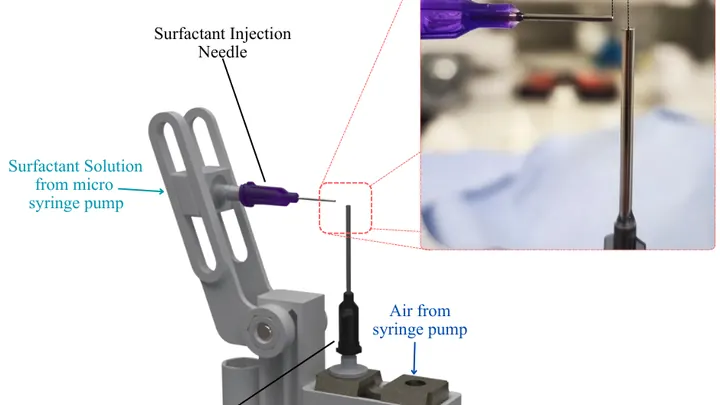
An air bubble escapes from a thin needle at the bottom of a glass and shoots upward. In clean water, it behaves like a spring: it flattens, then stretches, exchanging energy between motion and shape. Add a drop of soap to the water, and the bubble immediately calms down, becomes an almost perfect sphere, and rises smoothly without trembling.
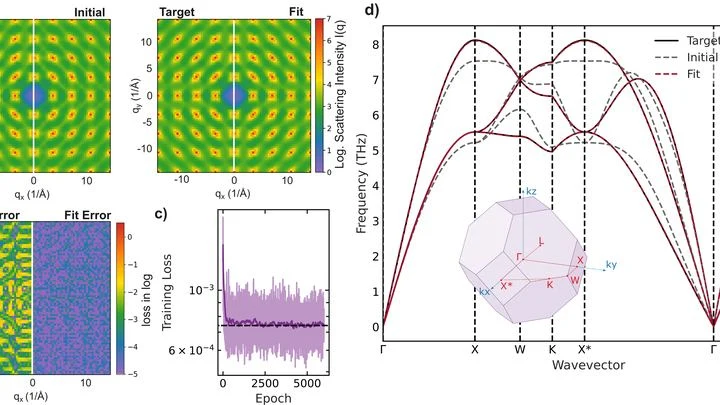
Heat a crystal, and its atoms start to jiggle like plucked strings. An X-ray beam passing through the crystal scatters off these vibrations, painting on the detector not only sharp spots but also faint, smeared patterns. These patterns are like fingerprints: from them, you can reconstruct how strongly atoms pull and push on each other.
A drop of oil in water, coated with soap molecules, behaves differently from a bare drop. Soap molecules are tiny rods: one end loves water, the other loves oil. In a quiescent fluid, they stand on the surface like a picket fence, lowering the surface tension — the force that pulls the drop into a sphere.
A tiny glass sphere floats in a laser beam like a speck of dust in sunlight. Inside it is radioactive lead, which decays from time to time. Each decay ejects charged particles, and the sphere loses or gains a tiny electric charge.
An atomic nucleus isn't always round. It can stretch out like a melon or flatten like a pumpkin. And its size depends on this shape — just as the size of a pie depends on the shape of the dough.
Scientists calculated the shapes and sizes of nuclei of berkelium isotopes — a heavy element produced in reactors.
Two tiny emitters, each about the size of an atom, can together do what neither can do alone. We're talking about light scattering — when light hits particles and bounces off in all directions. Usually, a pair of particles scatters light only slightly more than a single one.
Two laser beams cross at a tiny angle, and an invisible lattice appears in a cloud of rubidium atoms: some atoms are excited, others are not. Then this lattice begins to melt, like a pattern in the sand under the wind. Atoms collide with surrounding gas molecules and drift apart.
The speed of this blurring depends directly on the surrounding gas.
The antiproton is a mirror twin of the proton: same mass, but negative charge. When it approaches an atomic nucleus, the particles can annihilate, turning into radiation.
Four cesium atoms hang in vacuum, held by laser tweezers like beads on an invisible thread. Around them is a ring resonator, a closed loop of mirrors where light circulates without obstacles. When a probe beam strikes this tiny chain, something strange happens: the atoms scatter light not uniformly in all directions, but predominantly in one direction.