This formula is a mathematical expression that predicts the speed of a liquid jet produced by a collapsing bubble near a surface. It combines the curvature of the bubble's surface and the depth at which the bubble is submerged to determine how fast the resulting micro-jet will travel. This is crucial for understanding phenomena like cavitation damage, inkjet printing, and medical ultrasound therapies.
History
The study of bubble collapse jets dates back to Lord Rayleigh's work in 1917 on cavitation. The specific formula for jet speed as a function of curvature and depth was developed in the late 20th century through numerical simulations and experiments, notably by Blake and Gibson in the 1980s.
How it works
When a bubble collapses near a boundary, the asymmetry causes the far side to accelerate inward faster, forming a high-speed jet that pierces the bubble. The jet speed depends on the bubble's initial curvature (which sets the collapse timescale) and the distance to the boundary (which sets the asymmetry). The formula typically scales as the inverse square root of the dimensionless stand-off distance, with a prefactor involving the bubble's radius and the pressure driving the collapse.
In practice
This formula is used to predict erosion in hydraulic machinery, optimize ultrasonic cleaning, and design microfluidic devices that use bubble-driven jets for precise liquid delivery.
Fun fact
The jet speed can exceed 100 meters per second, which is why collapsing bubbles can erode even hard materials like steel over time.
A geometer runs a finger along an invisible surface, and by how the geodesics bend, lifts its fingerprint. That fingerprint can be the maximum normal curvature κ(F): the largest curvature among all geodesics passing through a point of the immersed manifold.
A flashlight doesn't cast a uniform circle of light; it has a bright spot in the center and a blurred halo at the edges. If you switch it off quickly, the edges are the last to fade, and by how the light dies, you can guess the shape of the reflector.
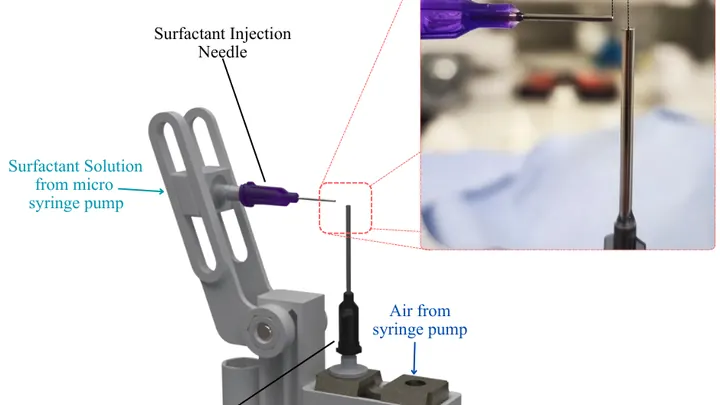
An air bubble escapes from a thin needle at the bottom of a glass and shoots upward. In clean water, it behaves like a spring: it flattens, then stretches, exchanging energy between motion and shape. Add a drop of soap to the water, and the bubble immediately calms down, becomes an almost perfect sphere, and rises smoothly without trembling.
In a pot of boiling water, steam bubbles rise and pop. In the quantum world of a superfluid, bubbles behave differently: they can collide and give birth to vortices — tiny swirling flows, like whirlpools in a river.
Scientists modeled such a liquid using a holographic approach.
A ship gliding through water constantly rubs against it, like a palm against a rough surface. This friction eats fuel and slows progress. One way to reduce it is to blow air under the hull: water stops sticking to the hull, and drag drops. But air is finicky: sometimes it helps, sometimes it hurts.
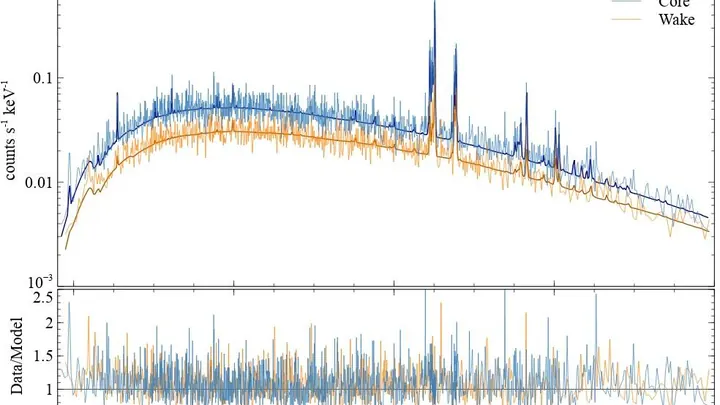
At the heart of the Ophiuchus galaxy cluster floats a bubble of hot plasma the size of several galaxies. It rises like a giant hot-air balloon in the atmosphere, leaving a wake behind it — a region where gas is set in motion.
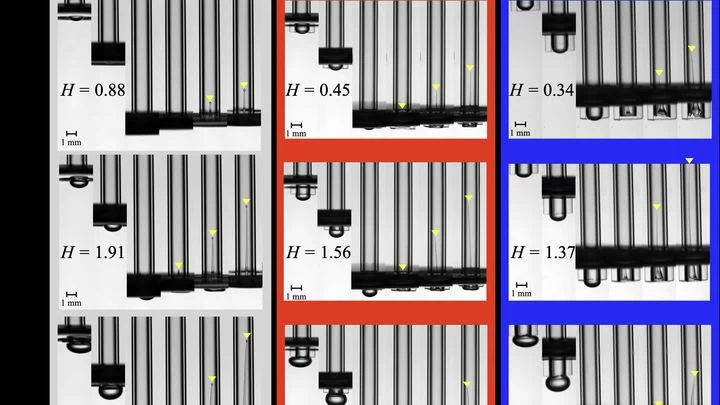
A drop falls into a glass, and a tiny jet, a thin fountain, shoots up from the surface for an instant. Something similar happens with a bubble stuck to the wall of a tube when you yank the tube downward. Water around the bubble rushes in, and a jet fires from its top. The speed of this jet depends on the bubble's shape — how much it bulges, like an umbrella dome.
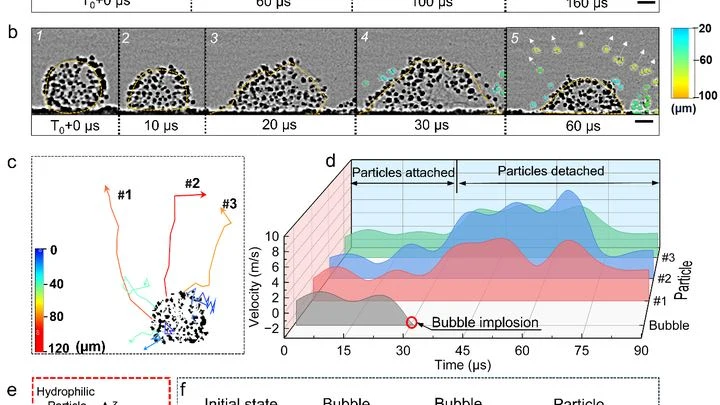
In a glass of water, ultrasound creates tiny bubbles. They grow and shrink, and sometimes they collapse sharply, like a popping soap bubble, but thousands of times faster. Near these bubbles float small particles — for example, nickel spheres the size of dust motes.
Ultrasound in a liquid is like shaking a bottle of soda vigorously: shake it, and bubbles appear. In science, this is called cavitation, and the bubbles don't just float around: they are born, grow, and collapse with tremendous force.