Wings Over a Star express
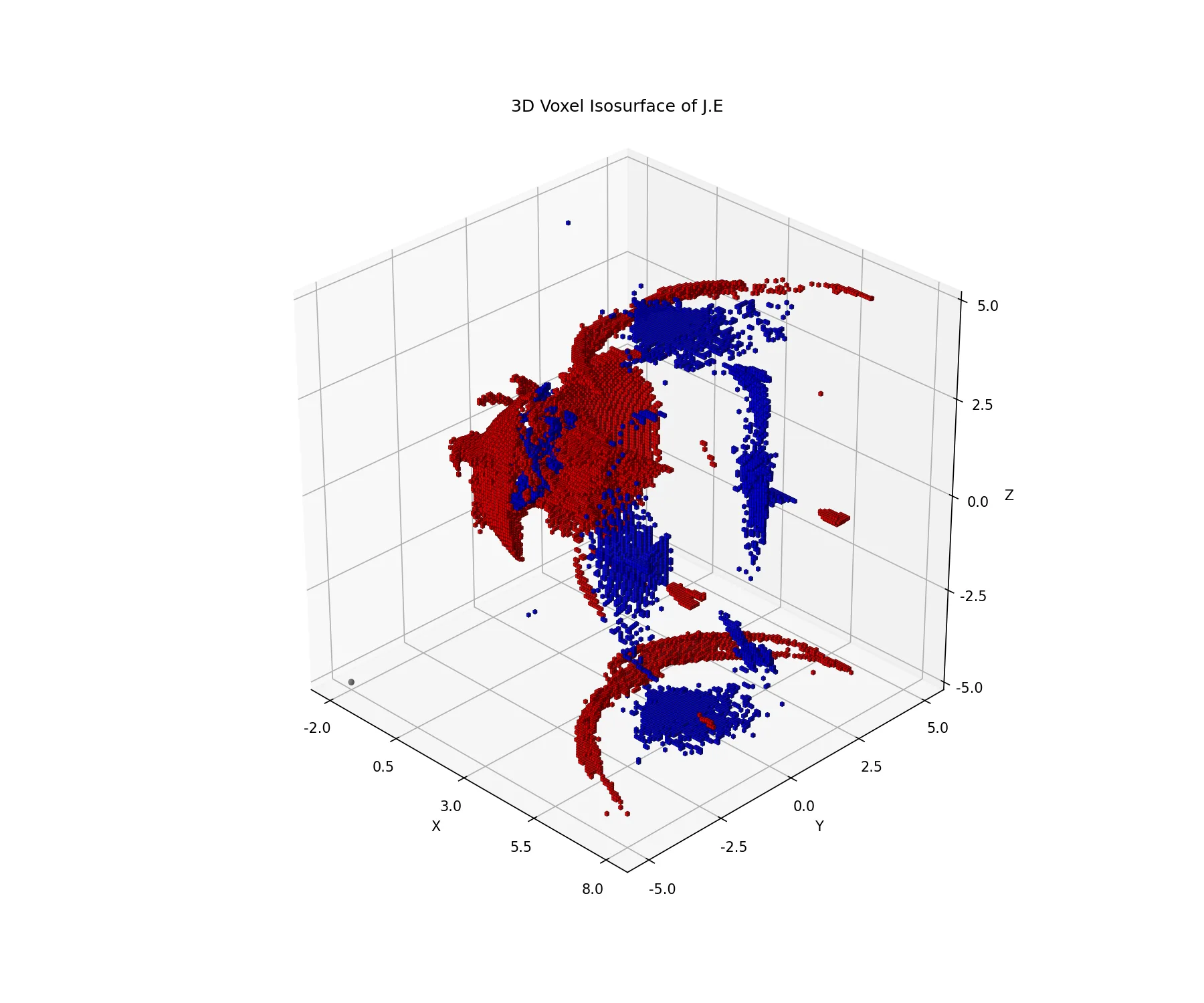
Two neutron stars spiral closer together, about to merge in an instant. Their dance lasts fractions of a second, but just before the finale, one star plows into the other's magnetic envelope, like a swimmer cutting through water, kicking up waves. At that moment, a complex system of currents is born, carrying energy away.
The authors of a new study calculated this process for a pair of neutron stars. They found that the secondary star, passing through the companion's magnetosphere, generates currents resembling relativistic Alfvén wings. These currents can emit in a narrow beam, just like a pulsar. But unlike a typical pulsar, the signal would vary in sync with the orbital motion: flashes repeat with each revolution until the stars merge.
Original abstract
as written by the authors arXiv:2604.23870
Detecting possible electromagnetic precursors to the gravitational signal from merging compact objects is challenging, but it can reveal intricate physical properties of the merging stars through their gravitational and electromagnetic interactions. We demonstrate, using 3D Particle-In-Cell simulations, that a neutron star moving through the magnetosphere of a merging companion generates a complicated system of dissipative currents, a relativistic analogue of planetary Alfven wings. Generated electric currents carry a large fraction of the electromagnetic power intersected by the neutron star. These currents may lead to the generation of beamed, pulsar-like coherent radio and high-energy emission. Orbital modulation will produce a nearly periodic signal, an Alfven-winged pulsar.
Alfvén wings were first predicted for Jupiter's moon Io: currents along magnetic field lines create auroras in the giant planet's atmosphere.
In Carl Sagan's novel 'Contact,' the alien signal repeats at strict intervals — much like the hypothetical pulses from a 'winged pulsar' before a stellar merger.