The electron neutrino is one of the three flavors of neutrinos, the ghostly elementary particles that interact only via the weak nuclear force and gravity. It is intimately tied to the electron: in the Standard Model of particle physics, the electron neutrino forms a doublet with the electron, meaning they are partners in weak interactions. Electron neutrinos are produced in enormous quantities in nuclear reactions, both in the Sun and in stellar explosions. During a core-collapsesupernova, the collapse of the iron core of a massive star releases a staggering number of electron neutrinos — on the order of 10^58 particles — carrying away the gravitational binding energy of the nascent neutron star. These neutrinos are crucial for understanding the explosion mechanism, as they can deposit energy in the surrounding material and help drive the shock wave outward.
History
The electron neutrino was first proposed by Wolfgang Pauli in 1930 as a 'desperate remedy' to explain the apparent violation of energy conservation in beta decay. It was experimentally detected in 1956 by Clyde Cowan and Frederick Reines, who used a nuclear reactor as a source of antineutrinos. The role of electron neutrinos in supernovae was confirmed with the detection of neutrinos from Supernova 1987A.
How it works
In the core of a massive star, nuclear fusion builds up elements up to iron, at which point fusion no longer releases energy. The core collapses under gravity, and protons and electrons are squeezed together in a process called electron capture, converting them into neutrons and electron neutrinos. These neutrinos stream out of the core, but the dense material traps them for a short time, creating a neutrino sphere. As the collapse continues, the core reaches nuclear density and bounces, sending a shock wave outward. The shock wave stalls, but the intense flux of electron neutrinos and antineutrinos from the cooling neutron star can re-energize it, a process known as the neutrino-driven mechanism. The detection of these neutrinos on Earth, as was done for Supernova 1987A, provides direct evidence of this process and constrains the physics of the explosion.
In practice
Electron neutrinos are used in neutrino astronomy to probe the interiors of stars and supernovae, as they can escape dense regions where photons cannot. They also play a role in reactor monitoring and in searches for sterile neutrinos and other beyond-Standard-Model physics.
Fun fact
The detection of electron neutrinos from Supernova 1987A arrived about three hours before the first light from the explosion, because neutrinos escape the collapsing core while the shock wave takes longer to reach the stellar surface.
A neutron star is the remnant of an exploded star, compressed so tightly that a teaspoon of its material would weigh as much as a mountain. Inside such an object, protons and neutrons are packed tightly together, and under enormous pressure, hyperons, particles containing a strange quark, can appear.
When a heavy atomic nucleus splits into two fragments, an invisible quantum thread remains between them. This thread is entanglement: the state of one fragment is instantly linked to the state of the other, as if they were still a single whole. For the first time, physicists have precisely calculated how long and strong such a thread can be, tracing the fission process step by step.
A massive star exhausts its fuel, and its core collapses in a fraction of a second. A supernova is born, along with a brief but powerful shower of neutrinos. These particles barely interact with matter, so they fly away freely, carrying information about the catastrophe.
An old factory where instead of machines there are atomic nuclei, and neutrino radiation seethes all around. When a massive star exhausts its fuel, its core compresses a hundredfold, and the temperature skyrockets to billions of degrees.
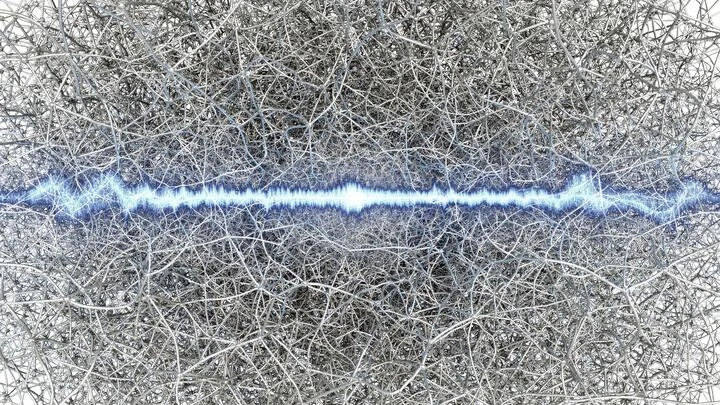
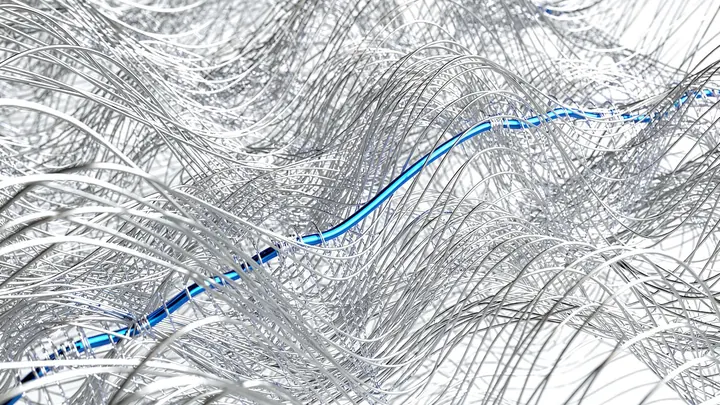
The interiors of neutron stars are a realm of degenerate matter. Here, protons condense into a superconducting condensate, threaded by quantum vortices. Imagine tiny magnetic tops: each carries a quantum of magnetic flux and glides through the electron fluid.
Two ultradense spheres, each the size of a city, whirl in a dance. Their masses are less than the Sun's, but inside them is matter compressed to unimaginable limits. One sphere is a neutron star; the other is a strange star, made entirely of quarks — the elementary particles that build up protons and neutrons.
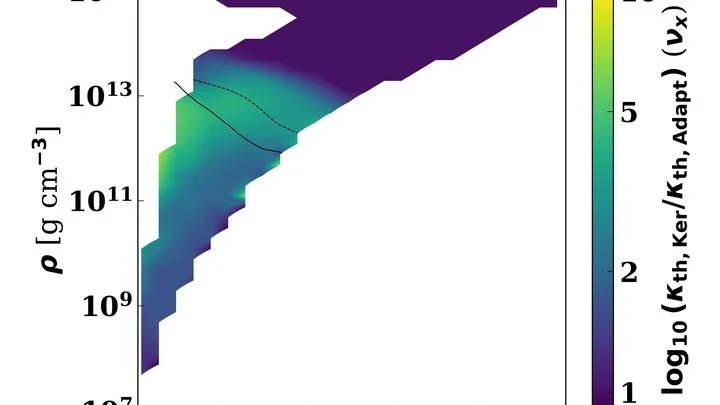
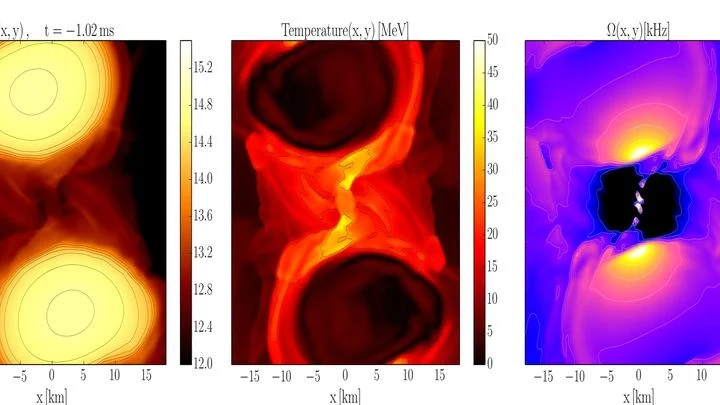
The collision of two neutron stars is a cosmic laboratory where matter is compressed to unimaginable densities. In the first moments after the merger, a hot cloud forms and cools by emitting neutrinos. These ghostly particles carry away energy and dictate how much matter is ejected into space and which heavy elements are synthesized.
A neutron star is a gravitational lens that focuses our attempts to glimpse dark matter. Through its ultra-dense matter, like exotic glass, we search for the axion — an elusive particle that could explain the hidden mass of the universe.
Somewhere in the galactic bulge, a massive star lies dormant, ready to trade quiet burning for collapse. Its core will exhaust its fuel, and in a fraction of a second, a neutron star or black hole will be born, releasing 10⁵⁸ neutrinos — almost all the energy of the explosion.
Two neutron stars whirl in their final dance. If their spin aligns with their orbital motion, the partners merge neatly, launching a narrow jet of superheated matter. If they spin in opposite directions, the dance breaks apart, scattering a thick shroud of debris.
In 2017, detectors picked up a tremor in space — gravitational waves from the merger of two neutron stars. Telescopes immediately found a flash of light: a cosmic explosion astronomers dubbed a kilonova. In that fiery cauldron, it turned out, the heaviest elements of the periodic table are born — gold, platinum, uranium.
Inside a neutron star, matter is compressed so intensely that atomic nuclei fuse into long strands and flat sheets. Astrophysicists call these structures nuclear pasta. At their surface, the density of matter plummets to nearly zero, like diving out of thick jelly into thin air.
It's this sharp transition that creates the unusual effect.
Imagine the early Universe as a giant balloon, instantly inflated to incredible size. The tiny bumps on its surface are frozen quantum ripples that later became galaxy clusters. This rapid inflation left behind an ancient glow — a map of the sky that astronomers study.
Imagine an interpreter at a crucial negotiation suddenly switching to another language, and the meaning of everything changes. That's roughly what neutrinos do in the depths of a dying star. These invisible particles are born in enormous numbers when a star's core compresses into a city-sized lump. But on their way out, neutrinos can change their type — physicists call this flavor transformation.
A spinning top whirls so fast it's about to fly apart. Add to it a super-strong magnet — one that, if placed on the Moon, would wipe data from every credit card on Earth. That's a magnetar: an ultra-dense remnant of an exploded star, a lump of matter where a teaspoon weighs as much as a mountain.
The outer crust of a neutron star is like a layered cake, where each layer is a strictly defined filling. It's a crystalline lattice of atomic nuclei immersed in a sea of electrons. The deeper you go, the stronger the pressure, and the heavier the nuclei that can exist there without falling apart.
Two neutron stars spiral closer together, about to merge in an instant. Their dance lasts fractions of a second, but just before the finale, one star plows into the other's magnetic envelope, like a swimmer cutting through water, kicking up waves. At that moment, a complex system of currents is born, carrying energy away.
Inside a neutron star, the density doesn't change smoothly but drops abruptly at sharp cliffs — density staircases. At these steps, the void suddenly births pairs: neutrinos and antineutrinos.
Two neutron stars — these are ultra-dense remnants of dead stars, each the size of a city but heavier than the Sun. Their existence was predicted back in 1934 by Fritz Zwicky. A teaspoon of this matter weighs billions of tons. When two such objects draw close before merging, their magnetic fields twist and snap like taut strings.
When a heavy atomic nucleus splits, it doesn't break into even halves. First, two fragments form that look like pears pressed together at their narrow ends. Then the junction begins to smooth out, like two droplets merging and the surface quickly leveling.
In that brief moment, the surface moves inward, and particles inside the nucleus can bounce off it, like a ball off an oncoming wall.
Neutrinos are tiny particles that barely interact with matter. They pass straight through a star like bullets through fog. When a massive star is gearing up to explode, its core contracts, temperatures soar, and neutrinos start streaming out.
The Large Hadron Collider doesn't just smash protons: it also collides entire atomic nuclei. When two nuclei smash together at tremendous speed, they create a tiny blob of matter so hot that protons and neutrons melt into a 'soup' of quarks and gluons.
Long before that, Fritz Zwicky predicted that a supernova explosion gives birth to a tiny neutron star. Years later, Jocelyn Bell Burnell caught its pulses, discovering pulsars.
In a dark corner of the Milky Way, a natural metronome is at work. Every 8196 seconds, about 2 hours and 16 minutes, X-ray light flares on the surface of a neutron star. The star EP J171159.4-333253 pulls gas from a neighboring star, and this gas, falling inward, accumulates on its surface.
A dying star is like a high-rise building collapsing in on itself. The core compresses to unimaginable density, while the outer layers fall onto it at speeds of tens of thousands of kilometers per second. At that moment, neutrinos are born — particles that barely notice ordinary matter and carry energy away.
Neutrinos are the most elusive of all known particles. Every second, trillions of neutrinos from the Sun fly through your body, but you never notice: they barely interact with matter. To catch even one, physicists build giant detectors — pools of water or liquid argon deep underground.
Cosmic rays are elementary particles carrying colossal energy that pierce the intergalactic void. When two such particles smash head-on, the energy density at the point of impact could be enough to collapse into a black hole the size of an atomic nucleus.