A radio pulsar is a highly magnetized, rotating neutron star that emits beams of radio waves from its magnetic poles. As the star spins, the beam sweeps across Earth like a lighthouse, producing periodic pulses of radio emission. These objects are the remnants of massive stars that exploded as supernovae, leaving behind a compact core about the size of a city but with more mass than the Sun.
History
The first radio pulsar was discovered in 1967 by Jocelyn Bell Burnell and Antony Hewish at Cambridge, who noticed a regular signal at 1.337 seconds. The identification with rotating neutron stars was made shortly after by Thomas Gold and Franco Pacini.
How it works
The pulsar's rapid rotation and strong magnetic field generate enormous electric fields that accelerate charged particles along the magnetic poles. These particles emit coherent radio waves, beamed in the direction of the magnetic axis. Because the magnetic axis is typically misaligned with the rotation axis, the beam sweeps around as the star spins, and we detect a pulse each time it points toward Earth. The pulse period is essentially the rotation period of the neutron star, ranging from milliseconds to seconds.
In practice
Radio pulsars are used as precision clocks in tests of general relativity, in pulsar timing arrays to detect gravitational waves, and as probes of the interstellar medium and neutron star physics.
Fun fact
The fastest known radio pulsar, PSR J1748-2446ad, spins at 716 times per second, meaning its surface moves at nearly a quarter of the speed of light.
In the first few hundred million years after the Big Bang, the universe was a dark ocean in which the first stars and black holes ignited. Some of those black holes shot out narrow jets of plasma traveling at nearly the speed of light. If such a jet points straight at Earth, we see it as a bright spot: a blazar.
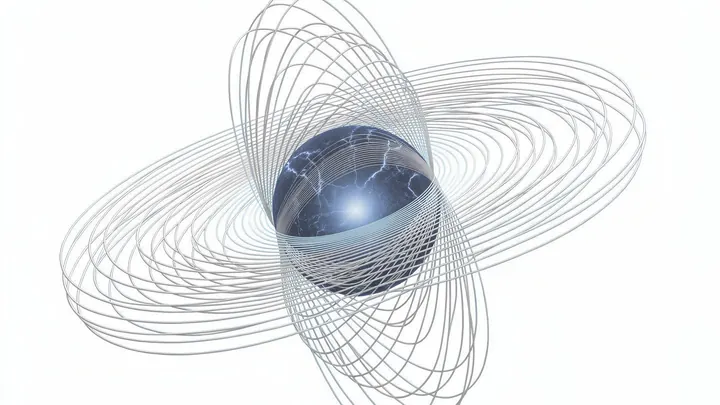
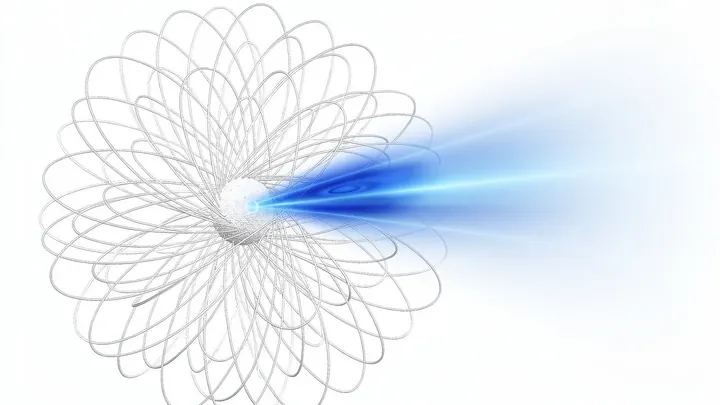
Pulsar PSR J0614-3329 spins 318 times per second. A point on its equator moves at about 10% of the speed of light. From a distance, the star looks like a lighthouse spinning so fast that its beam blurs into a continuous ring.
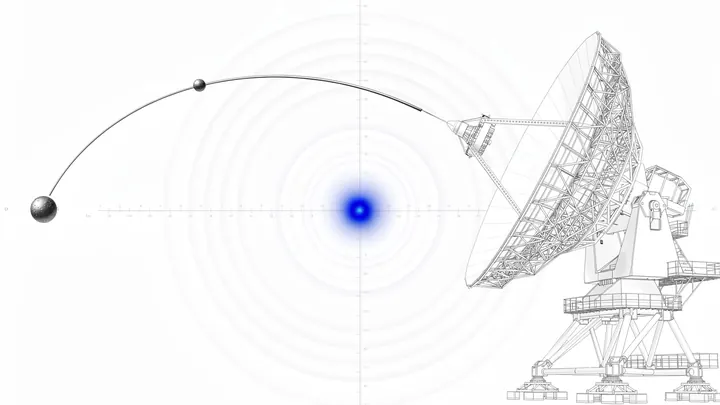
Radio waves from a distant pulsar travel through the interstellar medium, encountering invisible magnetic structures the size of the distance from the Sun to Earth. One such structure is a current sheet, where the magnetic field abruptly changes direction, like a compass needle flipping from north to south.
The night sky is full of rings and bubbles, but in the radio band they look different. In data from the Australian radio telescope ASKAP, a structure has surfaced that resembles two soap bubbles blown from the same straw.
Picture a lighthouse on the shore at night. Its lamp is off almost all the time, but once every few days, for a split second, it blazes so brightly that the light is visible beyond the horizon.
A lighthouse flashes for a fraction of a second and goes dark again. The MeerKAT telescope in South Africa catches such flashes in the radio band. During its observations, it picked up 27 new sources that no one had seen before. Neutron stars are the remnants of exploded stars, compressed to the size of a city.
Pulsars are rapidly spinning neutron stars that emit radio pulses like a lighthouse. But some of them stay silent almost all the time, occasionally emitting a single pulse. Such objects are called rotating radio transients (RRATs). They were discovered nearly twenty years ago, but they remain a mystery.
A lighthouse that blinks not every second but once every few minutes or even hours. That is exactly how long-period radio transients behave — cosmic sources discovered only recently.
At the end of a massive star's life, its core collapses in a fraction of a second, giving birth to a supernova flash. This cataclysm shakes spacetime itself, emitting gravitational waves — ripples that race across the Universe.
Three milliseconds before the merger. A gargantuan black hole spinning at breakneck speed drags in a neutron star — a ball the size of a city but with 1.5 times the Sun's mass. Tidal forces stretch the star into a thread as thin as a needle and fling its matter outward.
In June 2024, the CHIME radio telescope recorded over 700 radio bursts per hour from source FRB 20240114A. Such a hyperactive repeater releases in one hour nearly all the magnetic energy of a typical magnetar (a neutron star with an ultra-strong field).
A spinning top that makes a hundred turns per second suddenly starts losing speed dramatically — much faster than any known top. That's exactly what pulsar J0435+3233 is doing. It's a dead star, crushed to the size of a city, but whirling at a furious rate.
In the silent ocean of the Galaxy, mature civilizations have likely long chosen an unexpected strategy: instead of loud beacons, they scatter quiet fireflies — autonomous interstellar laser beacons, drifting in the void and dropping microsecond flashes. These 'seeds of contact' are not tied to their home stars and do not drown in their glow.
In a world locked in a crystal lattice and cooled nearly to absolute zero, matter knows how to hide its deepest secrets. A quantum spin liquid is a state where electron spins never freeze, even at zero temperature, remaining in an eternally flickering superposition.
Two ultradense spheres, each the size of a city, whirl in a dance. Their masses are less than the Sun's, but inside them is matter compressed to unimaginable limits. One sphere is a neutron star; the other is a strange star, made entirely of quarks — the elementary particles that build up protons and neutrons.
In 1967, astronomers caught the first radio signal from a distant cosmic lighthouse — a pulsar. Since then, thousands of these stellar remnants have been discovered, slicing through space with beams like a revolver's burst.
3I/ATLAS burst into the Solar System like an uninvited guest, a gift of fate for hunters of extraterrestrial intelligence. This comet-like wanderer from the depths of the Galaxy flew close enough to be heard in all its details — unlike distant exoplanets.
Think of a merry-go-round: it's easier to spin a light one, harder to spin a heavy one. Neutron stars, the ultra-dense remnants of exploded stars, behave in a similar way. Astronomers looked at fifty binary systems where one neutron star orbits another and noticed: the heavier the star, the longer its spin period. The link isn't strict, but it's statistically noticeable.
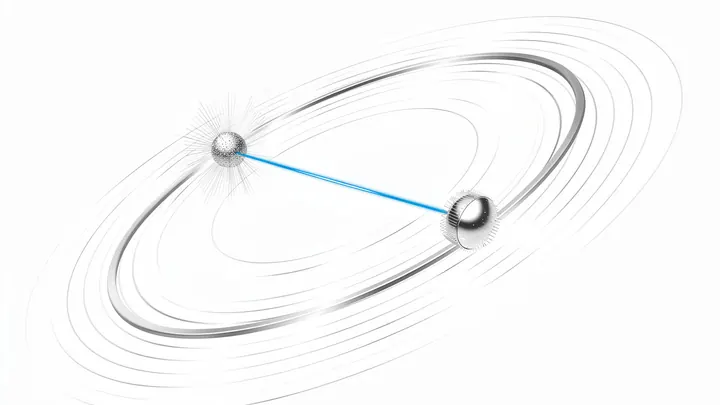
A pair of neutron stars, locked in a gravitational embrace, traces invisible circles in the void. A century ago, Albert Einstein described this dance as waves of curved geometry, but for a long time we could only catch glimpses — through the feverish flicker of radio pulses.
Even Jocelyn Bell Burnell, who first detected the strict periodicity of radio signals, noticed that some pulses would suddenly vanish. Today we know: variability is not a whim, but the voice of intricate electrodynamics.
In 2022, astronomers began discovering strange cosmic beacons — long-period radio transients. Unlike fast pulsars, discovered by Jocelyn Bell Burnell in 1967, these objects flared with periods of tens of minutes and hours.
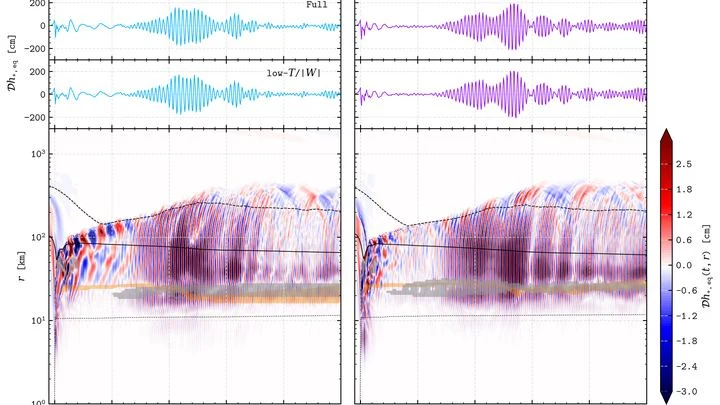
A figure skater pulls their arms in, and their spin suddenly accelerates. When a massive star exhausts its fuel and its core collapses, something similar happens, but on a cosmic scale. The core shrinks to a city-sized sphere, and if it is spinning rapidly, a peculiar instability can arise.
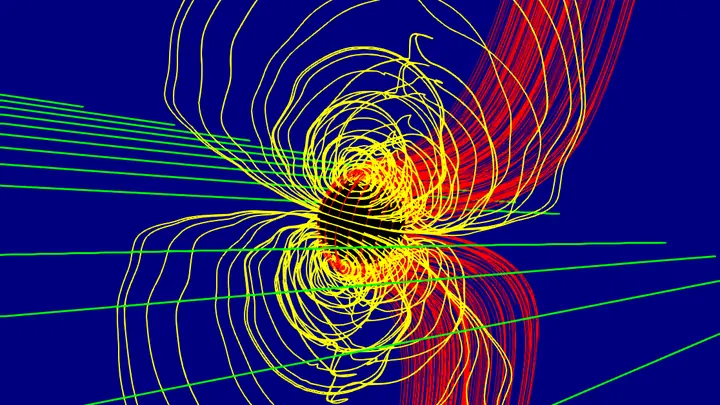
A neutron star is a sphere the size of a city but with the mass of an entire Sun. Its magnetic field can tear atoms apart from thousands of kilometers away. Yet until now, it was a mystery how this field is arranged inside: whether it is twisted into tight ropes or more like neat lines radiating from the poles.
A spinning top whirls at great speed and, instead of a steady hum, emits a quiet buzz — because it is slightly dented. Neutron stars work much the same way: city-sized spheres compressed to such density that a teaspoon of their material weighs as much as a mountain.
The first exoplanet was discovered around an unusual cosmic lighthouse — a neutron star known as a pulsar. These ultra-dense remnants of dead stars spin at tremendous speeds and emit precise radio pulses.
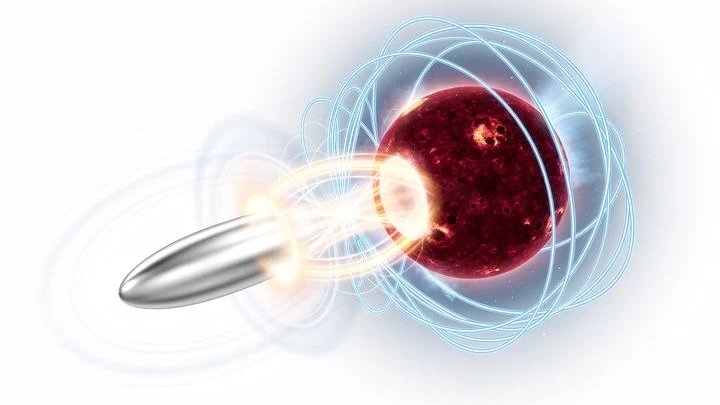
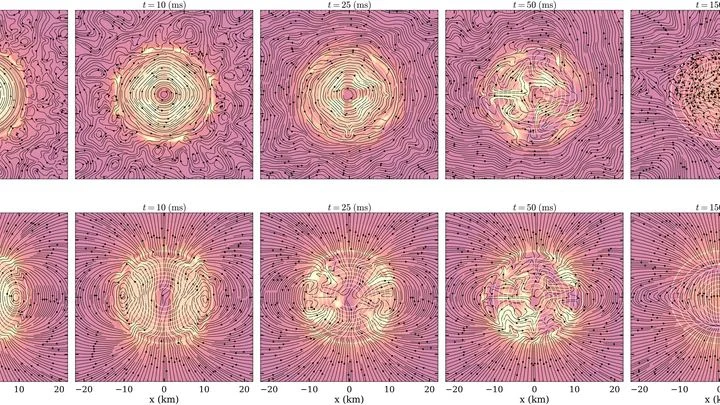
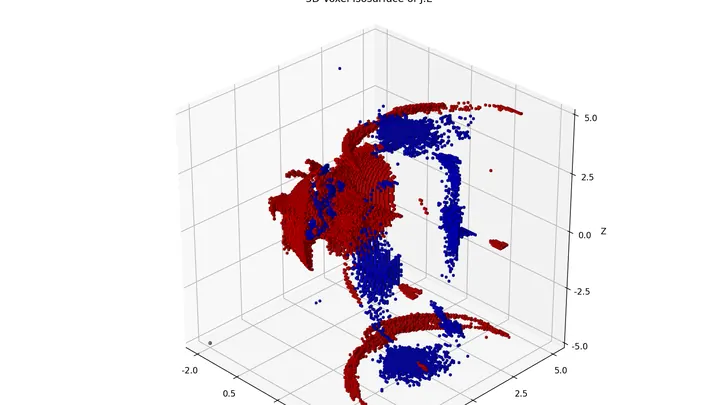
Two neutron stars spiral closer together, about to merge in an instant. Their dance lasts fractions of a second, but just before the finale, one star plows into the other's magnetic envelope, like a swimmer cutting through water, kicking up waves. At that moment, a complex system of currents is born, carrying energy away.
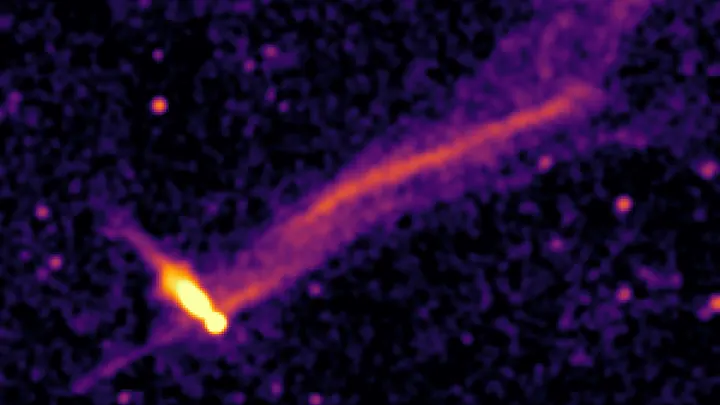
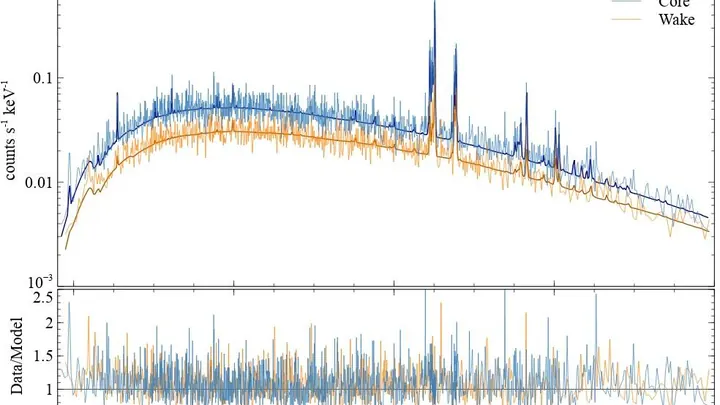
Deep in space, a rapidly spinning neutron star, a pulsar nicknamed the Lighthouse, speeds through tenuous gas. Like a motorboat cutting through water, it leaves a glowing trail of charged particles behind. In X-rays, this trail appears as a bright tail and a thin filament stretching over many light-years.
Be stars are rapidly rotating luminaries with bright gas disks. Usually, a companion star spins them up: mass flowing from the neighbor whirls the star like a bullet in a rifled barrel. But there are also lone Be stars without a partner: their origin long remained a mystery.
New research shows that solitaries can be born from a supernova explosion.
Two neutron stars — these are ultra-dense remnants of dead stars, each the size of a city but heavier than the Sun. Their existence was predicted back in 1934 by Fritz Zwicky. A teaspoon of this matter weighs billions of tons. When two such objects draw close before merging, their magnetic fields twist and snap like taut strings.
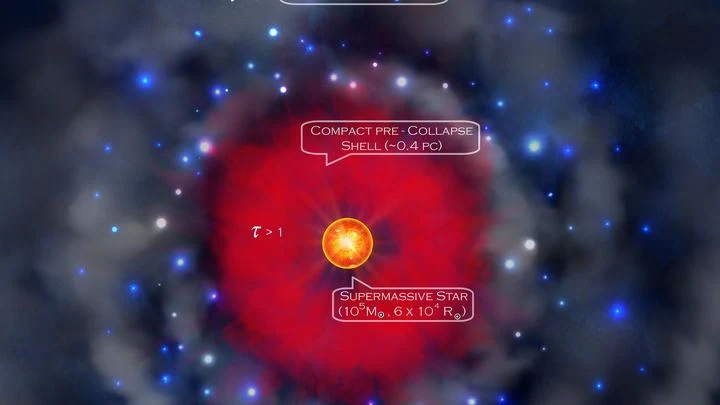
A star weighing a hundred thousand Suns lives bright and brief. Its finale is a rapid collapse into a black hole. But just before the end, it manages to wrap itself in a dense gas cocoon.
A sunspot, a dark island on the scorching surface, breathes. Every three minutes, a wave spreads from it, runs along an invisible magnetic arch, and makes the plasma above a neighboring spot flare with a radio signal. Radio telescopes caught seven such flares in a row on February 14, 2024.
The ASKAP radio telescope in Australia has spotted a very faint glowing ring in the southern sky, like a soap bubble the size of several full moons. Inside the ring, exactly at the center, shines a tiny point. Usually, such a picture means one thing: a star exploded here, leaving behind an expanding shell and a collapsed core at its heart.
But this pair has a quirk.
At the heart of the Ophiuchus galaxy cluster floats a bubble of hot plasma the size of several galaxies. It rises like a giant hot-air balloon in the atmosphere, leaving a wake behind it — a region where gas is set in motion.
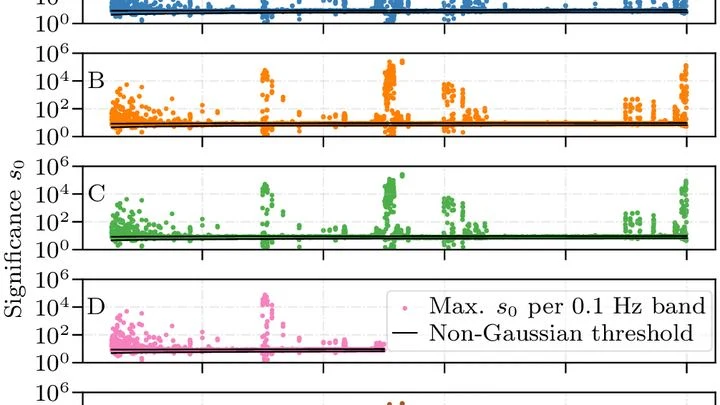
The night sky looks calm, but if you listen in on the radio band, it's full of short clicks and rustles. Astronomers are combing the sky for solitary radio pulses — bursts lasting milliseconds that come from various corners of the Galaxy and beyond.
One such search is underway at the 100-meter radio telescope in Effelsberg, Germany.
In 2017, the IceCube detector caught a neutrino from the distant galaxy TXS 0506+056. It was like hearing a phone ring from across the ocean: the signal came from where the most energetic particles in the Universe are born. At the same time as the neutrino, astronomers spotted a gamma-ray flare, and two to three years later, radio waves. Why was the radio late?
The night sky is full of beacons that blink on schedule. Pulsars are fast-spinning neutron stars whose radio pulses arrive with clockwork precision. But there are other beacons too: they stay silent for minutes or hours, then suddenly emit a single pulse, and go quiet again.
Radio pulsar J1574+4703 behaves like a finicky lighthouse. Instead of shining steadily, it turns its radio beam on in short flashes and then falls silent for long stretches. Objects like this are called 'rotating radio transients', or RRATs for short.
The universe wasn't born in silence. Primordial gravitational waves — ripples in spacetime — still carry the echo of that event. Scientists try to hear it in two ways. Low 'notes' are captured in the Big Bang's afterglow — light emitted 380,000 years later.
Above the Sun's surface hang long ribbons of glowing gas — streamers. They look like giant harps stretched across the corona. When a wave runs along such a ribbon, it trembles and bends like a string after being plucked.
For a long time, it was thought that only a very fast ejection of material, one traveling at more than 500 kilometers per second, could launch such a wave.