A Detector That Sees Helium Nuclei express
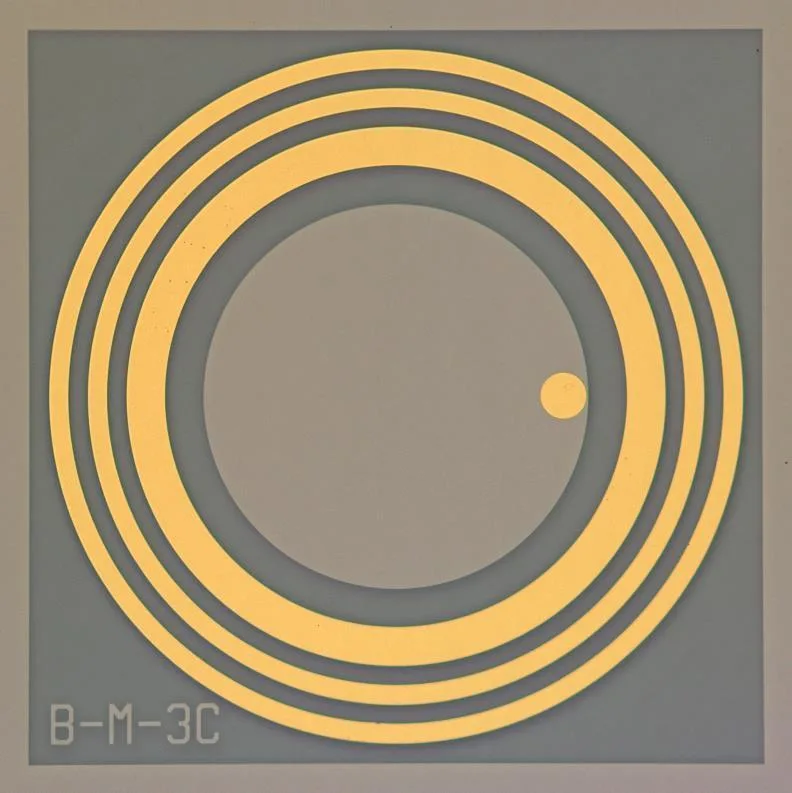
An alpha particle is a helium nucleus that flies out when heavy atoms decay. When it hits a gallium nitride crystal, it deposits its energy and creates an electrical pulse. The pulse height tells you how much energy the particle had. But on its way to the sensitive region, the particle loses some energy in the so-called dead layer — a thin, non-working area near the surface. The thinner this layer, the more accurate the measurement.
Engineers grew the gallium nitride crystal layer by layer, like a cake, and added a guard ring — a special electrode that shunts parasitic currents at the edges. As a result, the dead layer was only 20 nanometers thick — hundreds of times thinner than a human hair. At a reverse bias of 200 volts, the leakage current was minuscule: 2.195 nanoamperes, roughly the current through a turned-off transistor in a phone. At 260 volts, the detector collected 95.9% of the charge and resolved energies with 2.69% accuracy.
But the main finding concerns the "tail" in the energy spectrum. Sometimes the detector shows not a single sharp peak but a long, gentle slope to the left, as if some particles arrived weakened. For a long time, the cause was sought in noise or crystal imperfections. The authors simulated the process for the first time in the Geant4 program and saw: the culprit is the non-uniformity of the depletion zone. This zone is the detector's active volume where the electric field collects charge. If its thickness varies slightly from point to point, some energy leaks into "silent" regions, and the signal comes out lower.
The model built on this principle matched the experiment. Now the developers know where to look: to remove the tail, you need to make the depletion zone as flat and uniform as possible. Such detectors will be useful in spacecraft, where alpha particles bombard electronics, and in nuclear laboratories, where it is crucial to know the exact energy of each particle.
Gallium nitride is the same material used to make blue LEDs in lamps and screens. Its ability to withstand high voltages and radiation makes it an ideal candidate for detectors in open space.