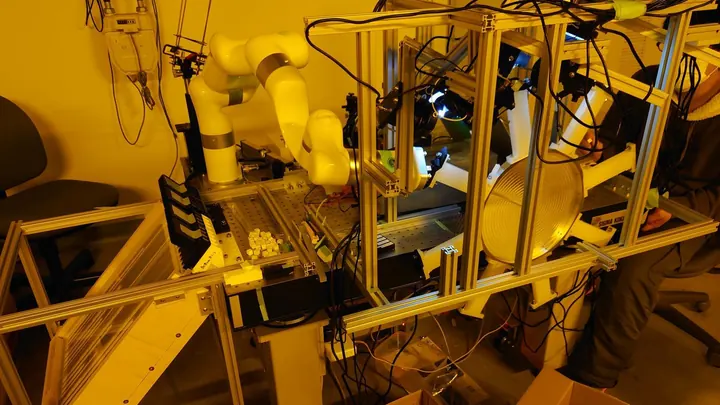
Particle detection technology encompasses the instruments and methods used to observe and measure subatomic particles, from electrons and photons to exotic particles like muons. Modern detectors are designed to capture the position, energy, and arrival time of particles with extreme precision, often at rates of millions of events per second. This technology is the foundation of experimental particle physics, astrophysics, and medical imaging, enabling discoveries from the Higgs boson to the mapping of the human brain's activity.
History
The field began with the cloud chamber, invented by Charles Wilson in 1911, and evolved through spark chambers, bubble chambers, and silicon detectors. The development of the photomultiplier tube in the 1930s was a key step for fast timing.
How it works
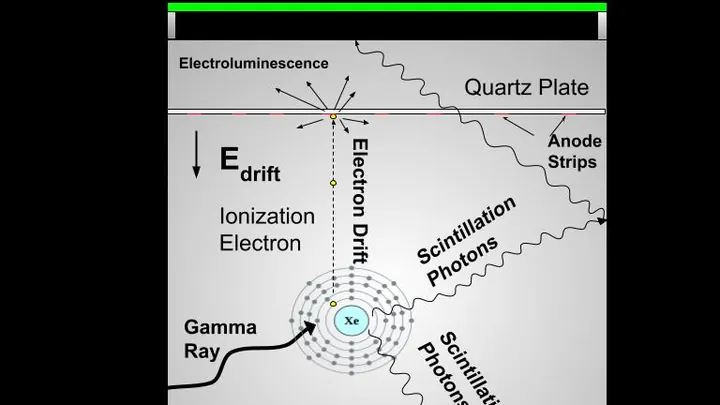
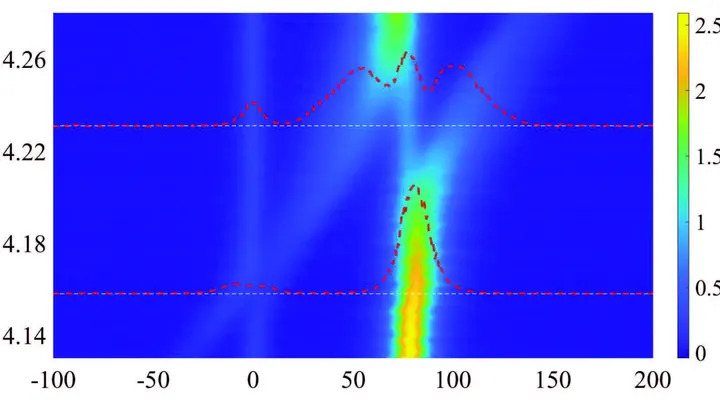
Most particle detectors rely on converting the energy of a passing particle into a measurable signal. In semiconductor detectors, a charged particle creates electron-hole pairs that are swept away by an electric field, producing a current pulse. In scintillators, the particle excites atoms that emit light, which is then captured by photodetectors. Time-of-flight systems measure the time it takes a particle to travel between two points, giving its velocity. To achieve high temporal resolution, detectors use fast electronics and materials with short response times, allowing the precise timing of events that occur in quick succession.
In practice
Particle detectors are used in medical imaging (PET scanners), radiation monitoring, and high-energy physics experiments like those at the Large Hadron Collider.
Fun fact
Modern particle detectors can timestamp events with an accuracy of tens of picoseconds, allowing them to distinguish particles traveling at nearly the speed of light that are separated by just a few millimeters.
You're looking for fireflies in a dark forest. Instead of photographing the whole forest every second and then poring over the images, you carry a small device that spots the flashes on its own and cuts out only a circle around each one. The rest, the blackness, isn't saved. That's exactly how the new sensor for scientific cameras works.
A night river is dotted with tiny sparks. This isn't plankton: it's functional pollen-sensors, millimeter-sized devices that swim on their own and measure the water's chemistry.
Each particle is a tiny lab. Inside, two reagents meet: one triggers a glow upon contact with a pollutant, and the second, a colored filter, blocks out interference.
A regular radar is like a microphone in a buzzing crowd: individual sounds blend into mush. PiVoT works like a conductor who instantly recognizes each instrument in the tuning chaos. Instead of shuffling through hypotheses, the algorithm tightens a loop around the most likely targets — cars, cyclists, pedestrians.
Every second, about a hundred invisible particles, muons, pass through your body. They are born high in the sky when cosmic rays collide with air atoms, raining down on Earth. These particles are so penetrating that they can pass through a multi-story building, but they slightly change direction when they encounter dense material, such as lead or uranium.
A photographer shoots a night forest, trying to catch fireflies in the frame. The flashes are rare and faint, while around there's the noise of wind and distant lights.
An ordinary rain gauge collects water in a bucket and shows the total volume of precipitation. But the new device is like a sensitive palm that feels every falling drop and keeps count, even when the drops number in the thousands.
That's exactly what physicists have built.
An alpha particle is a helium nucleus that flies out when heavy atoms decay. When it hits a gallium nitride crystal, it deposits its energy and creates an electrical pulse. The pulse height tells you how much energy the particle had.
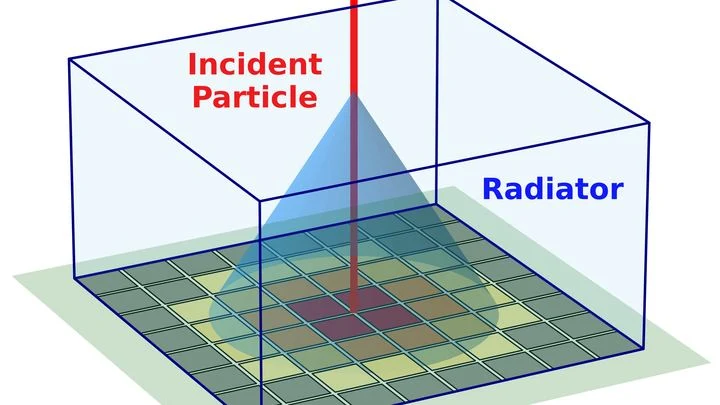
At the Large Hadron Collider, protons collide, and from the flash dozens of particles are born. Among them may be traces of rare processes — for example, the decay of a Standard Model Higgs boson into two W bosons. But these particles fly apart so quickly that their tracks merge into a single wide jet.
In giant accelerators, particles zip through detectors in billionths of a second, and telling one from another requires a stopwatch of incredible precision. The new µRWELL-PICOSEC detector acts as such a stopwatch: it captures the moment a particle passes with a precision of 48 picoseconds: that's 48 trillionths of a second.
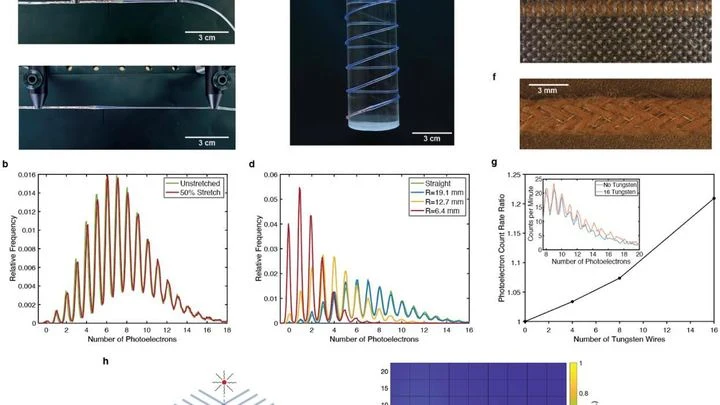
Inside an ultra-thin polymer thread are microscopic crystals — scintillators. When an invisible radioactive particle hits, they flash for a moment, like fireflies. A sensitive sensor catches each flash, turning the thread into a flexible detector.
A quantum computer holds atoms in light traps, like marbles in dimples. To read out the answer, you need to photograph each atom and determine whether it's glowing or not. Previously, analyzing such an image took so long that the computer sat idle. Now, engineers have created a specialized board that looks at the photo and instantly finds all the atoms.
The camera that hunts for tumors works like a highly sensitive camera: it catches the faint glow from a substance that accumulates in diseased cells. In conventional machines, the light is born in a crystal — a solid piece that resembles glass. But a crystal doesn't always convey exactly where the light flashed, so the image comes out slightly blurry.
The future neutrino detector will contain millions of tiny plastic cubes: each the size of a die. They flash when a ghostly particle passes through, and that flash must be captured and measured. But if a cube is warped, has a burr, or a hole in the wrong place, the signal gets distorted, and the detector starts lying.
Checking each cube by hand is like sifting through sand on a beach.
When a particle zips through a transparent material faster than light can travel through it, it leaves behind a faint blue flash, just as a jet breaking the sound barrier creates a shock wave. This Cherenkov radiation fires instantly, with no delay, making it perfect for ultra-precise timing in the world of elementary particles.
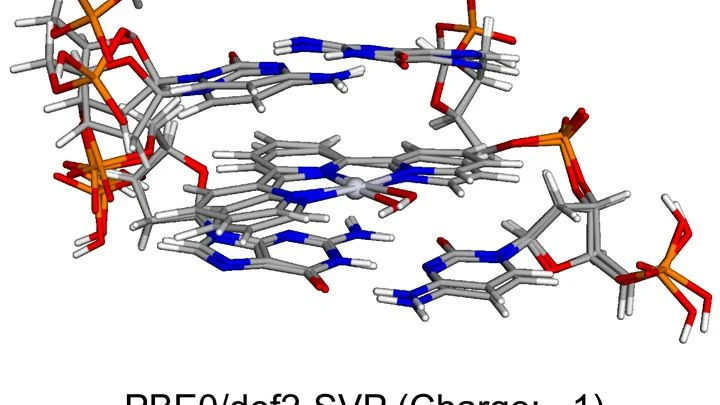
Standard chemotherapy hits the whole body like carpet bombing: both cancerous and healthy cells suffer. Scientists are hunting for more precise weapons — molecules that light up when they slip into a cancer cell's DNA, revealing its location. Such glowing probes could help doctors spot tumors early and even destroy them with pinpoint accuracy, leaving neighboring tissue untouched.
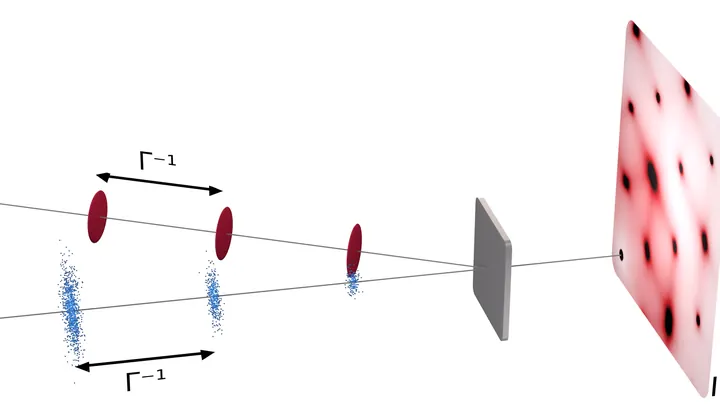
A camera that captures not light but a stream of electrons reflected off a crystal is a hybrid pixel detector. It can count every electron that hits it, generating almost no noise of its own. In normal mode, when the electron beam flows continuously, the detector works perfectly.
A regular radio receiver picks up waves with a metal antenna. Here, the antenna is a single atom with an electron boosted to a distant orbit, like a satellite in a high orbit around Earth. Such atoms are called Rydberg atoms.
At the Large Hadron Collider, protons smash into each other like two trucks full of confetti. The debris, dozens of new particles, scatters in all directions. The detector records their tracks, and then the real work begins: piecing together a complete picture of the collision from those tracks.
Previously, this was done by a set of rules devised by physicists.
In photometry (the measurement of light), catching individual microwave photons was long impossible: their energy is on par with the thermal jitter of atoms.
Detecting a single quantum emitter is like tuning a piano on a factory floor full of screaming machines: the pure tone drowns in noise. But the tuner doesn’t try to outshout the racket — he picks up a tuning fork and listens for beatings. That’s how even a barely audible echo becomes clear.
Picking up an ultraweak microwave signal is like trying to hear a whisper in a storm. Rydberg atoms, inflated to the size of bacteria, promise to become perfect antennas. But there's a fatal catch: during optical readout, up to 98% of messenger photons vanish without a trace in the detector.