Heavy Nuclei in the Fire of a Magnetar express
The crust of a neutron star is not just a solid shell. Under pressures of billions of tons per square centimeter, atoms lose their electrons, and the remaining nuclei arrange into a rigid crystal lattice, reminiscent of a honeycomb, but made of matter a trillion times denser than steel. When this lattice cracks under accumulated stress, a magnetar flare is born — a brief but dazzling burst of X-rays.
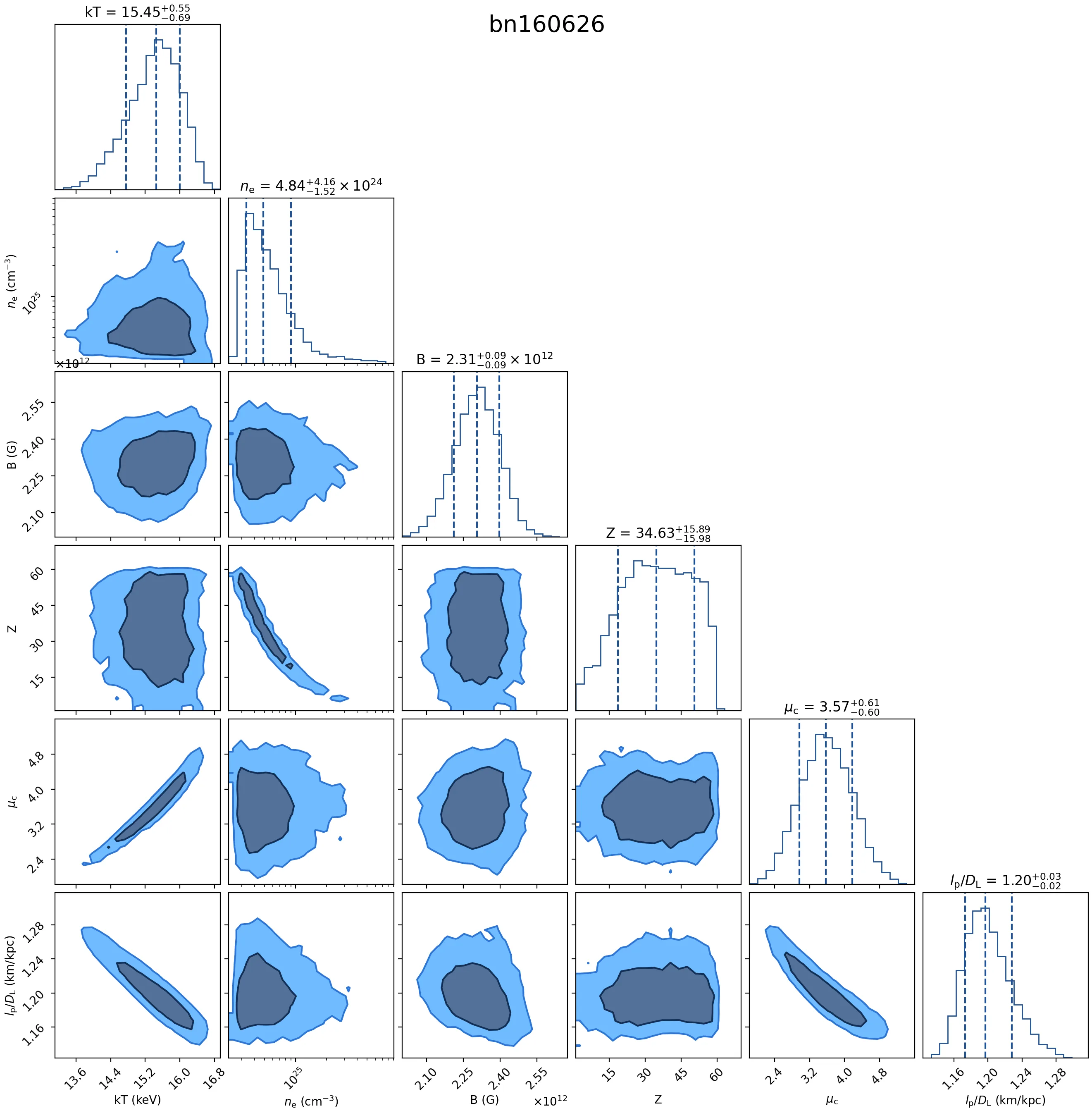
A team of scientists built a computer model of the glow of hot plasma in such fields and ran real flare data through it. The model tested different plasma compositions — from light nuclei like helium to heavy ones like krypton. The spectra (the decomposition of light by energy) matched best when the plasma was dominated by nuclei with an effective charge of about 37. This number is not the charge of a specific element but an averaged characteristic of a mixture rich in iron, nickel, and heavier elements.
Such a composition could not have come from nowhere. Light nuclei falling onto the star from space would not withstand the monstrous pressure and would quickly transform into a denser packing — into those very heavy nuclei. This means the flare brings out material from the crust itself, where it has been stored for millions of years. It's like determining from volcanic ash what minerals make up the magma tens of kilometers deep.
Now astrophysicists have a spectral key to the composition of neutron star interiors. Previously, they could only rely on theoretical calculations, but now they can test these theories against real flares. And when the next magnetar flares up in our Galaxy, its light will tell us not only about the cataclysm but also about what the toughest armor in the Universe is made of.
Original abstract
as written by the authors arXiv:2604.24750
The crust of a neutron star (NS) provides a unique laboratory for studying matter under extreme density and magnetic field conditions that cannot be realized in terrestrial experiments. However, direct observational constraints on its composition have remained very limited. Magnetar bursts provide a promising means to probe the nuclear composition of the outer crust, as their energy release may be associated with stress-driven yielding of the crustal Coulomb lattice (including plastic deformation) and magnetic reconnection in the surrounding magnetosphere. We develop a general-purpose radiative transfer framework for a strongly magnetized electron--ion thermal plasma (MEITP) and apply it to the observed X-ray burst spectra. The spectral fits disfavor light-ion compositions and instead favor plasmas characterized by effective charge numbers around $$Z \sim 37$$. These results provide spectral evidence for the participation of heavy nuclei in magnetar bursts, offer new observational constraints on the baryonic content and the location of the emitting fireballs, and further imply a crustal origin of the heavy ions.
The density of a neutron star's crust is so high that a sugar-cube-sized piece would weigh about 100 million tons, like a small asteroid.
In Robert Forward's novel "Dragon's Egg," life on the surface of a neutron star is described, where nuclear reactions replace chemistry and the crust vibrates with starquakes.