Two Photon Factories Strike a Chord in Unison ✎ express
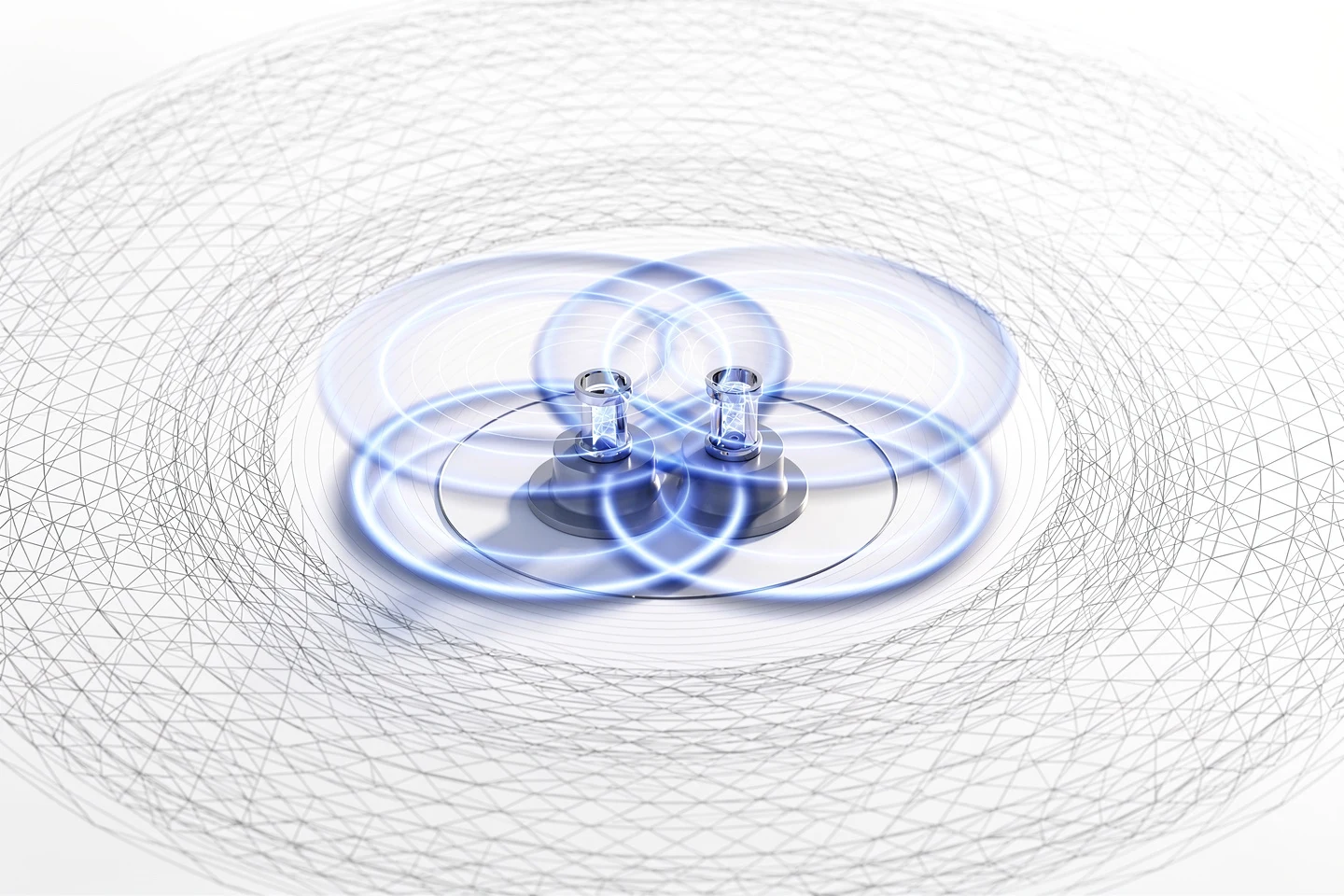
Two musicians in separate rooms play the same note. The sound must be so identical that a listener can't tell who is playing. In the quantum world, these musicians are single-photon sources — particles of light that must be indistinguishable from one another. Without this, you can't build a quantum computer or a secure communication network.
Quantum dots are tiny semiconductor crystals that can emit exactly one photon on command. Placed in an optical cavity (a miniature mirror chamber that enhances light), they operate with record efficiency. But two such dots from different devices usually differ slightly: the wavelength of light, the emission rate, the jitter from thermal noise. Even a tiny difference makes the photons distinguishable, and the quantum effect disappears.
The authors of the new work fabricated many cavities with quantum dots on a single substrate, achieving ultralow spectral noise and a small spread in wavelengths. They then used two fine-tuning mechanisms to bring the spectra of two distant sources into perfect alignment. The result: photons from two different sources became indistinguishable at 88±1%—this is the upper limit set by the intrinsic imperfection of each source individually.
This result is a major milestone for scaling photonic quantum technologies. Now it's possible to combine many independent sources into a single quantum network without losing particle identity. The musicians in different rooms are finally playing in unison.
A quantum dot is so small that millions of such sources could fit on the tip of a needle, yet each emits strictly one photon at a time, like a vending machine that dispenses a single ball.
In the series "Dark," quantum entanglement links events across different times, such sources of indistinguishable photons could become the basis for real quantum communication between distant nodes.