Calibrating a Neutrino Detector to 4% Precision express
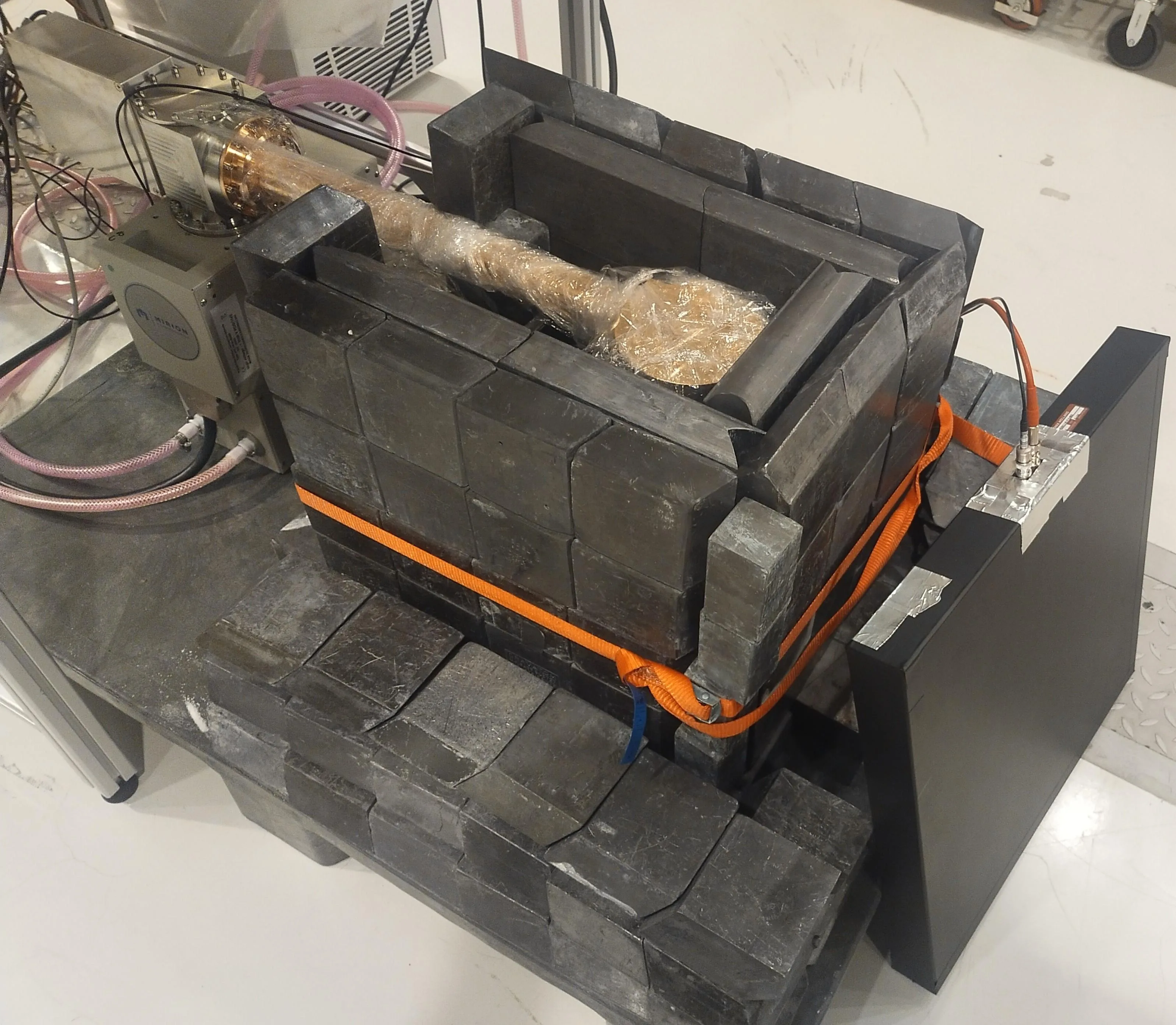
Inside the detector, which resembles a large thermos filled with germanium, faint flashes are born. Neutrinos, tiny particles that barely interact with matter, occasionally bump into germanium nuclei. The nucleus recoils, and the detector registers the jolt. But to distinguish a real signal from noise, the instrument needs precise calibration.
Scientists from the CONUS+ experiment irradiated the detector with neutrons from an americium-beryllium source. Neutrons, like neutrinos, can push nuclei, but their flux can be controlled. By comparing the known energy of the neutrons with the detector's readings, physicists fine-tuned the energy scale. Now the measurement uncertainty is less than 4%—previously it was 14%.
This precision will allow the detector to catch neutrinos from the Leibstadt nuclear power plant reactor and search for signs of new physics beyond the Standard Model. Perhaps it will uncover dark matter particles or other exotic phenomena.
Original abstract
as written by the authors arXiv:2604.25748
The CONUS+ experiment has recently reported the first detection of coherent elastic neutrino-nucleus scattering (CEvNS) of reactor antineutrinos on germanium nuclei and is now entering a precision phase. The dominant uncertainty in the first measurement was the energy scale, which contributed 14% to the uncertainty of the prediction of the combined signal. We present a dedicated neutron activation campaign in which one of the new 2.4 kg CONUS+ germanium detectors was irradiated with a strong 241AmBe source, demonstrating that a contribution below 4% to the uncertainty of signal prediction is achievable. For the first time, the 71Ge M-shell X-ray line was clearly resolved at (158.7+-1.4) eVee, validating the CONUS+ energy reconstruction down to the detection threshold. This validation includes the understanding of the energy scale, the energy resolution, the trigger efficiency, and the correct separation of physical from noise events. These results establish the foundation for a future activation campaign at the Kernkraftwerk Leibstadt reactor site, strengthening the CONUS+ energy calibration and extending its sensitivity to precision CEvNS and beyond Standard Model physics measurements.
Neutrinos are so ubiquitous that trillions of them pass through your thumbnail every second, yet you never notice.