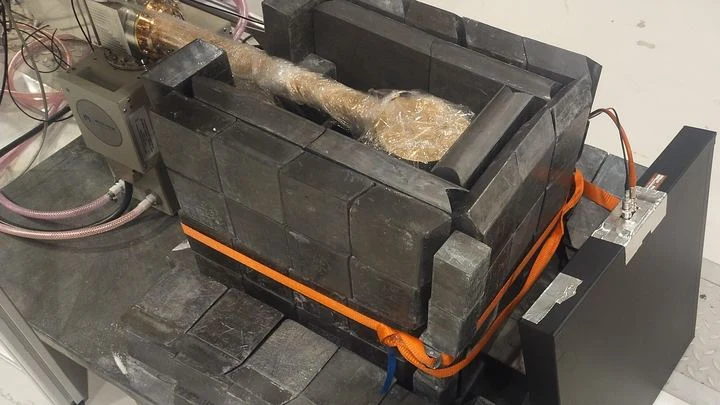
J. Hakenmüller

4 articles · 30 co-authors · latest: 2026-04-28
1,490 citations · h-index 16 · 47 papersData: Semantic Scholar

We have retold 4 papers by this author. most often about: neutrino, dark matter, neutrino oscillations. 30 co-authors across our retellings.

Links in the knowledge graph
A Cold Detector and Extra Signals
In a dark chamber where the temperature sits just four degrees above absolute zero, a sapphire crystal the size of a grain of rice lies waiting. When a neutrino, a ghostly particle that barely notices matter, flies through it, the crystal shudders and warms by a tiny fraction of a degree.

HEP Experiment2026-03-181 minarXiv:2603.17951express
The Invisible Nudge: How Neutrinos Strike the Nucleus
A tiny ghostly particle zips through a piece of germanium. Usually it leaves no trace, but sometimes, like a billiard ball, it smacks into an atom's nucleus. The nucleus recoils, and that jolt can be detected. At Oak Ridge National Laboratory, the Ge-Mini detector caught such recoils for two years. Neutrinos are the most elusive of known particles.
How to Hear the Faintest Signal
A detector that hunts for rare particles is like an ear trying to catch a whisper in a noisy room. The quieter the signal, the harder it is to tell apart from random noise. In the NUCLEUS experiment, such detectors, cryogenic calorimeters, are cooled to near absolute zero so they can pick up even a faint pulse of heat from a single particle.
HEP Experiment2026-04-281 minarXiv:2604.25748express
Calibrating a Neutrino Detector to 4% Precision
Inside the detector, which resembles a large thermos filled with germanium, faint flashes are born. Neutrinos, tiny particles that barely interact with matter, occasionally bump into germanium nuclei. The nucleus recoils, and the detector registers the jolt. But to distinguish a real signal from noise, the instrument needs precise calibration.