The CMS (Compact Muon Solenoid) detector is one of two general-purpose particle detectors at the Large Hadron Collider (LHC) at CERN. It is designed to capture the debris from proton-proton collisions at energies up to 13 TeV, identifying and measuring the momenta and energies of particles produced in the collisions. Its name reflects two key features: it is remarkably compact for its mass (about 14,000 tonnes), and it has a powerful solenoid magnet that bends charged particles so their momenta can be measured.
History
CMS was proposed in the early 1990s as part of the LHC project, with the detector completed and first collisions recorded in 2008. It was built by a collaboration of over 4,000 scientists from more than 50 countries.
How it works
CMS is built like an onion, with layers of subdetectors surrounding the collision point. Closest in is a silicon pixel tracker that records the paths of charged particles; next are electromagnetic and hadronic calorimeters that stop particles and measure their energies; outermost is the muon system embedded in the iron return yoke of the solenoid. The 3.8-tesla magnetic field curves particle trajectories, and by fitting those curves, physicists reconstruct the particles' momenta and identities. The entire detector reads out data at 40 million collisions per second, with a trigger system selecting the most interesting events for analysis.
In practice
CMS is used to search for new physics beyond the Standard Model, including the Higgs boson (discovered there in 2012), dark matter candidates, and exotic particles; its data also constrain the properties of quark-gluon plasma and neutrino interactions.
Fun fact
The CMS solenoid magnet stores about 2.6 gigajoules of energy — enough to melt 18 tonnes of gold — and its magnetic field is about 100,000 times stronger than Earth's.
The antiproton beam hits the plate, and each impact bursts into a shower of charged particles. In the GBAR experiment at CERN, this picture is captured not by a sophisticated detector but by an ordinary industrial camera without a lens, pressed against the vacuum window from the outside.
Instead of an ice bath, a warm gas blanket. That is how the cryogenic current comparator at Japan's National Metrology Institute is now cooled. Previously, this instrument, which compares electric currents to within billionths of a percent, required immersion in liquid helium.
In southern India, in the city of Madurai, from 2018 to 2022, an unusual 'catcher' of cosmic particles stood — the mini-ICAL prototype, weighing 85 tons. It is a 600-times scaled-down version of the future neutrino detector (those elusive ghost particles) that will be built deep underground.
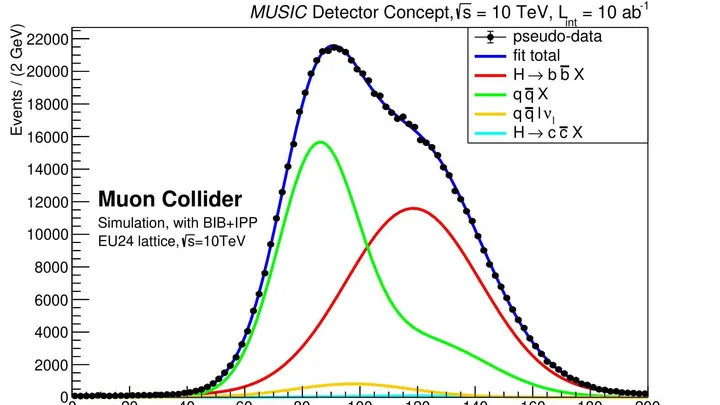
The 21-kilometer ring near Protvino was once planned to accelerate protons. Today, the same tunnel could host a very different machine — a muon collider. The muon is a heavy cousin of the electron, and that's its strength. On a curve, an electron radiates like a searchlight, losing precious energy. A muon radiates a billion times less.
Cosmology is like an orchestra where different sections suddenly start playing out of sync. Measurements of the universe's expansion rate (the Hubble constant) from the early and late universe give different numbers.
In the late 1990s, the night sky delivered a surprise: Saul Perlmutter and Adam Riess found that the expansion of the Universe is accelerating. Ever since, the greatest riddle has been dark energy — a substance making up nearly 70% of the cosmos, yet evading laboratory study.
Two pendulums hang from the same crossbar. A push, and they start swinging, gradually falling into and out of sync. In a topological qubit, Majorana particles, special excitations that can store quantum information, play the role of these pendulums.
Trying to count people in a dark room by the sound of their breathing hits a wall of background noise — individual breaths are inaudible. Scientists working with quantum spins in solids face a similar challenge. Each spin (the electron's magnetic moment) has its own "voice," but it is drowned out by the technical noise of the instruments.
The Universe at 700 million years old was a noisy construction site, just beginning to light up. Telescopes caught a signal from that distant epoch: the galaxy REBELS-25, massive and full of stellar fuel.
When a massive star dies, its core collapses, and a supernova explosion occurs. The cataclysm births streams of particles — like ripples from a thrown stone. The first to arrive are swift neutrinos, which pierce the Earth, hardly interacting. Then, hours later, ghost particles with a tiny charge appear.
Every second, about a hundred invisible particles, muons, pass through your body. They are born high in the sky when cosmic rays collide with air atoms, raining down on Earth. These particles are so penetrating that they can pass through a multi-story building, but they slightly change direction when they encounter dense material, such as lead or uranium.
An old photograph taken at the moment of the universe's birth has been carrying its light to us for nearly 14 billion years. This snapshot is the cosmic microwave background, the cooled echo of the Big Bang. It captures the tiny inhomogeneities from which galaxies later grew.
Ice, water, steam — phase transitions we all know. But what happens if you squeeze and heat an atomic nucleus itself? Theorists think protons and neutrons inside it 'melt,' releasing smaller building blocks — quarks and gluons.
Deep inside the detector at the Large Hadron Collider, protons collide, and for a fleeting moment something heavy is born. It instantly shatters into two Higgs bosons — particles that, like nesting dolls, each hide two pairs of b-quarks.
A noisy train station at rush hour. Thousands of people hurry past, voices merging into a dull roar. Somewhere in the crowd, two people try to shake hands with a special, barely visible gesture. Spotting such a handshake is nearly impossible.
A firework bursts, and one point explodes into four sparks at once. That's how the Z boson, the particle that carries the weak force, behaves when it decays into four charged leptons (electrons or muons). The process is extremely rare: for every million Z bosons produced, only about five decay this way.
In the dense gaseous cocoon around a young massive star, streams of matter collide as if in a giant chemical flask. One stream moves relative to us at about 11 kilometers per second, the other at about 5. The telescope at Onsala (Sweden) caught their radio voices and resolved them into hundreds of spectral lines — molecular fingerprints.
Two clocks tell different times. One sits on our desk, the other lies far in the past, in the glow left over from the Big Bang. The first, looking at nearby galaxies, ticks off the expansion rate of the universe — about 73 kilometers per second per megaparsec of distance. The second, peering into ancient light, gives a noticeably lower value — roughly 67.
Inside the detector, which resembles a large thermos filled with germanium, faint flashes are born. Neutrinos, tiny particles that barely interact with matter, occasionally bump into germanium nuclei. The nucleus recoils, and the detector registers the jolt. But to distinguish a real signal from noise, the instrument needs precise calibration.
A tiny glass bead hangs in a laser beam like a speck of dust in sunlight. Around it is a rarefied gas: atoms of krypton, xenon, and heavy molecules of sulfur hexafluoride. They collide with the bead, and each hit transfers a tiny impulse, like a pea thrown at a taut sheet makes it tremble.
Impulse is a measure of motion: mass times velocity.
At the very heart of the Milky Way, something is continuously glowing in gamma rays. This light is special: its energy is exactly 511 thousand electronvolts. Such energy is produced when an electron meets its antimatter counterpart, a positron, and they annihilate, leaving behind a flash of light.
The Higgs boson is like a conductor that gives mass to all other particles. Without it, electrons would be massless and atoms would fall apart. But how does the conductor interact with itself? That is the key question a future muon collider aims to answer.
In the CMS detector at the Large Hadron Collider, protons accelerated to nearly the speed of light collided. Among billions of such collisions, physicists searched for a rare signature: the production of a single heavy particle that immediately decays into a W boson and a b quark.
Oil droplets in boiling broth usually scatter apart, but if you bump them together very slowly, they may stick for a moment. Something similar happens with top quarks — the heaviest known building blocks of matter.
Light twisted in one direction hits a proton. The particle can absorb the photon or deflect it — depending on how its own spin, a tiny internal top, is oriented. In the experiment at the MAMI accelerator in Mainz, a beam of polarized photons struck targets of polarized protons and deuterons (nuclei of heavy hydrogen).
When two particles fly at almost the same speed in the same direction, their signals in the detector merge, like two voices in unison. Telling a duet from a soloist is an art in itself.
From 2016 to 2018, at the Large Hadron Collider at CERN, protons collided at energies of 13 teraelectronvolts, as if two peas were accelerated to speeds where their impact spawns a whole swarm of new particles.
At the Large Hadron Collider, protons collide, and from the flash dozens of particles are born. Among them may be traces of rare processes — for example, the decay of a Standard Model Higgs boson into two W bosons. But these particles fly apart so quickly that their tracks merge into a single wide jet.
Cosmic rays are particles that arrive from deep space. When such a particle hits the atmosphere, it triggers a whole shower of new particles, like a billiard ball breaking a rack, sending balls scattering in all directions. To predict what such a shower will look like, we need to know how the primary particle interacts with the nuclei of air atoms.
Every second, billions of decays happen inside our bodies, and nobody notices. But physicists do: they smash particles in accelerators and watch what fragments they fly into. Hidden in those fragments is the answer to why we exist at all. Right after the Universe was born, there were equal amounts of particles and antiparticles, but today all we see around us is particles.
Imagine a balance scale with identical weights, yet one pan always tips lower. In the world of elementary particles, this imbalance is called CP violation: particles and their mirror twins (antiparticles) behave slightly differently.
Colliding two lead nuclei at the Large Hadron Collider is like throwing two hefty bags of marbles at each other. Usually, the marbles scatter in all directions, but sometimes one bag passes so close that the marbles don't collide: they just exchange glances.
In giant accelerators, particles zip through detectors in billionths of a second, and telling one from another requires a stopwatch of incredible precision. The new µRWELL-PICOSEC detector acts as such a stopwatch: it captures the moment a particle passes with a precision of 48 picoseconds: that's 48 trillionths of a second.
Protons accelerated to enormous energies slam into a thick metal plate, like bullets into armor. Inside the metal, a J/ψ particle is born for an instant, which immediately decays into two muons — light relatives of the electron. These muons fly out of the target, and detectors catch their tracks.
The scientists compared the number of caught muons with predictions from a computer model.
When heavy nuclei collide in accelerators, a multitude of particles is produced, and physicists want to understand how electric charge moves through this chaos. Two trains crash into each other: the passengers (quarks) scatter, but their luggage (charge) may end up far from the crash site.
A ring road around the Sun, where the traffic is not cars but clumps of matter. The diameter of this road is measured in light-years: it encircles our planetary system at its outer edge, in the Oort Cloud, where the star's weak gravity still holds sway.
In proton collisions at the Large Hadron Collider, physicists have for the first time caught a particle with two charm quarks. It is called Ξcc+ (pronounced "ksi-ksi-plus") and resembles a bead with not one but two heavy nuclei.
The camera that hunts for tumors works like a highly sensitive camera: it catches the faint glow from a substance that accumulates in diseased cells. In conventional machines, the light is born in a crystal — a solid piece that resembles glass. But a crystal doesn't always convey exactly where the light flashed, so the image comes out slightly blurry.
In the kitchen, two flashlight beams pass through each other without noticing. Light barely interacts with light. But if you accelerate particles to enormous energies, two photons can collide and give birth to something new.
At the Large Hadron Collider, protons collide at nearly the speed of light. Sometimes they don't smash apart but exchange photons — particles of light. These photons can produce a pair: one particle the detector sees, and another that flies off unnoticed.