A Cosmic Horn from the Universe's Infancy express
A huge orchestra is tuning up before a concert. Each instrument makes its own noise, and in the general hubbub it's hard to pick out individual sounds. But if the conductor gives a special flick of the baton for a second, all the violins will simultaneously hit one high note, and that pure tone will cut through the cacophony. Such a "conductor's flick" could have happened in the first moments of the universe's life. Only instead of music, it produced a powerful burst of gravitational waves — ripples in spacetime itself.
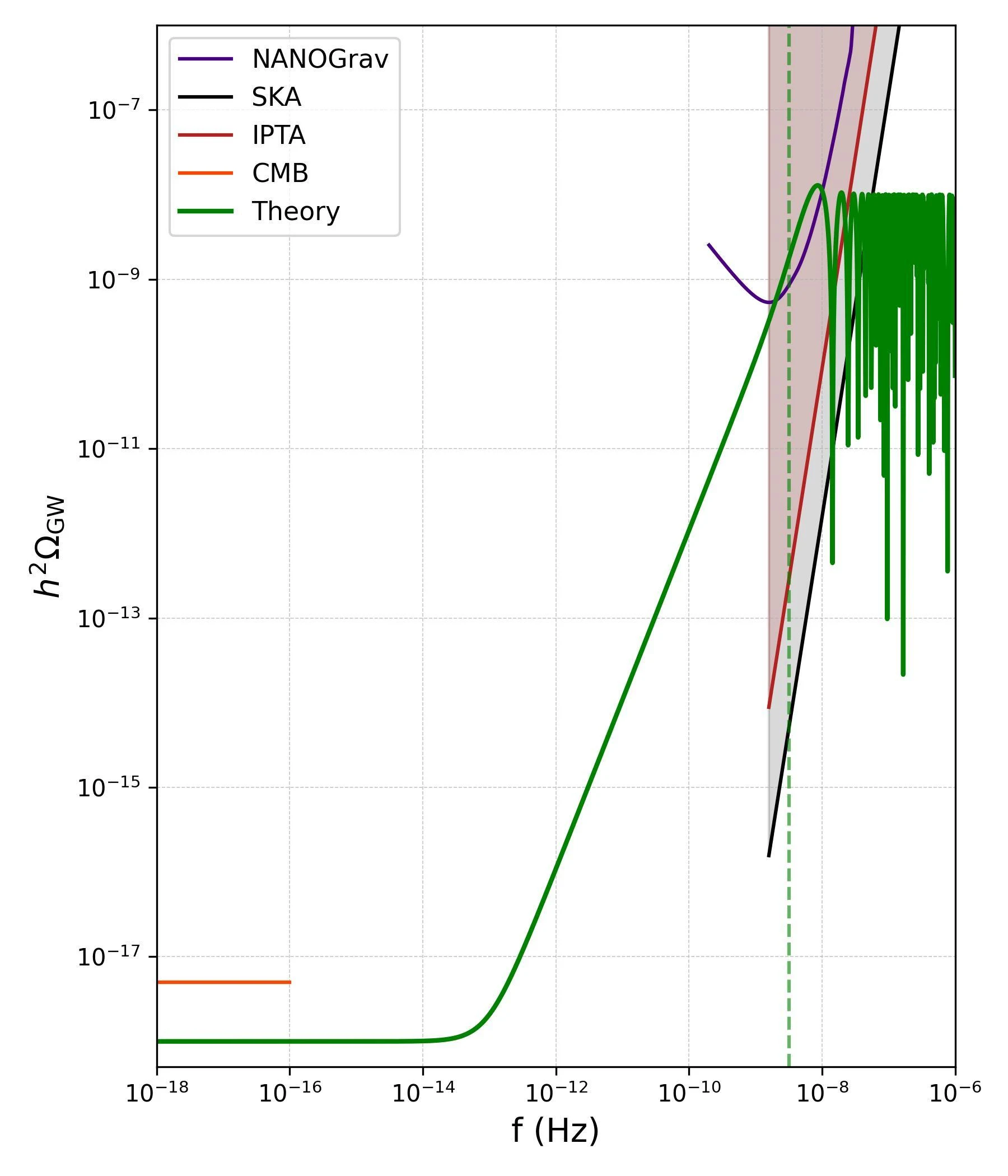
Under normal conditions, gravitational waves are "twisted" equally left and right, like screws with different threads. But the authors of the work suggested that for a short time, symmetry was broken. The universe became slightly "lopsided," favoring one direction of twist. This effect, called parity violation, acted as an amplifier: tiny quantum fluctuations, always present in the vacuum, were inflated to observable sizes. The resulting waves should have a distinctive pattern: their energy rises sharply with frequency, and they are almost entirely twisted one way, like a tightly wound clock spring.
Today, this ancient hum is being sought with pulsar timing arrays — rapidly spinning stellar remnants. Their signals arrive with the precision of atomic clocks. A passing gravitational wave slightly shifts the rhythm of these pulses, and from those shifts one can reconstruct the pattern of ripples. Recent hints of such a signal have already appeared in the data, but its nature is not yet clear. It could be noise from many distant black holes, or an echo of the Big Bang itself. The proposed scenario gives a clear benchmark: if a strong circular polarization, a preferred twist in one direction, is found in the signal, that would be strong evidence for its cosmic, rather than astrophysical, origin. Then we would for the first time hear the pure note played by the orchestra in the first moments of creation.
Original abstract
as written by the authors arXiv:2604.26513
We investigate the consequences of a transient phase of enhanced parity violation during inflation. Modeling this phase through a time-localized Chern--Simons-like coupling, we show that it amplifies primordial gravitational waves at small scales, producing a robust spectral shape with a blue growth of effective slope $$n_T \simeq 2$$, largely insensitive to microscopic details. This prediction lies in the range explored by recent pulsar timing array (PTA) analyses under cosmological power-law interpretations, while differing from the canonical supermassive black hole binary expectation. Our framework thus provides a predictive cosmological template to benchmark astrophysical versus primordial origins of the signal, consistent with cosmic microwave background bounds. The signal also exhibits large linear polarization and non-trivial Stokes correlations, corresponding to an almost maximally phase-coherent helicity state. Such features are difficult to realize in classical stochastic backgrounds, and their detection would provide circumstantial evidence for a primordial, coherently generated origin of the gravitational-wave background.
If gravitational waves from inflation were sound, their frequency would be billions of times lower than the lowest note the human ear can detect. To "hear" such a signal, you'd need a detector the size of a galaxy, and that's exactly the role pulsar timing arrays play.
In Carl Sagan's novel "Contact," the protagonist deciphers a message from an extraterrestrial civilization hidden in the polarization of a radio signal. Here, the universe itself leaves its autograph in the polarization of gravitational waves.