Primordial gravitational waves are ripples in spacetime that were generated in the very early universe, likely during a period of rapid expansion known as inflation, or during a bounce phase in non-singular cosmologies. Unlike gravitational waves from astrophysical sources like merging black holes, which are high-frequency and short-lived, primordial waves are expected to have very long wavelengths and form a stochastic background that fills the entire universe. Detecting them would provide a direct window into the physics of the universe's first moments, potentially revealing the energy scale of inflation and the nature of quantum gravity.
History
The concept of primordial gravitational waves was developed in the 1980s alongside inflationary theory, with key contributions from Alexei Starobinsky and others. The first direct detection of a stochastic background of gravitational waves was announced in 2023 by the NANOGrav collaboration, which attributed it to a background of supermassive black hole binaries, though primordial waves remain a target for future searches.
How it works
During inflation, quantum fluctuations in the gravitational field are stretched to cosmic scales, creating a background of gravitational waves. These waves leave an imprint on the polarization of the cosmic microwave background (CMB) — specifically, a pattern called B-modes. Alternatively, primordial waves can be detected through pulsar timing arrays, which measure tiny variations in the arrival times of radio pulses from millisecond pulsars caused by passing gravitational waves. The timing residuals from a network of pulsars can reveal a common signal characteristic of a stochastic background.
In practice
Detecting primordial gravitational waves would allow scientists to probe physics at energies far beyond those achievable in particle accelerators, potentially confirming or ruling out specific models of inflation and quantum gravity.
Fun fact
The gravitational wave background from the early universe is so faint that it would take decades of pulsar timing data to distinguish it from noise, but it carries information from when the universe was less than a second old.
In the first fractions of a second after the Big Bang, the universe was a stage of rapid change. A stretched rubber sheet that cools quickly becomes covered with microscopic cracks. A similar process on a cosmic scale could have given rise to cosmic strings — ultra-thin but super-dense threads of energy stretching across the entire universe.
These strings are not just defects in space.
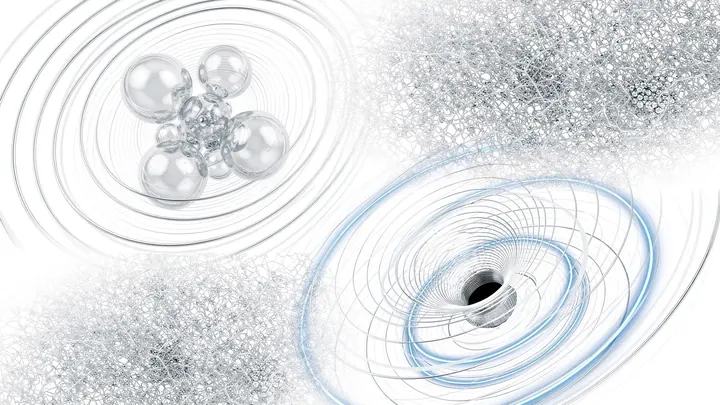
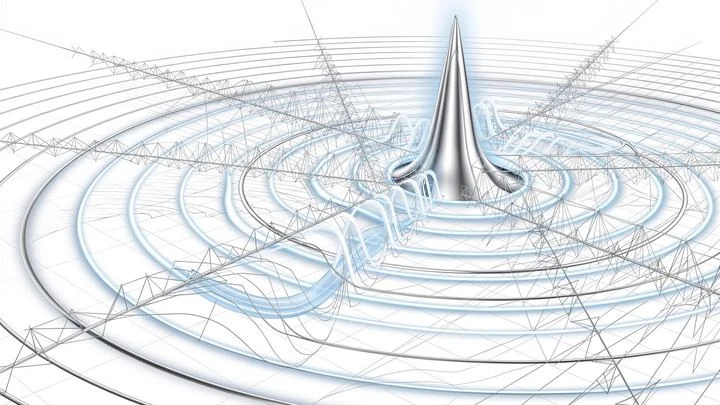
A stone falls into still water, and smooth rings spread across the surface. If the stone doesn't just fall but also spins, tiny whirlpools, vortices, appear on the surface. Light can do the same, only instead of water, it's space and time themselves.
In the first moments after the Big Bang, cosmic symmetry breaking divided the hot plasma into regions with different vacuums — the lowest energy states of a field.
13.8 billion years ago, the universe swirled in a waltz. The right turn was forbidden. Today, the echoes of that cosmic ball reach us as a barely perceptible ripple in spacetime — gravitational waves. Their existence was predicted by Albert Einstein.
Picture the early Universe as an unimaginably large bell. Inflation — the era of rapid expansion, dreamed up by Alan Guth, strikes it, sending a wave rippling across the fabric of spacetime.
A low rumble coming from underground could be the noise of a distant construction site, or it could be the echo of an ancient earthquake. Astronomers faced a similar puzzle in 2023 when they detected ultra-low-frequency gravitational waves — the trembling of spacetime itself, rippling across the universe.
In 1981, Alan Guth proposed a scenario of cosmological inflation — a lightning-fast expansion of space that stretched quantum fluctuations to the scale of entire galaxies. Since then, cosmologists, like archaeologists, have been excavating this event from the structures of the Universe.
Like an exquisite clockwork mechanism, a multi-planet system responds sensitively to the slightest nudge. And when the star at the heart of this mechanism dies, shedding its envelope and turning into a white dwarf, even a modest kick at a speed of 0.75 km/s can trigger a cascade of events, flinging entire worlds into interstellar emptiness.
The early universe resembled an overcrowded hall where heavy particles collided and decayed at a deafening pace. Among them could have been scalar leptoquarks — particles that simultaneously latch onto a quark (a building block of matter) and a lepton (such as an electron).
In the search for the nature of dark matter, one of the most intriguing hypotheses traces back to the first moments after the Big Bang. Back then, quantum fluctuations of the inflation field gave rise to clumps of matter that could collapse into primordial black holes.
It all began not with emptiness, but with a boiling ocean of plasma. In that primordial broth, sound waves raced through the fiery matter, colliding and compressing it. Sometimes a clump grew so dense that light could no longer escape, and right out of the scorching gas, a primordial black hole was born.
A hum resonates across the universe. It is not sound, but a trembling of space itself — the gravitational wave background. It is produced by pairs of supermassive black holes circling each other at the centers of distant galaxies. Each pair is like a bass instrument in a vast orchestra.
In the kitchen cupboard sits a jar of sugar. If you shake it, the grains will spread almost evenly — no need to place each one with tweezers. In much the same way, tiny black holes could have appeared in the first moments after the Big Bang. Their mass is like that of an asteroid, their size smaller than an atom.
Astronomers listen to the cosmos like an old radio: they twist the knob not to find a particular station, but to catch any unusual noise. This approach breaks the mold: instead of hunting for gravitational waves using memorized patterns, they catch everything — without bias.
The universe is filled with invisible dark matter. Just as a drop of water, as it evaporates, leaves behind a tiny salt crystal, so too can a black hole evaporate, leaving behind a minuscule stable remnant.
In the early Universe, primordial black holes emerged — objects no larger than an atom but with the mass of a mountain. They gradually evaporate and, before disappearing, should produce gravitational waves — ripples in spacetime. If they were all identical, they would pop simultaneously, like popcorn kernels: the roar would be deafening.
A spotlight shines through a dark hall. Between the lamp and the wall, an invisible lens drifts by, and the spot of light briefly brightens and shifts. That is exactly what the DECam telescope, aimed at the Large Magellanic Cloud, a satellite galaxy of our Milky Way, was watching for five consecutive nights.
A sponge thrown into a bucket of water eagerly soaks up moisture and swells before your eyes. But if you keep adding water and squeeze and release the sponge, absorption becomes harder and takes longer. That's roughly how tiny black holes behaved at the very beginning of the universe.
Two ocean liners sail at night without lights. One was built in a shipyard from steel plates, the other seems to have grown by itself from foam and waves. By ear they are almost indistinguishable, but an experienced hydroacoustician will catch the difference in the hum of the propellers and the contours of the hull.
A tiny black hole the size of an atomic nucleus but with the mass of a mountain emerged in the first moments after the Big Bang, when random clumps of energy collapsed into such objects.
The mystery of dark matter, first glimpsed in the stellar whirlpools by Vera Rubin, has been tormenting physics for nearly a century. One of the boldest hypotheses: primordial black holes, born in the scalding broth of the early universe.
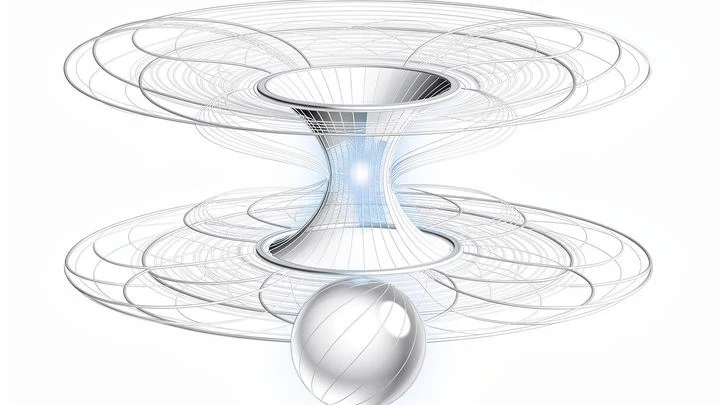
First thing that comes to mind when thinking about the birth of the Universe is an explosion. But modern cosmology paints a more refined picture: birth through the neck of a wine glass. This geometry is not a sommelier's fantasy, but a rigorous form of Euclidean wormhole that connects two anti-de Sitter worlds.
Right after the Big Bang, the Universe expanded incredibly fast — this phase was called inflation. In some microscopic regions, matter randomly clumped so much that it collapsed into primordial black holes. They are tiny — the size of a proton, yet as massive as an iceberg.
Right after the Big Bang, space rippled with gravitational waves, like those from a thrown stone. These tremors in the very fabric of the cosmos, predicted by Alan Guth, stretched across the entire universe. The ripples slightly compressed primordial matter in some places and thinned it out in others.
Gravitational wave detectors pick up a low-frequency hum, like the sound of a distant waterfall. The Webb telescope finds galaxies in the early universe with black holes that seem too massive for such a young age.
The Universe performs a symphony in two contrasting tempos. The first explosive accelerando (inflation, conceived by Alan Guth) sent spacetime soaring in the first trillionth of a second. The second acceleration, slow but relentless, began five billion years ago.
A huge orchestra is tuning up before a concert. Each instrument makes its own noise, and in the general hubbub it's hard to pick out individual sounds. But if the conductor gives a special flick of the baton for a second, all the violins will simultaneously hit one high note, and that pure tone will cut through the cacophony.
Usually, the story of the universe goes like this: there was nothing, then a bang, and ever since everything has been flying apart. But what if there was no 'nothing'? A group of physicists has shown that the universe could have existed forever: it just sometimes contracts and then expands again, like a spring.
Imagine a vast lake at night, perfectly still. You can't see waves, but you hear them lapping evenly on the shore from all sides. That's what astronomers call the gravitational-wave background — a constant hum from distant black hole mergers. But what if the splashing were slightly louder on one side?
A tiny black hole the size of an atomic nucleus floats in the hot soup of the early universe. Normally, such a little one should quickly evaporate, releasing energy like a drop of water on a hot skillet. But if space is more complex than it seems and contains hidden dimensions, everything changes.
The universe wasn't born in silence. Primordial gravitational waves — ripples in spacetime — still carry the echo of that event. Scientists try to hear it in two ways. Low 'notes' are captured in the Big Bang's afterglow — light emitted 380,000 years later.
The standard cosmological model describes the birth of the universe as an explosion from a singularity — a point of infinite density and spacetime curvature.
The Big Bang was like a cosmic thunderclap that set the fabric of space vibrating. These vibrations — gravitational waves — still echo through the Universe like a fading rumble from that ancient event. The louder the initial 'bang,' the more primordial black holes should have formed.
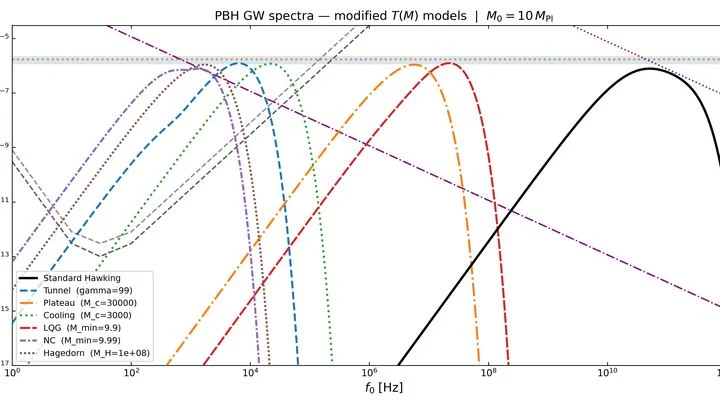
Primordial black holes behave like boiling kettles: as they evaporate, they whistle gravitational waves. The character of the whistle, its spectrum, depends on how the hole's temperature relates to its mass.
In its first moments, the universe resembled dough that alternately rises rapidly and then pauses for a second. During these short bursts, called expansion of the universe with interruptions, even tiny magnetic fields could have grown like bubbles in well-beaten dough.
The universe began with the Big Bang and subsequent inflation — a rapid expansion. Alan Guth suggested that in some regions this growth never stopped. They remained ‘underbaked’ pockets of eternal expansion forever.
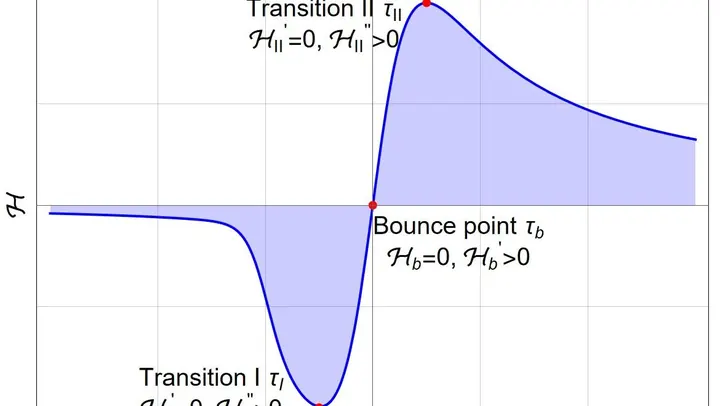
The universe can behave like a spring: compressing to microscopic sizes and then expanding again. In this cycle of contraction and bounce, black holes and dark matter are born.
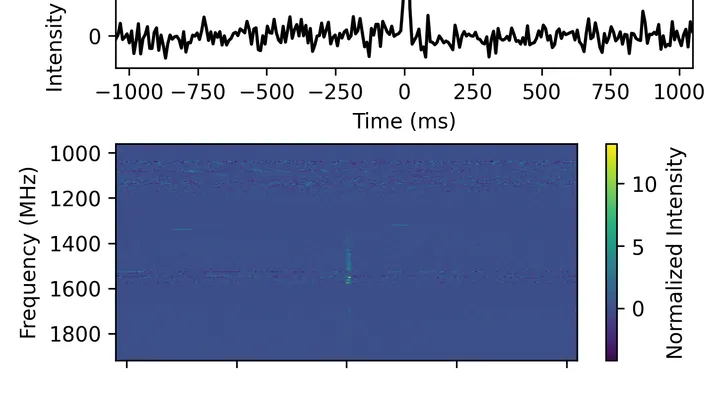
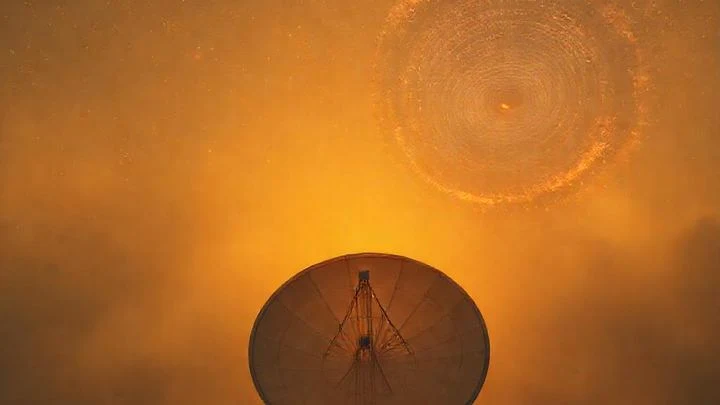
At night, while most people sleep, the giant dish of the Green Bank radio telescope in West Virginia keeps listening to the sky. Over 24,186 hours, that's nearly three years of continuous observation, it caught 50 pulsars and three fast radio bursts.
Dark matter may not be particles but black holes from the Big Bang era. In the early Universe, which was like a swirling batter, they were like heavy lumps — barely moving, they gathered surrounding matter and spun it into the swift galaxy flows astronomers observe today.
Road noise is a great informant. Rare cars sound as individual signals; dense traffic merges into a steady hum. Just the same, mergers of black holes produce either single bursts or a continuous background of gravitational waves.