Parity is a quantum number that describes how a particle's wavefunction behaves under spatial inversion, which means flipping all spatial coordinates (x, y, z) to (-x, -y, -z). If the wavefunction remains the same, the parity is even (+1); if it changes sign, the parity is odd (-1). Parity is a fundamental property in quantum mechanics, used to classify particles and their interactions.
History
The concept of parity was introduced in quantum mechanics in the 1920s by Eugene Wigner, who used it to classify atomic spectra. In 1956, Tsung-Dao Lee and Chen-Ning Yang proposed that parity is not conserved in weak interactions, which was experimentally confirmed by Chien-Shiung Wu in 1957.
How it works
In quantum mechanics, the parity operator P acts on a wavefunction ψ(r) to give ψ(-r). If Pψ = ψ, parity is +1; if Pψ = -ψ, parity is -1. For a system of particles, the total parity is the product of the parities of each particle and the orbital parity, which depends on the angular momentumquantum number l: (-1)^l. Conservation of parity in strong and electromagnetic interactions means that the parity of a system before and after a reaction must be the same, which is a powerful selection rule.
In practice
Parity is used in particle physics to classify mesons and baryons, and in nuclear physics to understand nuclear energy levels and transitions. It also plays a role in quantum computing, where parity checks are used for error correction.
Fun fact
The violation of parity in weak interactions means that the universe has a 'handedness' — certain nuclear decays produce electrons with a preferred spin direction, which is why the Wu experiment is sometimes called the 'mirror experiment'.
An ordinary mirror swaps left and right. Many laws of physics don't notice the swap: they are mirror-symmetric. But some phenomena, like the weak interaction, break this symmetry. Until now, it was thought that gravity and light each break mirror symmetry in their own independent way.
Alice prepares a quantum particle in one of several states and sends it to Bob. The channel the particle travels through isn't perfect: it's noisy, scatters, interacts with the environment. Bob receives the signal and tries to figure out what Alice actually sent. This is the classic "prepare-send-measure" scheme, and there's always a risk of losing something along the way.
The early Universe was not just a hot soup of particles. In the first fractions of a second, mirror symmetry could have been broken: the world and its reflection would not be quite identical. If so, the large-scale cosmic web of galaxies would retain a barely noticeable 'curl'—as if all matter were slightly twisted in one direction.
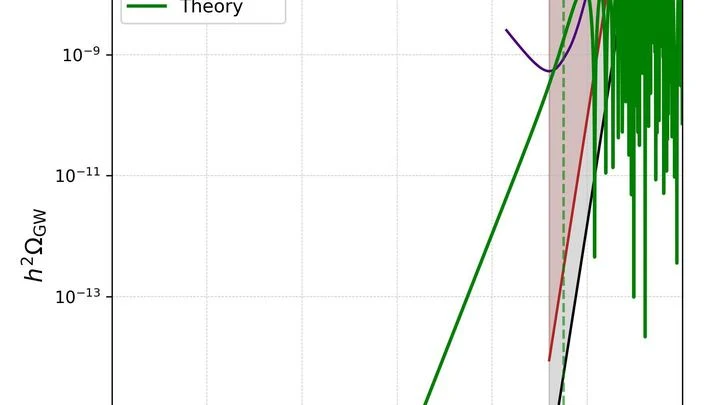
13.8 billion years ago, the universe swirled in a waltz. The right turn was forbidden. Today, the echoes of that cosmic ball reach us as a barely perceptible ripple in spacetime — gravitational waves. Their existence was predicted by Albert Einstein.
Quantum matter rarely treats us to the spectacle of self-motion. Where the classical world teems with starling murmurations, fish schools, and bustling bacteria, quantum thermodynamics long remained serene.
A translator gets distracted by every rustle in the hall, and a one-hour meeting stretches into two. That's roughly how ordinary quantum mechanics works: a particle evolves in time, while space serves as the stage. But what if we swapped their roles? Then the particle 'moves' through space, and time becomes a static backdrop.
A huge orchestra is tuning up before a concert. Each instrument makes its own noise, and in the general hubbub it's hard to pick out individual sounds. But if the conductor gives a special flick of the baton for a second, all the violins will simultaneously hit one high note, and that pure tone will cut through the cacophony.
Vacuum is not silent emptiness, but a boiling cauldron of quantum fluctuations, born from nothing and vanishing in billionths of a second. This invisible symphony acts like a constant wind, pressing an atom against a wall — as if a powerful bass note pushes a light ball.
Galileo, legend has it, dropped balls from the Tower of Pisa to prove that heavy and light objects fall equally. This law formed the foundation of Einstein's theory of gravity. Today, scientists have turned an entire space station into such a tower.
In the quantum world, there are rules that seem to be broken. One of them is the conservation law: if in classical physics symmetry guarantees the conservation of charge, then in the quantum description this guarantee can disappear. This phenomenon is called a quantum anomaly.
A snowflake falling from a cloud chooses between a left-handed and a right-handed form. The difference between them is almost imperceptible, like a breath of wind, yet it is that very breath that decides which pattern will grow.
Light strikes a metal plate, and electrons fly out. This is the photoelectric effect, and it works only if the light has enough energy to cross the threshold that holds electrons inside.