Taming Nanoparticle Heat express
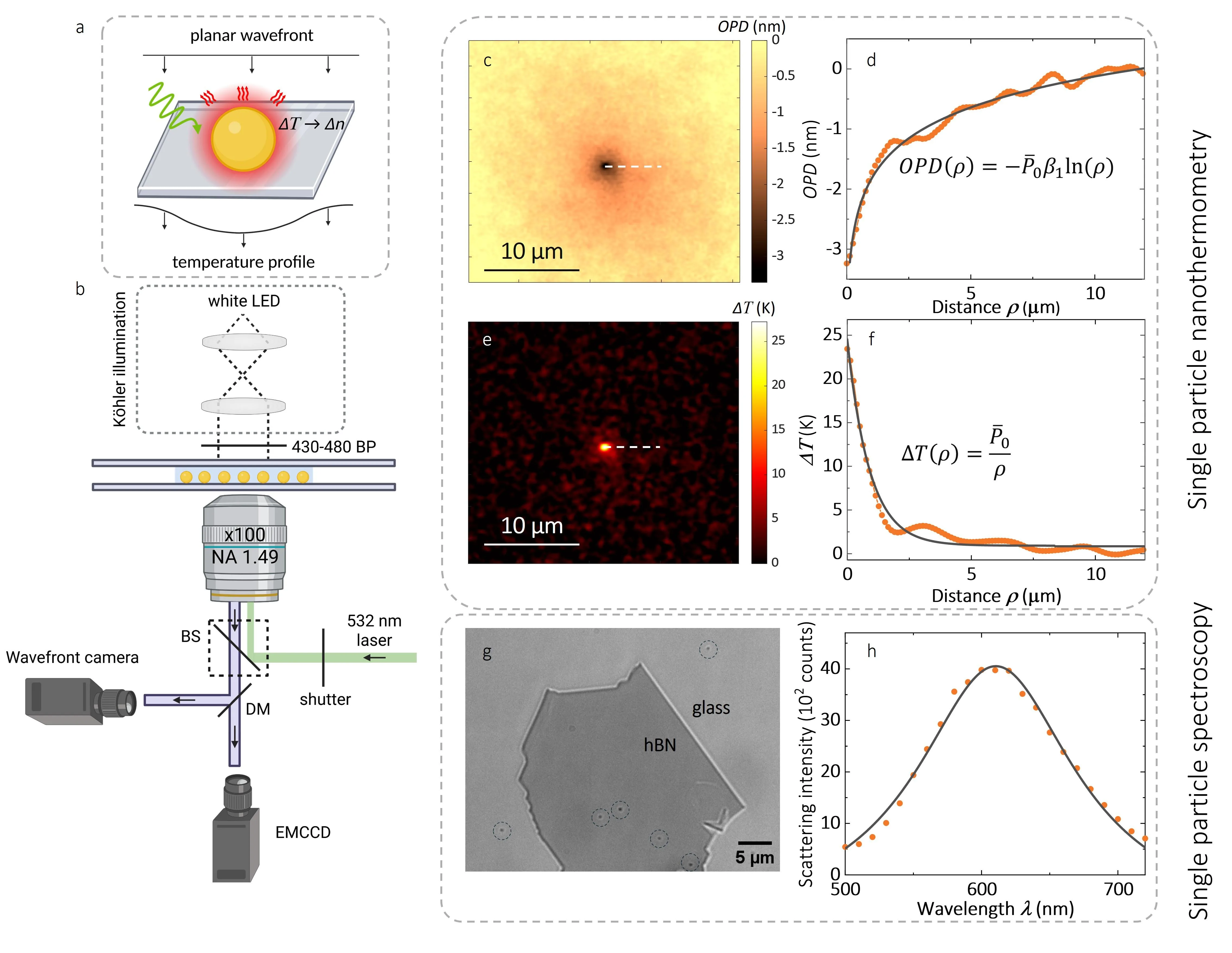
A gold speck the size of a hundred atoms catches a beam of light, and heats up. In everyday life, that's no big deal, but in the world of nanotechnology, this tiny heat can ruin a biosensor or fry a microchip. You can't just put a fan on it: at these scales, heat gets trapped like in a thick winter coat.
Saving the day is a thin, nearly invisible film of hexagonal boron nitride — a material similar to graphite, but transparent and heat-resistant. In experiments, gold nanospheres were placed on flakes of this substance, then heated with light and monitored with wave microscopy — a technique that catches the slightest changes in light refraction. It turned out that boron nitride works like a thermal sponge: it soaks up heat from the particle and spreads it across its surface, preventing a hot spot.
Interestingly, heat escapes by two routes: directly from the particle into the flake, and via a roundabout path — through the surrounding water. Together, these channels reduce heating by up to 60 percent compared to ordinary glass. This approach doesn't require complex equipment and is suitable for quickly testing new two-dimensional materials.
Hexagonal boron nitride is sometimes called 'white graphene' for its similar layered structure, but unlike graphene, it doesn't conduct electricity, yet it conducts heat very well.