Light Working in a Team Measures Distances More Accurately express
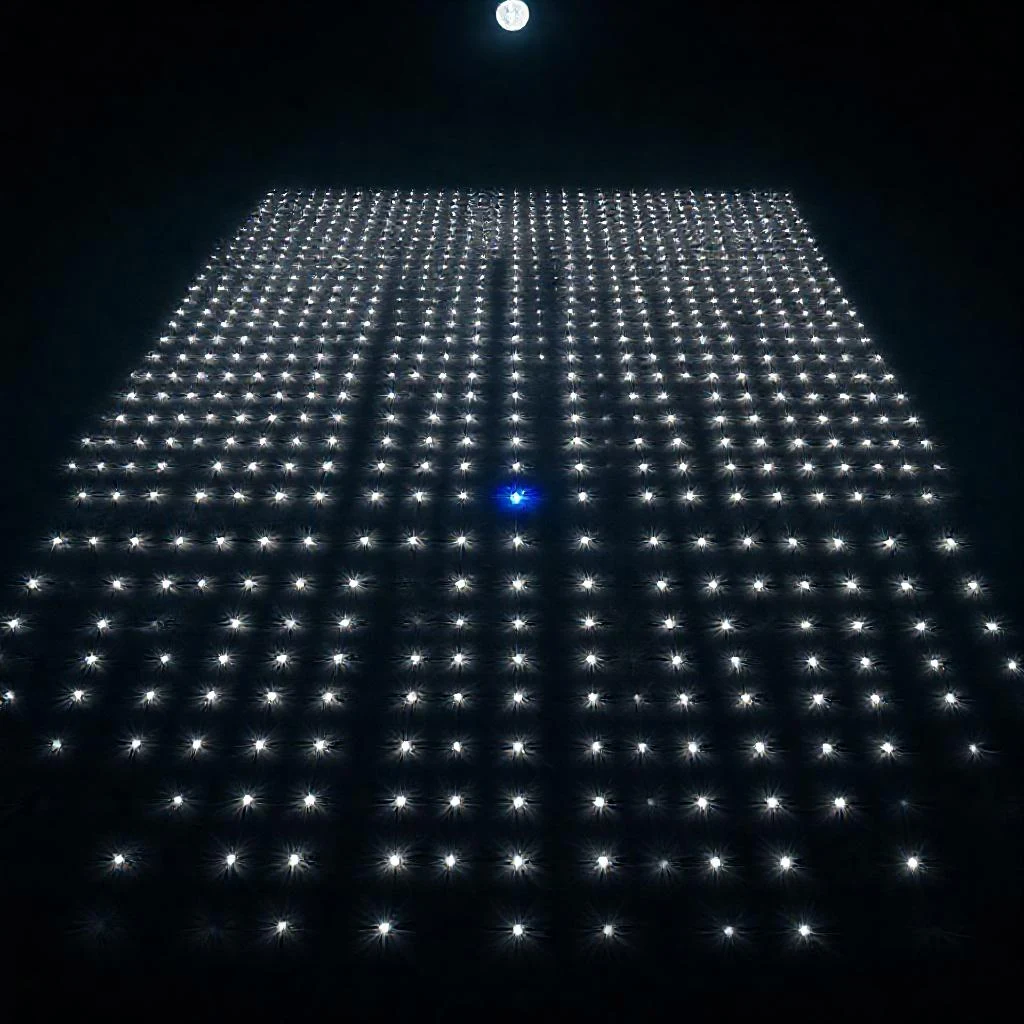
A regular rangefinder sends a single light pulse and waits for it to return — like a person shouting into the void and listening for an echo. But if you use multiple sources that glow in unison, and analyze not the volume but the rhythm of the echo of reflected flashes, the picture becomes sharper. The effect of synchronous glow — superradiance — is known from the work of [scientist:Roy Glauber]. Now it has been applied in [tag:photometry]: not just brightness, but the coherence of the flashes is measured.
With two such "fireflies" the error drops fourfold, and as the number of sources increases, the accuracy grows faster than a simple proportion. In practice, this means that future laser tape measures for drones and surveying will "feel" space with an error of fractions of a millimeter. Light working in a team notices what a lone one would have missed.
Original abstract
as written by the authors arXiv:2605.28378
In recent years, light detection and ranging (LIDAR) has seen a steep rise in the sensitivity of measuring the distances of remote objects. Here, we propose to enhance the sensitivity of LIDAR even further by exploiting Dicke's concept of superradiance, i.e., the collective light emission of statistically independent light sources. By using $$N$$ thermal light sources (TLS) and measuring intensity correlations of order $$m \geq 2$$ instead of $$m=1$$, i.e., the intensity, we show that the Cram\'er-Rao bound on the measurement of the distance of a remote object undercuts that of traditional LIDAR by a factor of $$N$$, and can be reduced further with increasing correlation order $$m$$. Our numerical calculations are supported by analytical expressions for the special cases of two and three TLS and a general approximate expression for any number of TLS.
Synchronized flashes of fireflies are visible from afar — similarly, superradiance collects light into a powerful precise signal.
Droids from Star Wars with such rangefinders would gain an intuitive sense of distance.