Radar is an active radio-location system that emits electromagnetic waves and analyzes their reflections from targets. Modern radars use complex pulse sequences (chirps) with linear frequency modulation, allowing high range resolution (down to centimeters) at moderate peak power. The receiver measures the time of flight τ, amplitude, phase, and frequency of the returned signal, calculating range, size, speed, and even shape of the object. Doppler shift gives radial velocity, and beam steering (scanning) gives angular coordinates. Pulsed radars alternate transmission and reception; Doppler radars transmit continuously and filter the reflected signal from stationary clutter.
History
The idea of radar was proposed by Tesla as early as 1900, but practical implementation began in the 1930s simultaneously in several countries. Robert Watson-Watt in 1935 demonstrated aircraft detection at a distance of 27 km. The key invention was the cavity magnetron (1940, Boot and Randall), which enabled compact, powerful microwave radars. After the war, civilian applications—air navigation, meteorology, astronomy (radio telescopes)—came to the fore. The 1970s saw the introduction of digital signal processing, and the 21st century brought multiple-input multiple-output (MIMO) radars.
How it works
Radar emits a coherentbeam of electromagnetic waves (usually in the microwave band) and receives the reflected signal. The time delay Δt determines range: R = cΔt/2. Doppler frequency shift f_d = 2v/λ gives radial velocity v. Phased arrays steer the beam by changing the phase of the signal at each element, without moving the antenna. Pulse compression improves range resolution: a long chirp with frequency modulation is transmitted, and upon reception it is convolved with a matched filter to obtain a short response. In SAR, a moving platform (satellite, aircraft) uses its displacement to form an artificially synthesized aperture, whose length is proportional to the distance traveled, yielding resolution far better than a stationary antenna of real size.
In practice
Radar measures the speed of your car, helps airplanes land in fog, and predicts thunderstorms by detecting raindrops hundreds of kilometers away.
Fun fact
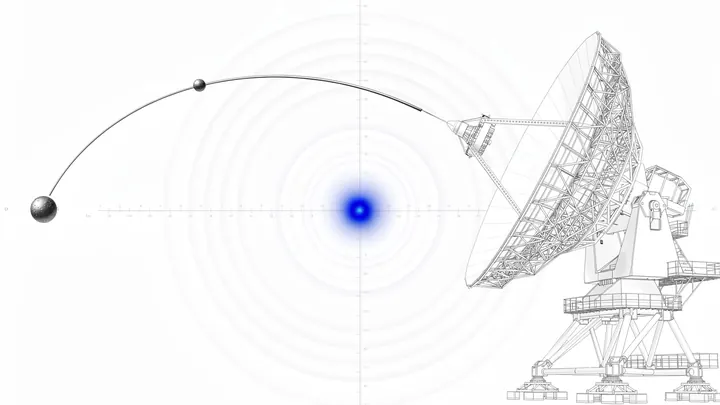
The radar installation at the Arecibo Observatory could measure the distance to the Moon with an accuracy of a few centimeters—that's like the thickness of a finger at a distance of 384,000 kilometers.
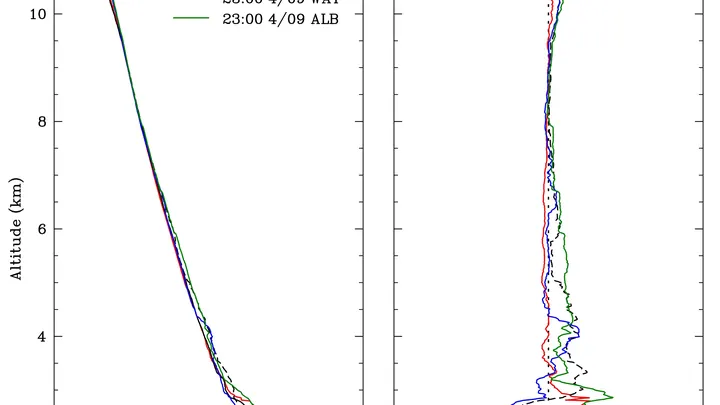
Every second, thousands of passenger aircraft in the sky transmit radio signals: that's how air traffic controllers track where each flight is. These signals don't travel in a straight line: air of varying humidity bends them like a lens. If you can measure that bending, you can work out where the air is drier and where it's more humid.
Every second, thousands of passenger aircraft in the sky transmit radio signals: that's how air traffic controllers track where each flight is. These signals don't travel in a straight line: air of varying humidity bends them like a lens. If you can measure that bending, you can work out where the air is drier and where it's more humid.
From 1987 to 1991, astronomers last measured how Jupiter's icy moons reflect radio waves. Then came a long pause. In 2011–2024, researchers aimed a radar beam at Europa again: this time using the 70-meter antenna at Goldstone and the Green Bank Telescope.
Ice is nearly transparent to radio waves, like clear window glass is to light.
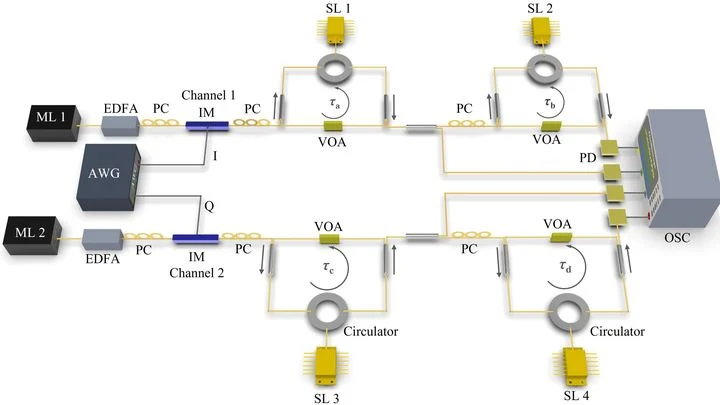
Data zips through optical fibers at the speed of light, but the path isn't perfect: the signal gets muddled, like a voice echoing down a long hallway. The faster the speed and the longer the distance, the worse the distortion. Usually, electronics fix this, but they can't keep up with light.
A lighthouse that blinks not every second but once every few minutes or even hours. That is exactly how long-period radio transients behave — cosmic sources discovered only recently.
In a room, air touches the skin, and we feel its temperature. But if your body suddenly accelerated at a colossal rate, heat would come even from absolute emptiness. This is not fiction but a strict consequence of quantum field theory: for an accelerating observer, the vacuum becomes a warm bath.
Low-frequency radio waves (from 30 to 300 kilohertz) carry information through water and earth. But catching them with an ordinary antenna is hard: the wavelength reaches several kilometers, and a small receiver barely feels such a field.
In combat, a pilot needs to instantly understand what an object is and what its intentions are. Conventional systems wait for complete radar data — like a goalkeeper who only reacts after the shot. The new algorithm works like an experienced goalkeeper: from the attacker's first moves, it predicts the target's maneuver.
Radar, like a bat in a cave, sends out a pulse and listens for the echo. But a microscopic imbalance in the receiver is unavoidable: it scrambles frequencies and creates a phantom twin for each target, like a second, slightly distorted echo.
Usually, these phantoms just get in the way and are cleaned up beforehand. In this new work, ghost echoes become an ally.
Radars listen to the echo of radio waves, like a microphone recording music. To make equipment cheaper, the 'recording' is done less frequently than theory demands: this is spectrally efficient (compressed) sensing. The cost of this economy is the emergence of false 'ghosts': the system sees targets that aren't there, just like off-key notes on old tape.
A mirror can direct a reflected beam onto one spot, even as it rotates. Engineers borrowed this trick for radio waves, building a smart mirror on a drone. It cancels out shakes and vibrations on the fly: it anticipates the drone's movements and instantly re-aims to keep the signal crisp.
Communicating with a satellite is like trying to hear a whisper in a storm: the signal drowns in noise. Engineers have created an AI algorithm that runs directly on the satellite and, with minimal power consumption, detects distortions more accurately than previous methods.
When a radio wave encounters a building in its path, it doesn't just reflect or get absorbed: it bends around it, much like ocean waves flowing around a rock, leaving calm water behind. In radiophysics, this phenomenon creates a radio shadow — a complex pattern of zones where the signal is amplified or attenuated, which scientists call a radio portrait.
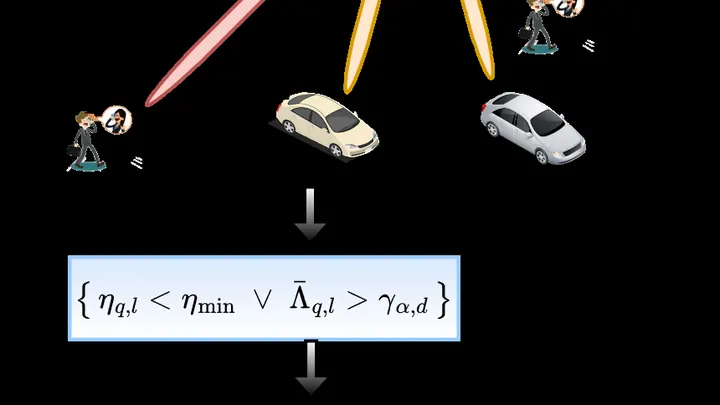
A regular radar is like a microphone in a buzzing crowd: individual sounds blend into mush. PiVoT works like a conductor who instantly recognizes each instrument in the tuning chaos. Instead of shuffling through hypotheses, the algorithm tightens a loop around the most likely targets — cars, cyclists, pedestrians.
Next-generation radars handle both communication and object tracking. Their constant vigilance quickly drains batteries. Engineers took a cue from astronomy: hunting for exoplanets via the transit method only needs a telescope when a planet crosses its star's disk.
At the heart of the system is a rail with clip-on antennas moving along it, each emitting a radio signal. The smartphone receives these and, knowing the speed of light, calculates the distance to each antenna from the time delay.
Urban concrete jungles turn drones into blinded bats. Cameras go blind around every corner, GPS gets lost among skyscrapers, and radio waves scatter into a hundred echoes.
A regular radar works like an amateur photographer: it takes a series of blurry snapshots and tries to stitch them into a panorama. Details are smeared, and in a long corridor or crowd, the robot easily gets lost.
The principle is simple: like a bat, the radar emits a wave and catches the echo.
A city signal bounces between walls like a ball, and your phone catches dozens of its 'reflections'—echoes. Each microsecond of delay adds 300 meters to the path.
The signal's speed is constant, like that of light (speed of light).
Passive sensors communicate by reflecting radio waves, like an echo. The energy savings are clear, but many reflections turn into a jumbled mess. It's like a choir where each singer repeats their own part without a conductor.
A new approach assigns each sensor a specific rhythm — a digital code.
Radio waves from a smartphone, traveling at the speed of light, easily reflect off walls and corners, losing strength. Smart surfaces are programmable mirrors: they catch the scattered signal and redirect it precisely to its target, like a deft magician making a beam bypass obstacles.
Fast radio bursts — millisecond radio pulses arriving from distant galaxies — long remained a puzzle. Their colossal energy, compressed into instants, pointed to cataclysms on neutron stars, perhaps pulsars or magnetars.
In quantum field theory, there is a long-standing mystery: infrared divergences. Usually they are seen as an annoying technical nuisance that must be carefully 'papered over' in calculations. But what if this is not a bug, but a feature?
3I/ATLAS burst into the Solar System like an uninvited guest, a gift of fate for hunters of extraterrestrial intelligence. This comet-like wanderer from the depths of the Galaxy flew close enough to be heard in all its details — unlike distant exoplanets.
3I/ATLAS burst into the Solar System like an uninvited guest, a gift of fate for hunters of extraterrestrial intelligence. This comet-like wanderer from the depths of the Galaxy flew close enough to be heard in all its details — unlike distant exoplanets.
The open ocean is a vast basin where almost no one measures the wind directly. Fixed platforms are rare and expensive, and satellite scatterometers, instruments that probe the surface with radar, need ground truth for calibration. Coastal zones have such data, but far from shore, there's a void.
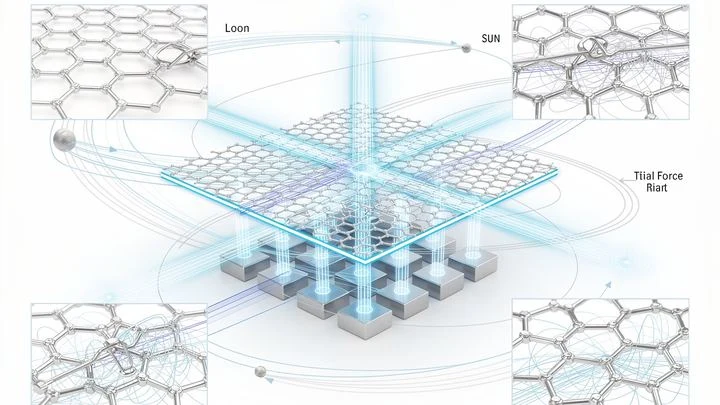
In the quiet of a laboratory, a graphite flake hovers above a magnetic grid. This is not just a demo of diamagnetism's magic — it's listening to the Universe. Like a spider casting its web to catch vibrations from an invisible world, this flake has become a gravitational web.
A regular rangefinder sends a single light pulse and waits for it to return — like a person shouting into the void and listening for an echo. But if you use multiple sources that glow in unison, and analyze not the volume but the rhythm of the echo of reflected flashes, the picture becomes sharper.
A charged particle streaks through a silicon sensor, leaving behind a trail of free electrons. The time it takes for this charge to be collected at the electrode depends on how deep in the crystal it was born. A particle entering head-on carves identical paths through neighboring pixels: their signals arrive almost simultaneously.
When you need to see inside the brain, you usually lie in a tight tube of an MRI scanner or get zapped with X-rays. Both methods are costly, bulky, and not always available.
A pendulum swings with such precision that, had it been counting seconds since the Big Bang, it would have drifted by only half a second by today. That is the stability of the new portable ultraviolet laser — the heart of aluminum atomic clocks.
A conventional lidar is like an artist who paints a landscape but sees only gray shadows. It measures distances to each point accurately, but can't tell whether it's looking at rock, wood, or plastic. To learn the composition, you need a spectrometer — a separate device that works slowly and can't keep up with a fast scanner.
The new system takes a different approach.
The heart beats steadily, then slips into arrhythmia. The climate holds its familiar rhythm for decades, then shifts to a new state over a single summer. Such regime shifts are like a flick of a switch, but in real data we see only a noisy one-dimensional signal in which the moment of the break is hidden.
Beneath city streets lies a web of fiber optics — hundreds of kilometers of glass threads carrying the internet. But accurate maps of this web are often lost or outdated. Finding a cable underground is like feeling for a wire inside a wall without knowing where it runs.
This new method turns the cable itself into an ear.
Light in a particle detector behaves like a voice in the mountains. One shout, and the echo repeats several times, growing fainter with each reflection. So it is in a silicon detector: a real flash from a particle gives rise to false ones that confuse measurements.
An ordinary antenna picks up radio waves, but there are fields it barely feels. We're talking about slow electric fields: those that change once a second or less. For them, physicists built a sensor from a beam of rubidium atoms.
The compass needle trembles when a truck rumbles by. Similarly, in a tiny gyroscope, a device that senses rotation, any noise drowns out the useful signal. For a long time, engineers couldn't shrink a gyroscope down to fingernail size without sacrificing accuracy.
The solution came in a two-loop architecture.
A conventional radio receiver compares the incoming wave with a reference to extract information from it. Rubidium atoms can do this differently: they themselves act as both antenna and detector. But until now, they required an additional radio signal to set a reference point.
The new scheme does without it.
A laser strikes a tiny glass grating, and electrons passing through it are accelerated. You can't see inside, so you judge what's happening by the energy of the electrons after acceleration, like judging the shape of a stone by the splash it makes.
Scientists built a digital twin: a computer model that mimics the behavior of the real accelerator.