A standard candle is an astronomical object whose intrinsic luminosity is known with high confidence. By comparing this known brightness to the object's apparent brightness as seen from Earth, astronomers can calculate its distance using the inverse-square law of light. Standard candles are fundamental tools for measuring cosmic distances, from nearby stars to galaxies billions of light-years away.
History
The concept was formalized in the early 20th century, with Henrietta Swan Leavitt's discovery of the Cepheid period-luminosity relation in 1908–1912, and Edwin Hubble's subsequent use of Cepheids to prove galaxies lie far beyond the Milky Way.
How it works
The method relies on the fact that light dims with the square of distance. If an object's true luminosity (total energy emitted per second) is known, then measuring how much dimmer it appears gives the distance directly. The most famous standard candles are Cepheid variable stars, whose pulsation periods correlate tightly with their luminosity, and Type Ia supernovae, which explode with remarkably uniform peak brightness.
In practice
Standard candles are used to map the large-scale structure of the universe, measure the expansion rate (Hubble constant), and probe dark energy through distance measurements to distant supernovae.
Fun fact
Type Ia supernovae are so consistent that they can be used to measure distances to within a few percent, even across billions of light-years.
The cosmological standard model is like a recipe for a cake where everything is strictly measured: dark matter is like flour without a single lump (zero pressure), and dark energy is like the perfect leavening agent (equation of state exactly minus one). But what if the flour is a bit damp and the leavening agent has lost its oomph?
Measuring distances in the universe is no easy task. Almost all methods rely on light, which can be absorbed by dust, scattered, or distorted along the way. It's like trying to spot a distant lighthouse through fog and haze. Neutrinos are a different story. These ghostly particles pass through anything without noticing obstacles.
Predicted by Albert Einstein, gravitational waves are like beacons in the dark ocean of space. They flare up when black holes collide, sending ripples through the fabric of the Universe.
A false vacuum is not just a supercooled liquid, but a quantum hologram, ready to spring to life under the right projection. Its decay is described by the tunneling of a quantum field from a metastable minimum, and the classic calculation via Euclidean instantons is as elegant as a still life under spotlights.
Cosmology is like an orchestra where different sections suddenly start playing out of sync. Measurements of the universe's expansion rate (the Hubble constant) from the early and late universe give different numbers.
The cosmological orchestra doesn't tune to a single tuning fork. There are two groups of instruments: one listens to the hum of the young universe — the cosmic microwave background, while the other reads notes from mature galaxies and supernovae.
The Universe resembles a dense forest: up close, individual galaxy-trees are visible, gathered into groves, but from a distance everything merges into a solid green canopy. The boundary beyond which the cosmos becomes homogeneous is called the angular scale of homogeneity: it's the size of a patch of sky from which galaxies are distributed evenly.
A regular rangefinder sends a single light pulse and waits for it to return — like a person shouting into the void and listening for an echo. But if you use multiple sources that glow in unison, and analyze not the volume but the rhythm of the echo of reflected flashes, the picture becomes sharper.
Edwin Hubble and Georges Lemaître discovered the expansion of the Universe nearly a century ago. One way to test it is the surface brightness test: in an expanding cosmos, the light of a distant galaxy should fade like a pattern on a stretching film.
Astronomers occasionally spot interstellar objects — rocky chunks or comets from other star systems. Most look ordinary, but some puzzle us with their shape, speed, or shine. To stop guessing, scientists applied the Loeb scale: from 0 (plain rock) to 5 (technosignature — an artificial signal from space).
In galaxy clusters, invisible dark matter serves as the framework holding star systems together. Its shape is betrayed by a faint glow — stars ripped from galaxies by tidal forces. This stellar 'broth' fills the cluster like a liquid taking the shape of its container: it envelops the clumps of dark matter, creating a precise cast of their outlines.
In distant galaxies, old stars swell and redden. Among them are two groups that act like lighthouses: some have just ignited helium burning, while others are already burning carbon and oxygen.
A flashlight in thick fog is useless: the beam scatters, and the reflected light drowns in noise. But if you tie two photons with an invisible thread, one can pass through the fog and come back, while the other stays safe. This connection is called quantum entanglement — when two particles behave as a single whole, even when far apart.
Light from a streetlamp passing through blinds flickers: the stripes shift, and brightness rises and falls. From that rhythm, you can guess how wide the lamp is. The new method for measuring stars works similarly: instead of capturing a sharp image, astronomers monitor the "twinkling" of light collected by two or more telescopes simultaneously.
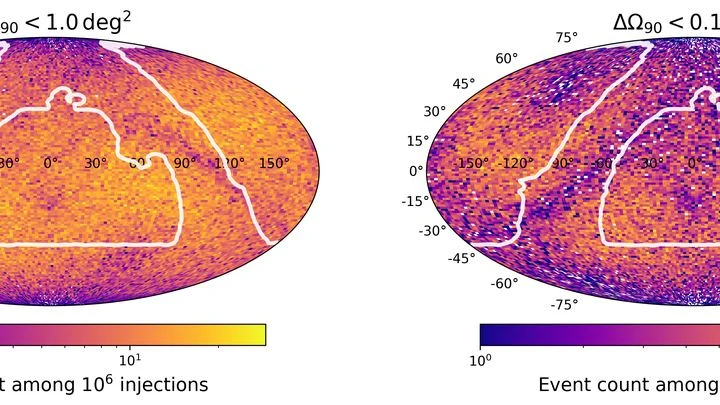
The merger of two neutron stars is like a strike on a gong: a ripple in space, a gravitational wave, spreads through the universe. Detectors on Earth catch this ripple and, from its strength, calculate the distance to the source.
Measuring the universe’s expansion is like timing a race when the track stretches. Neutron star mergers act as standard sirens: their gravitational waves ring out with a known “volume,” so fainter signals mean greater distance.
The universe is a pie baked from a single recipe, but the teaspoon and the kitchen scale stubbornly show different amounts of sugar. That’s how it is with the expansion of the universe: measurements from nearby stars (the spoon) give one number, while those from the ancient light of the Big Bang (the scale) give a completely different one.