The Iron Signature of Black Holes express
Imagine a multi-story building where each floor glows with a different shade of light. That's roughly how the region around the supermassive black hole in galaxy IZw1 is structured. Only here, the light doesn't come from light bulbs but from iron atoms — FeII. IZw1 has long been known to astronomers as a record-holder for the brightness of these lines, but until now, no one could explain why the optical glow (visible to the eye) and the infrared glow (thermal) seem to arise under different conditions. A new study finally brings everything into a unified picture.
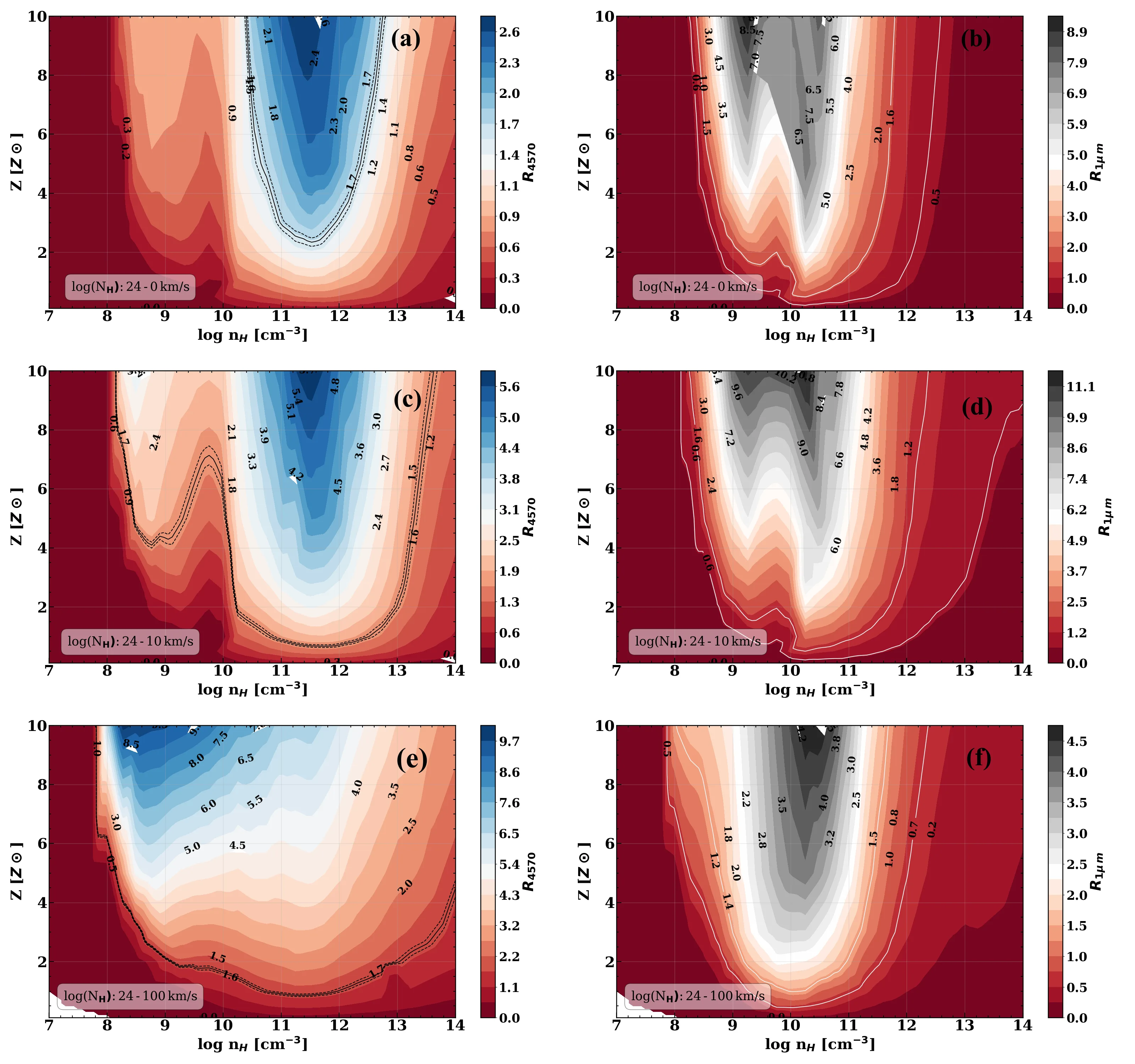
The authors took real spectra of IZw1—a sort of "rainbow" of the galaxy's light, and compared them with a computer model. The model tested dozens of scenarios: where the gas is denser, where it's hotter, and how many metals it contains (astronomers call all elements heavier than hydrogen and helium "metals"). It turned out that the optical and infrared FeII emission can be reproduced simultaneously if the gas has a density between $10^{11}$ and $10^{12}$ particles per cubic centimeter. That's billions of times thinner than air, but quite typical for the vicinity of a black hole. Think of a kitchen: a pot of soup with a few peppercorns floating in it: that's roughly how iron atoms are distributed in the cloud.
The most surprising result concerns the "illumination." In the ultraviolet, the galaxy's core emits a very bright line — Lyman-alpha. When its photons hit the clouds, they make FeII atoms glow, much like a streetlamp makes wet asphalt shine. This effect, fluorescence, turns out to be the main driver of the infrared emission. In the optical, however, collisions dominate: iron atoms, struck by free electrons, jump to excited states and release energy. So the same "building" is lit in two different ways: the lower floors by a spotlight, the upper floors by impacts.
This led to the idea of a vertical structure: the clouds around the black hole are not uniform: they have layers. Infrared iron and OI sit higher, in more diffuse regions. Optical iron and calcium sit lower, where it's denser. It's like a dumpling: the filling lies deeper, while the edges are thinner. Previously, astronomers debated whether calcium could be used as a proxy for optical iron (whose lines are hard to measure). Now it's clear: yes, it can. The calcium triplet is an excellent stand-in.
The study relied on three modern datasets of FeII atomic transitions. The best match to observations came from the catalog of Smyth et al. (2019). This matters because without accurate atomic constants, modeling becomes guesswork. Now astronomers have a reliable tool to determine gas density and chemical composition from iron emission in the most distant galaxies — even where a black hole is just waking up.
So the light from iron "floors" revealed the layered life of gas near a black hole, and provided a key to deciphering distant galactic nuclei.
The FeII lines in IZw1's spectrum are so bright that the galaxy is sometimes called an "iron lighthouse." Its light helped calibrate atomic data for dozens of other studies.
In Stanisław Lem's novel "Solaris," the planet's ocean emitted mysterious spectra. FeII in IZw1 is a similar "message," but from gas clouds swirling around a black hole.