Gas density is a measure of how much mass or how many particles of a gas are packed into a given volume. In the context of a tokamak — a donut-shaped device designed to confine hot plasma for nuclear fusion — the density of the fuel gas injected into the vacuum chamber is a critical parameter. It determines how many fuel atoms (typically isotopes of hydrogen, like deuterium and tritium) are available for fusion reactions, and it directly influences the plasma pressure, energy confinement, and overall performance of the fusion device.
How it works
Gas density is typically expressed in units of particles per cubic meter or as a pressure at a given temperature. In a tokamak, fuel gas is injected through valves into the vacuum vessel, where it is then ionized and heated to form plasma. The density is carefully controlled and measured using diagnostics like interferometry, which measures the phase shift of a laser beam passing through the plasma. Too low a density means too few fusion collisions; too high a density can lead to instabilities or even a disruption of the plasma.
In practice
In fusion research, precise control of gas density is essential for achieving and sustaining the conditions needed for net energy gain, as demonstrated in experiments like ITER and JET.
Fun fact
The density of the fuel gas in a tokamak is so low that it is a better vacuum than outer space, yet it still contains enough particles to produce fusion reactions.
Units by system: SI: kilogrampercubicmeter · CGS: grampercubiccentimeter · Planck: planckdensity · natural: electronvoltpercubicmeter
A vacuum cleaner sucks in dust even if there is more of it near the nozzle. The same happens in a tokamak: plasma particles are drawn toward the center, even though their density is higher at the edge. This phenomenon is called particle pinch, and it contradicts the usual rule that everything tends to move from dense regions to sparse ones.
When an alpha particle tears through a gas, it leaves behind not a continuous track but a chain of individual ionizations: tiny flashes where electrons are knocked off atoms. In a living cell, such flashes damage DNA, and the denser they are packed into a clump, the more severe the damage.
A gas target is like a funnel: the steeper its walls, the stronger the flow. But in this funnel, it is not water that flows, but ultraviolet light, born when a powerful laser pulse passes through a cloud of argon. The efficiency of this conversion is usually minuscule, about 0.001%: out of a thousand laser photons, only one turns into useful ultraviolet.
Microwave plasma in a vortex is like a kitchen mixer that simultaneously heats and stirs the gas. In the reactor, the gas is swirled, and microwaves heat it to thousands of degrees, tearing carbon dioxide molecules apart. Scientists created a computer model of such a reactor to understand how pressure affects the process.
The atomic nucleus is not a solid ball but a dense swarm of tiny particles called quarks, glued together by a special glue (the strong force). In light nuclei, such as calcium, this swarm is simply arranged: the numbers of the two quark types, up and down, are almost equal, like the white and black keys in an octave.
Water in a cup cools down in minutes. Gas in a room spreads evenly in seconds. But if you trap atoms in a tube as thin as a laser beam and give them a good kick, they will take several seconds to "cool" toward equilibrium — an eternity by atomic standards.
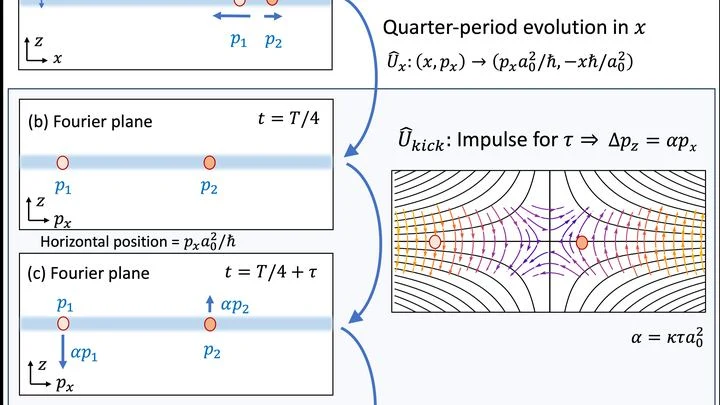
Fireflies flash in a dark forest: you see each flash, but not the flight. A quantum gas microscope can show individual cold atoms, like those fireflies. But until now, it couldn't tell you how fast they're moving.
Now scientists have found a way to fix that.
Hot plasma in a tokamak is like a temperamental beast: you need to hold it in, but not let it overheat. In the ASDEX Upgrade reactor, researchers found a regime where plasma eddies solve this problem on their own. Stochastic modeling showed that oscillations at the plasma edge fling out blobs, like bubbles from a boiling pot.
A fusion reactor is an attempt to hold a miniature sun in a magnetic cage. To get more energy out of it, you need to squeeze the plasma denser. But tokamaks have an invisible fence: once the density crosses a certain line, the plasma shudders and falls apart. This disruption is one of the main mysteries on the road to clean energy.
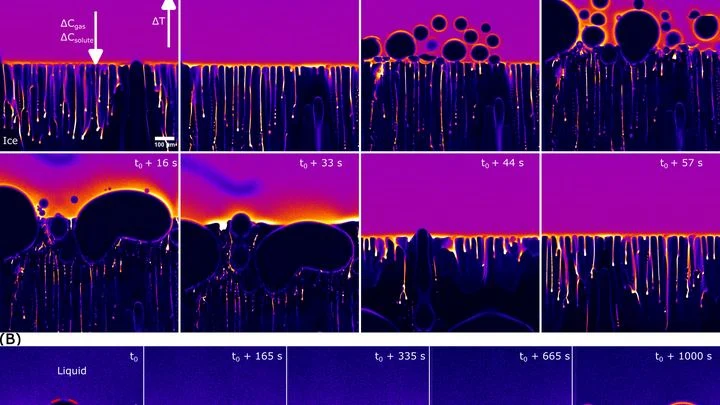
In a glass of soda, bubbles merrily rise to the top. But if you freeze the water, some bubbles end up trapped in the ice. How do they get there? After all, ice grows, pushing gas aside, but it doesn't always manage to.