How to knit a molecular net without a single knot express
Crocheting, but instead of yarn you have individual molecules, and instead of a hook, a gold surface. Until now, attempts to knit such molecules into a smooth fabric ended in a tangle: the threads hooked where they shouldn't, and the pattern went awry.
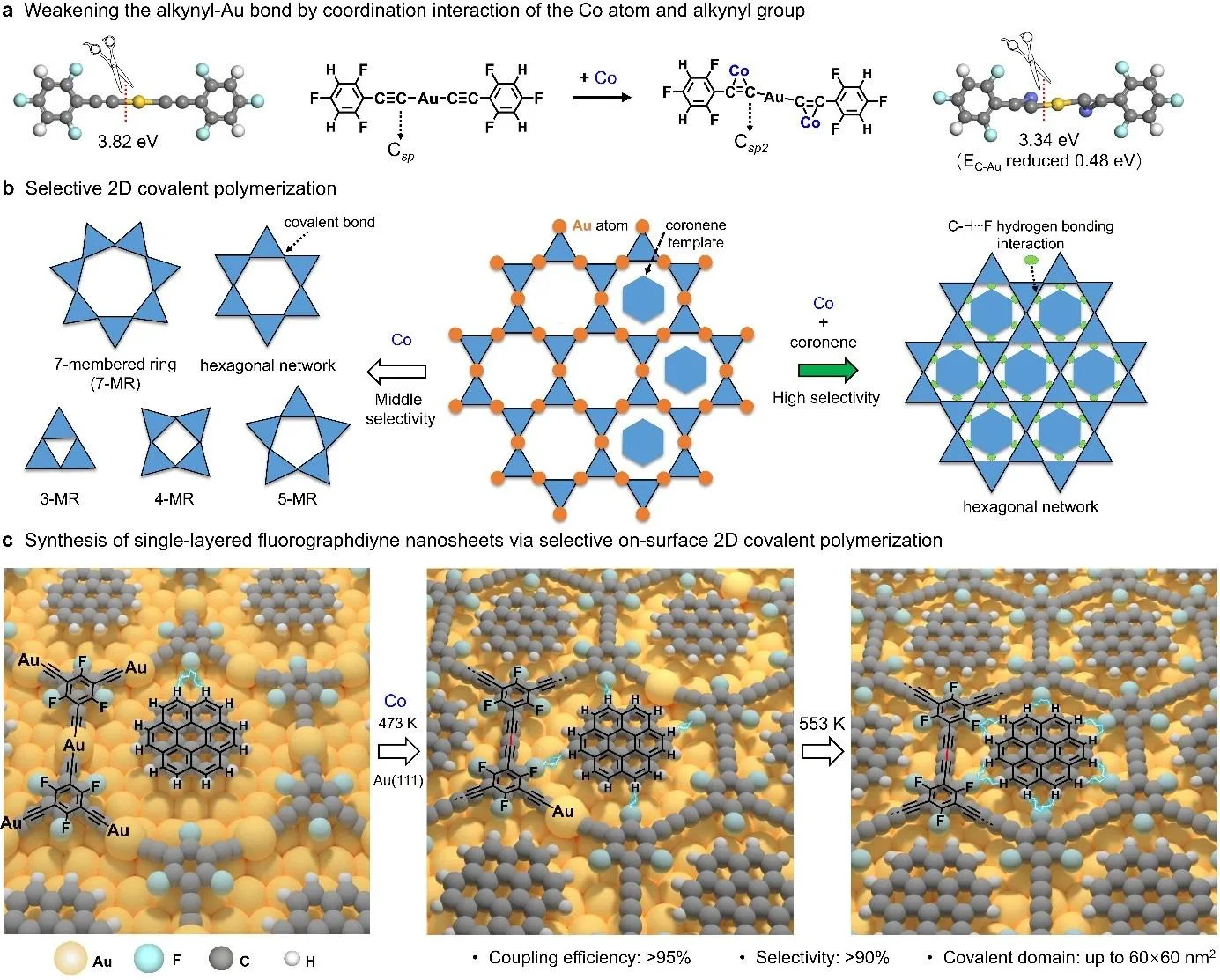
A team of scientists has found a way to fix this. They took building blocks — molecules with triple bonds between carbon atoms (like rigid rods with hooks at the ends)—and laid them on a gold substrate. To make the reaction go right, they added two components: cobalt atoms as a catalyst and flat coronene molecules as a template. Cobalt acts like a nimble assistant that loosens the grip of the "hooks" on the gold surface and lets them connect to each other. Coronene, like a stencil, hints at exactly where the hexagonal ring, the main motif of the future mesh, should close.
Using a scanning probe microscope, the authors literally peeked at how the network grows: they saw intermediate complexes where cobalt still holds the molecules together, and the moment when the bond finally closes. Calculations confirmed that the key role is played by a strong interaction between cobalt's electrons and the carbon chain. It turns the strong carbon–gold bond into a weaker one, and then the molecules easily stitch together in the right order.
Such controlled synthesis opens the way to creating defect-free two-dimensional polymers — materials that could be useful in microelectronics, sensors, or membranes for purifying water. Coming back to the beginning, one could say that knitting a molecular fabric has finally become precise and predictable — no tangled threads, no messed-up pattern.
Coronene, used as a template, is a tiny flat disk made of seven hexagons, resembling a piece of graphene. Its name comes from the word "corona," because it was once considered the "king" of aromatic molecules.