A layered crystal is a material whose atoms are arranged in strongly bonded two-dimensional sheets that are only weakly held together by van der Waals forces. This structure allows the crystal to be easily cleaved into thin flakes, sometimes down to a single atomic layer. A notable example is CrSBr, a magnetic layered crystal that has attracted attention for its unique properties. Layered crystals are the basis of many two-dimensional materials, such as graphene and transitionmetal dichalcogenides, which exhibit electronic, optical, and mechanical properties that differ dramatically from their bulk counterparts.
History
The concept of layered crystals dates back to the study of graphite and mica in the 19th century, but the modern era began in 2004 when graphene was isolated by Andre Geim and Konstantin Novoselov, who later won the Nobel Prize in Physics.
How it works
In a layered crystal, strong covalent or ionic bonds hold atoms together within each layer, while weak van der Waals forces act between layers. This anisotropic bonding means that the crystal can be peeled apart along the layers with relative ease, using simple adhesive tape. The weak interlayer coupling also allows for the intercalation of foreign atoms or molecules between layers, which can tune the material's properties. The electronic structure of a single layer can be quite different from the bulk, leading to phenomena like direct band gaps in semiconductors or enhanced superconductivity.
In practice
Layered crystals are used in making flexible electronics, high-performance transistors, photodetectors, and as lubricants. They are also key materials in research on quantum magnetism and superconductivity.
Fun fact
CrSBr is one of the few layered crystals that is both magnetic and semiconducting, making it a promising candidate for spintronic devices.
A deck of cards in which each card is slightly rotated cannot lie flat: the backs and faces will never align. But if the cards are flexible, they will start to adjust, shifting by fractions of a millimeter to find the perfect match. Something similar happens inside crystals when two thick layers of MoS2 or MoS2 with WS2 are stacked with a twist of 1–2 degrees.
A slice of eucalyptus a tenth of a millimeter thick is placed under a polarized light microscope, and the wood suddenly blooms: blue, yellow, and pink bands twist into spirals, forming rings and swirls. This is not paint but the play of light: the cellulose fibers that make up cell walls transmit light differently depending on their orientation.
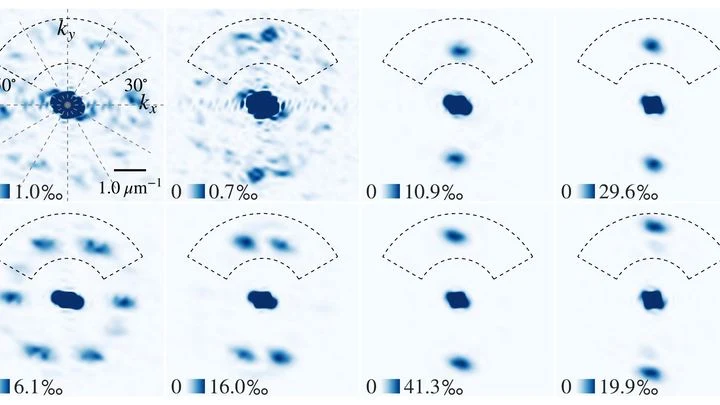
Two dancers on one stage: the triangle and the stripe. In a quantum gas of dysprosium atoms cooled to 62 nanokelvin, these two spatial structures have met for the first time in a single experiment. The gas is held in a trap shaped like a surfboard, and its atoms are among the most magnetic in the periodic table.
A light beam usually travels in a straight line, but you can make it spin around its axis, like water swirling into a vortex as it drains. This 'twisted' light carries more information and is needed for ultra-fast communication and quantum computing.
A solid under a microscope is not a monolith at all. In glass, polymer, or solidified resin, atoms are arranged randomly, and as a result, the material's properties vary from point to point. On large scales, we are used to describing them with smooth fields, like temperature or pressure in a room. But when you zoom down to a few atomic layers, that smoothness disappears.
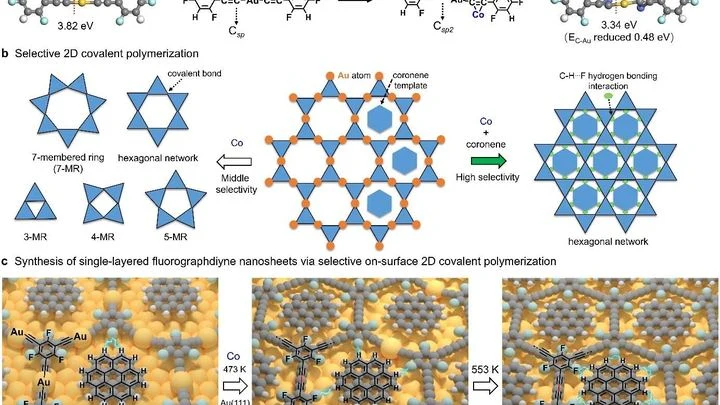
Crocheting, but instead of yarn you have individual molecules, and instead of a hook, a gold surface. Until now, attempts to knit such molecules into a smooth fabric ended in a tangle: the threads hooked where they shouldn't, and the pattern went awry.
A team of scientists has found a way to fix this.
An ordinary crystal is like an apartment building: electrons move through shared hallways and staircases, influencing each other through the walls. Now, imagine removing all the walls, leaving just a single line of apartments. How would the residents behave?
Hydrogen has nothing to do with it, but the collective behavior of electrons takes center stage.
A sheet of paper weighs almost nothing, but stack a hundred sheets and you get a noticeable pile. That's roughly what scientists did with a material that excels at converting one color of light into another, but only when it's just one atom thick. A single layer is like a single sheet: it works beautifully, but it's too thin to produce much light.
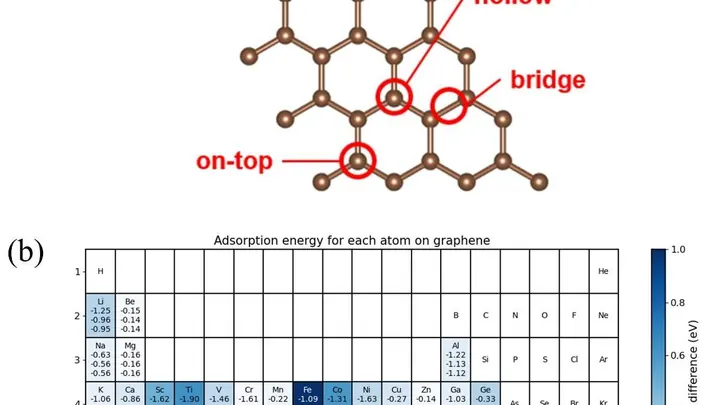
Two sheets of graphene — carbon film one atom thick — without a twist resemble a harbor clogged with shoals: lithium ions either run aground or rush past without stopping. But a 9.43° twist lays out a perfect fairway. The ion ships dock securely to carbon 'piers' and immediately cast off without losing speed.
A magnet that stacks up like a pile of pancakes: that's how the material CrSBr is structured. At low temperatures, each layer is magnetized, but neighboring layers point in opposite directions, and their magnetic fields cancel each other out. This order is called antiferromagnetic, and it's fragile: just a slight warming demagnetizes the layers.
A stack of identical pancakes on a plate is just a stack. But if you arrange them with a certain order, something new suddenly appears: for example, a pattern that was not visible in each pancake individually. Physicists have performed a similar trick with thin layers of materials.
Light usually tends to scatter in all directions, like splashes from a thrown stone. But it can be caught in an invisible cage where it swirls in place, losing almost no energy. Physicists have built just such a cage using the magnetic material CrSBr — a layered crystal that can be split into flakes just a few atoms thick.
Electrons in a conductor usually behave like a gas: they dart around chaotically, collide, and don't hold formation. But if you spread them far apart and cool them down, their mutual repulsion can force them into place, like attendees in an overcrowded hall who settle into every other seat.