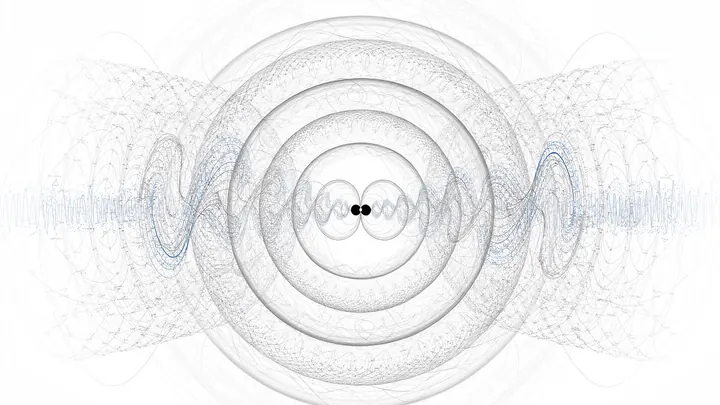
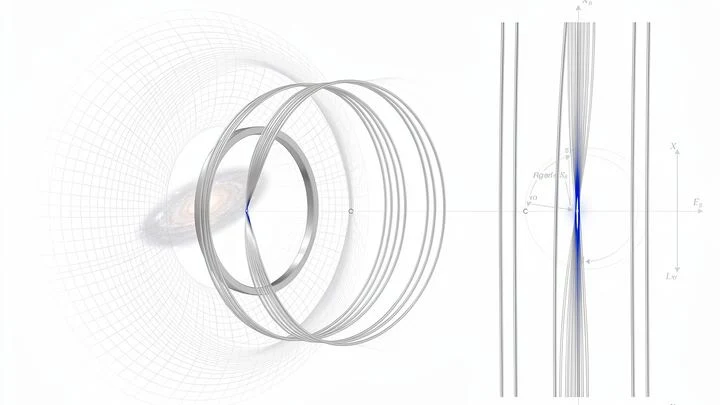
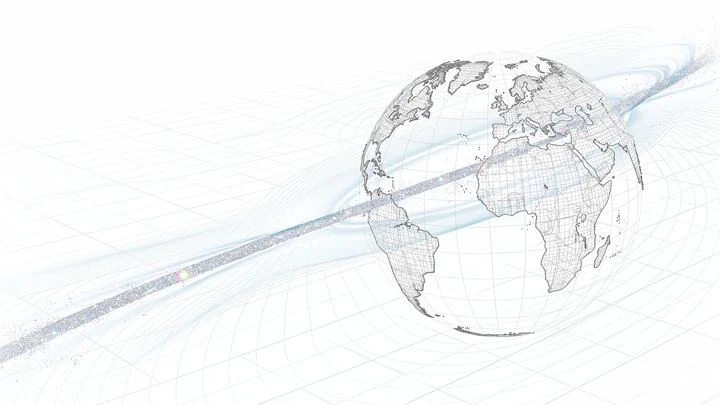
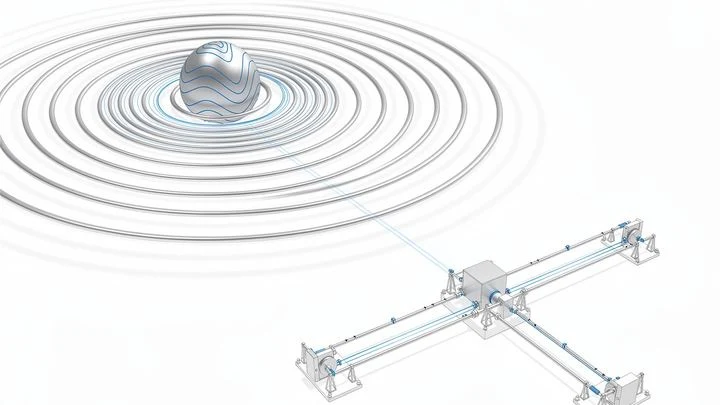
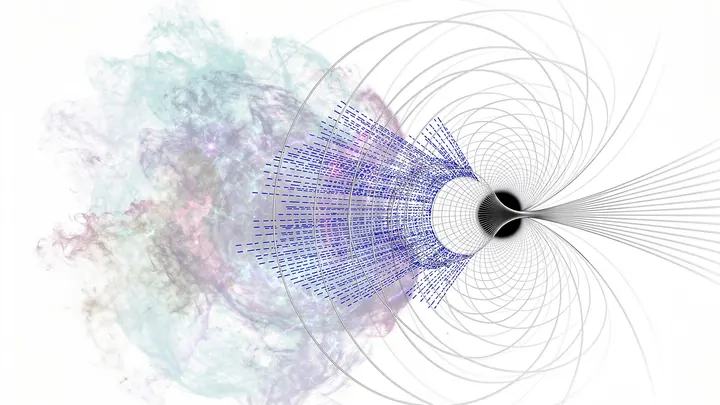
Dark matter, though invisible, can leave subtle imprints on gravitational wave signals. These imprints arise from the gravitational influence of dark matter halos on the sources of gravitational waves, such as merging black holes or neutron stars, or from the direct interaction of dark matter particles with the emitting systems. The signals can be altered in their phase, amplitude, or frequency evolution, providing a potential indirect way to detect and study dark matter.
History
The idea that dark matter could influence gravitational wave signals gained traction in the 2010s, with theoretical studies on dark matter spikes around black holes and superradiant boson clouds. The first observational constraints came from LIGO's detections of binary black hole mergers.
How it works
Dark matter can affect gravitational waves in several ways. A dense dark matter spike around a black hole can exert an additional gravitational drag, causing the inspiral to proceed faster than expected. Alternatively, if dark matter consists of ultralight bosons, they can form a 'cloud' around a rotating black hole through superradiance, extracting rotational energy and emitting continuous gravitational waves. Dark matter particles passing through a neutron star can also deposit energy, altering its shape and thus its gravitational wave emission.
In practice
Gravitational wave observatories like LIGO and Virgo are now used to search for dark matter signatures, such as excess phase shifts in inspiral signals or continuous waves from boson clouds, complementing direct detection experiments.
Fun fact
A superradiant boson cloud around a black hole can act like a giant 'gravitational laser', emitting coherent gravitational waves at a nearly constant frequency for millions of years.
A neutron star is a city the size of Manhattan that weighs as much as half a million Earths. A teaspoon of its material would outweigh Mount Everest. Now, into this superdense sphere, something invisible and elusive has been mixed — dark matter particles.
That's exactly what physicists did in a new study.
The Universe is a giant concert hall, where instead of walls and balconies, invisible clouds of dark matter float. This architectural ensemble is not static: it refracts and scatters the 'music' rushing through it — gravitational waves from merging black holes.
Gravitational waves from merging black holes sound like bass chords, pulsars tap out a rhythm, and the cosmic microwave background carries echoes of the Big Bang. But there is a silent player — dark matter, whose presence is betrayed only by gravitational effects.
A black hole merger is not a silent impact. The newborn hole quivers and decays, emitting gravitational waves — ripples in space itself. This signal is called the 'ringdown,' and it resembles the fading chime of a bell: it has a fundamental tone and several overtones.
Almost a century after Фриц Цвикки suspected something was amiss in the motion of galaxies in the Coma cluster, and Вера Рубин measured stellar velocities in spiral arms, the nature of тёмной материи remains one of the most vexing mysteries.
Light passes through a crumpled film — and comes out slightly altered. In much the same way, gravitational waves born in the early universe feel the lumpy distribution of galaxies and dark matter.
When a piano falls into an abyss, we think about the abyss. We don't think about the piano's cover. In much the same way, astrophysicists have for decades studied extreme close encounters between small bodies and massive black holes. They focused on the black hole itself and what orbits it. But what the 'bullet'—the small object heading toward doom — is wearing, almost no one asked.
At the center of the Milky Way, like a matryoshka doll within a matryoshka doll, lies a supermassive black hole, surrounded by a swarm of stars and an invisible shell of dark matter. This shell, or "spike," is expected to be extremely dense right at the horizon.
An ultra-sensitive microphone listens not to sound, but to the trembling of space itself. That's how gravitational wave detectors work — LIGO, Virgo, KAGRA.
On May 14, 2019, LIGO detectors registered a gravitational burst that didn't fit the usual mold. Event GW190521 appeared as a collision of two black holes weighing 85 and 66 solar masses. The resulting hole of 142 solar masses landed right in the "forbidden" range — where stellar collapses leave almost no trace.
A neutron star is a super-dense remnant of a supernova explosion, where a teaspoon of matter weighs a billion tons. Many of them, as discovered back in 1967 by Jocelyn Bell Burnell, become pulsars — cosmic lighthouses that regularly flash in the radio band.
The Universe is pervaded by an invisible substance — ultralight dark matter, which doesn't collide with ordinary matter but can tremble like a taut string. Its oscillations alter the world's most fundamental properties: the electron charge, the speed of light — as if the tuning of a single cosmic note slightly drifts.
In the first moments after the Big Bang, the universe was a boiling cauldron. But then, according to a new hypothesis, it suddenly cooled dramatically — far more than previously thought. In this icy world, dark matter particles, like tiny pendulums, froze and did not begin their oscillations.
Dark matter is the great cosmic invisible. It neither emits, absorbs, nor reflects light, yet its gravitational grip is felt in every motion of galaxies. Seventy years ago Vera Rubin showed that the outskirts of galaxies rotate too fast — as if spurred on by an unseen shepherd.
Right after the Big Bang, space rippled with gravitational waves, like those from a thrown stone. These tremors in the very fabric of the cosmos, predicted by Alan Guth, stretched across the entire universe. The ripples slightly compressed primordial matter in some places and thinned it out in others.
A detector filled with superfluid helium-4 is like a perfectly still lake. The liquid doesn't slosh or bubble: it's frozen in a single quantum state. An invisible guest, a dark matter particle, flies through it. It doesn't shine or leave a track. But sometimes it nudges a helium nucleus.
In a vast hall, a hundred tuning forks are set out. Each one is a pulsar — an ultra-dense stellar remnant spinning at a furious rate, sending out radio pulses more precisely than any clock. When a low-frequency sound wave sweeps through the hall, all the tuning forks start to go slightly out of tune at the same moment.
In the quantum world, electrons can behave like waves. If you create the right conditions for them, these waves start to feel something akin to gravity. In crystals known as Weyl semimetals, electrons move as if they were massless, and their energy depends on direction, like a tilted cone.
Gravitational waves are ripples in the fabric of spacetime, spreading from sources like circles on water from a thrown stone. When a wave passes a galaxy, its path bends, like water ripples meeting an underwater boulder.
Every evening, in the city archive, the attendant places new folders on the shelves. If too many arrive during the day, the shelves sag, and the next morning the archive responds to requests more slowly. A black hole's memory works in much the same way: it doesn't just store information, it physically feels its weight.