Electron and Hole Dance in a Crystal express
Light hits a crystal and knocks an electron out of its rightful place. A void remains — a hole that behaves like a positive charge. The electron and hole attract each other and circle around one another, like a pair in a slow dance. Such a pair is called an exciton (from the word "excitation").
But this dance is not in a vacuum. Around them are plenty of other electrons, and their cloud shifts to weaken the attraction between the partners. Usually, it is assumed that the cloud rearranges instantly, as if it were always ready. In reality, it takes time. When the exciton is very robust (the electron and hole are strongly bound), the delay becomes important: the cloud cannot keep up with the fast motions of the pair, and a calculation assuming instantaneous response gives an error.
The authors built on an approach where the response of the environment is described via an effective dielectric permittivity — a quantity that shows how much the medium weakens the electric field. Previously, this method was used with plane waves, but for molecular crystals that is like painting a portrait with a paint roller. Here, orbitals localized on atoms are needed, like a fine brush. The researchers reformulated the method for such atomic orbitals and embedded it into a program where they had already learned to calculate quasiparticle energies (electrons with a "fur coat" of polarization) using the GW scheme.
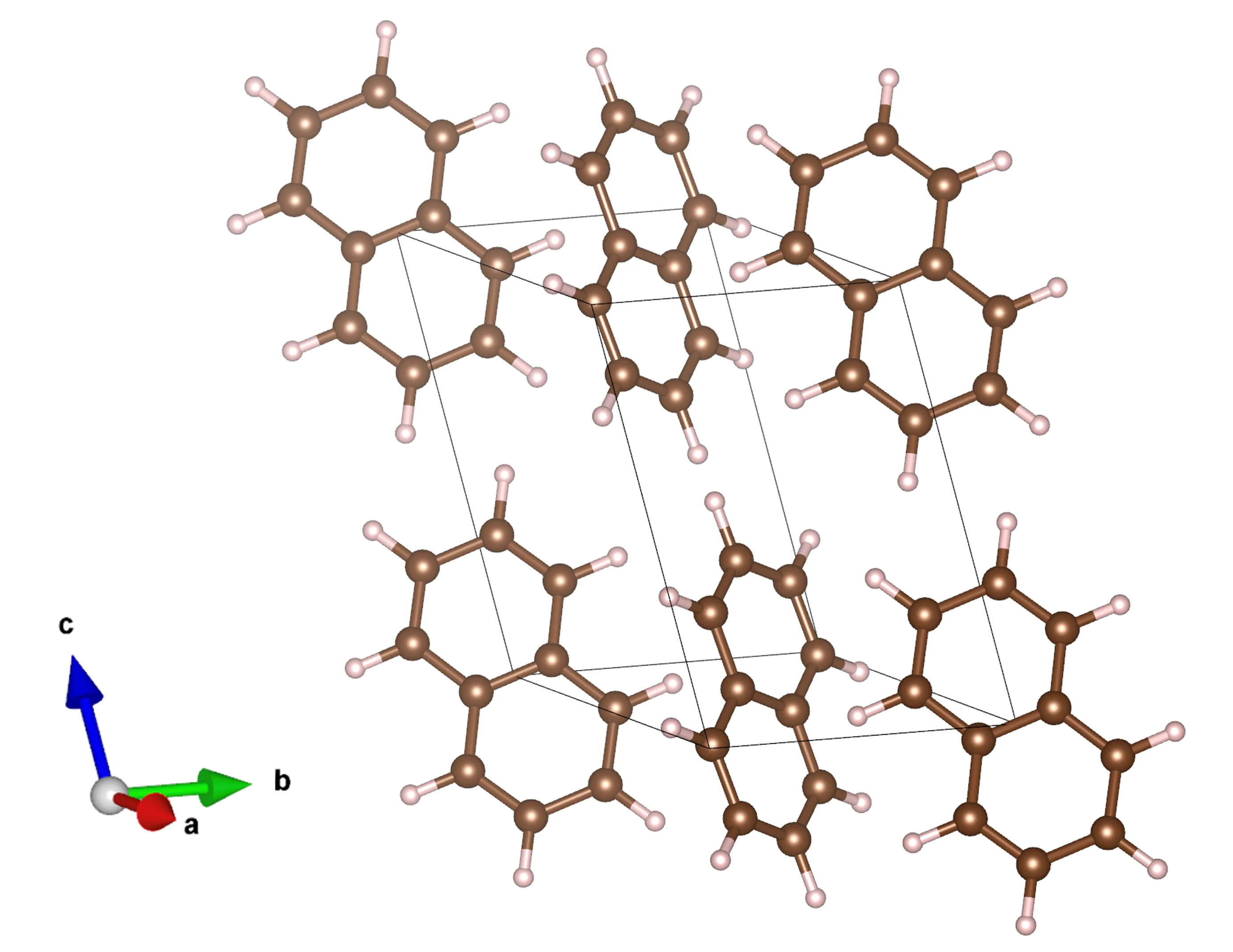
Calculations for a naphthalene crystal showed that the dynamic correction noticeably shifts excitation energies. Without it, predictions would be too optimistic, as if we estimated wind strength without considering gusts. The method opens the way to accurate modeling of optical properties of molecular crystals without sky-high computational costs.
Excitons exist not only in crystals. In plant leaves, they transfer light energy to the reaction centers of photosynthesis, working like a perfect wireless transport network.