Entropy as Fuel for Chaos: How an Environment Speeds Up Quantum Mixing
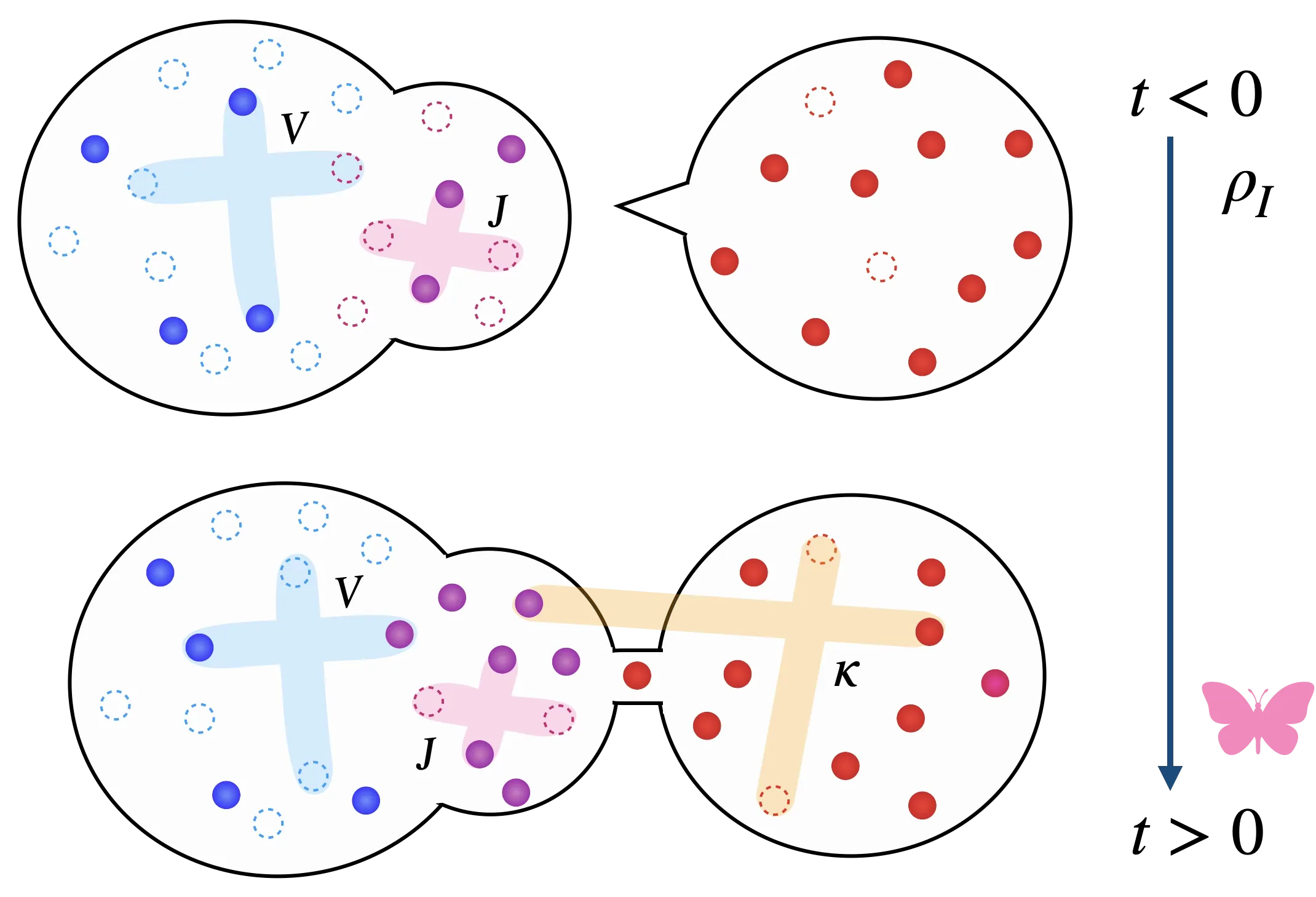
A translator is working in a hall where an important meeting is taking place. He translates every sentence, but the hall is noisy: nearby conversations distract him, words get mixed up, and the meaning is lost. That is what a quantum system coupled to an environment looks like: quantum chaos usually dies out because information leaks away. But what if the noise does not interfere but instead tosses the translator new words from a second dictionary? That is exactly the situation physicists have analyzed: they coupled a quantum system to a second environment with a different chemical potential and found that the entropy flow can speed up chaos rather than suppress it.
The work used the exactly solvable SYK model, a set of fermions with random interactions that serves as a testing ground for studying quantum chaos. First, a system of N fermions was in equilibrium with the first environment at chemical potential μ. At time t=0, the coupling to the second environment with a different potential ν was switched on, and particles began to flow between the environments. This entropy flow expands the available Hilbert space, as if the translator were handed an extra dictionary with new turns of phrase. But at the same time, dissipation is at work: some information is irretrievably lost to the environments, as if the translator let remarks go in one ear and out the other.
The authors derived a formula for this exponent in the new steady state: κ = 2Jf(1−f) − γ₁ − γ₂. Here f is the steady-state particle density, and γ₁ and γ₂ are the charge leakage rates into the first and second environments. The first term grows with entropy injection, because more possible states become available for mixing. The second and third terms represent direct information loss, and they are always negative. The competition between these contributions determines whether chaos is enhanced or dies.
If the coupling to the second environment is weak and the difference in chemical potentials is large, entropy injection wins: the Lyapunov exponent grows. If the coupling is strong, dissipation takes over, and chaos is suppressed. The plots show a nonmonotonic dependence: chaos can be switched on even where it was absent altogether without the second environment. It is as if a translator in a quiet room worked slowly, but once you add background noise with the right words, he starts speaking faster.
It used to be thought that an environment only hinders quantum chaos: dissipation zeroes out the Lyapunov exponent, and the system becomes predictable. Now it is clear that entropy flow is a resource that can be dosed. The discovery changes the view of open quantum systems: instead of isolating them from their surroundings, one can use the surroundings to control complexity. For quantum simulators and quantum information protocols, this means a new tool: on-demand controlled chaos. The translator no longer needs complete silence; sometimes it helps to have whispers of hints in the hall.
In the model with pair-hopping interaction, it is possible to enhance chaos without any dissipation, reminiscent of a situation where a translator is not distracted by background conversations but still gains extra vocabulary.