Entropy as chaos fuel: how an environment can speed up quantum mixing
Context
In recent years, quantum chaos and information scrambling have been studied in open systems, where coupling to an environment competes with internal dynamics. It was previously established that dissipation causes a scrambling transition: at strong coupling, the quantum Lyapunov exponent goes to zero. Nearby in the archive are studies of the quantum Mpemba paradox, entanglement under observation, and chaos without entropy growth, which explore how external influences change the dynamics of complexity. This paper proposes a different mechanism: not suppression but enhancement of chaos through entropy injection from a second environment with a different chemical potential.
Methods
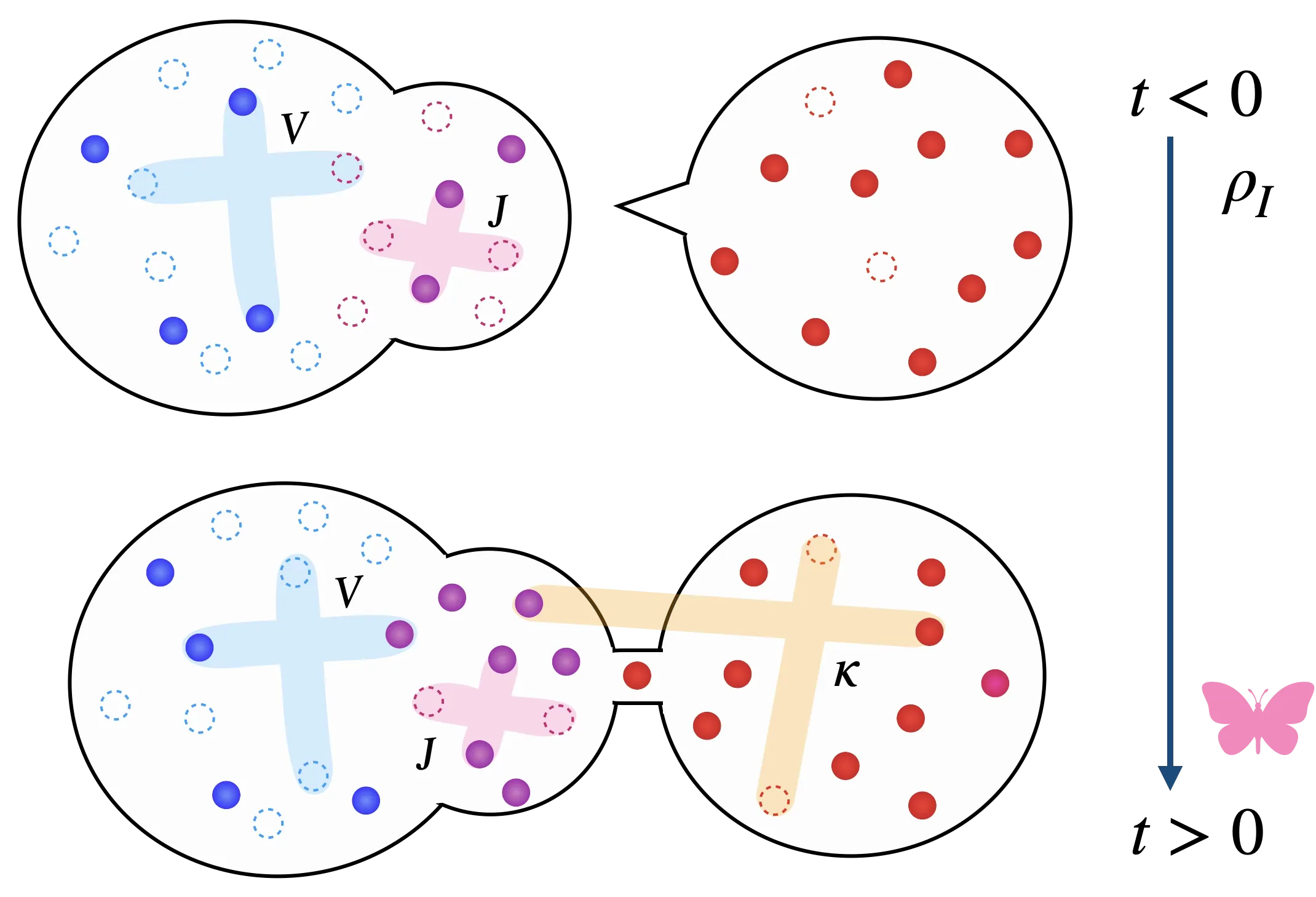
The authors construct an exactly solvable complex Brownian SYK model with charge conservation. A system of N fermions is coupled to a first environment (M fermionic modes, M ≫ N) and is in equilibrium at chemical potential μ. At time t = 0, coupling to a second environment with a different chemical potential ν is switched on, creating a flow of particles and entropy. Relaxation is described by a quantum Boltzmann equation for the distribution function f(t), and the quantum Lyapunov exponent is computed from the linearized equation for out-of-time-order correlators (OTOC) in the steady state. To suppress dissipation, a pair-hopping interaction that preserves operator size is also considered.
Results
An analytical expression is obtained for the quantum Lyapunov exponent in the nonequilibrium steady state: κ = 2Jf(1−f) − γ₁ − γ₂, where f is the steady-state density, and γ₁ and γ₂ are the charge transfer rates to the first and second environments. The first term reflects the change in the available Hilbert space due to entropy injection, while the second term represents direct information leakage. At weak coupling κ, the second environment can increase the Lyapunov exponent if the chemical potential difference is large enough; at strong coupling, dissipation always dominates. Contour plots in Fig. 2 show a nonmonotonic dependence and the possibility of inducing chaos even where it would not exist without the second environment. For coupling without dissipation (pair-hopping interaction), the chaos enhancement persists at any coupling strength, as confirmed in Fig. 3.
Implications
The work shows that entropy flow is a resource that can enhance quantum scrambling, in contrast to the traditional suppression by dissipation. This broadens the understanding of open quantum systems and provides a new mechanism for controlling chaos. Compared with neighboring works that focus on transitions caused by dissipation or measurements, this is the first analytical demonstration of chaos enhancement through entropy injection in an exactly solvable model.
Future development
The topic could develop toward studying the effect of entropy injection on other diagnostics of quantum chaos, such as Krylov complexity, as well as on quantum teleportation protocols through wormholes. An open question remains about the interplay of entropy injection with measurement-induced dynamics, which could provide additional ways to control operator growth.
Impact
The results could influence quantum thermodynamics, the theory of open quantum systems, quantum information, and black hole physics, where scrambling plays a key role.
Next steps
Test the chaos enhancement in more realistic models with a finite number of particles and in experiments on quantum simulators. Investigate how entropy injection affects teleportation fidelity and Krylov complexity.
Key open problems
The work connects to the fundamental problem of the relationship between quantum chaos, thermodynamics, and information in open systems, namely the question of how entropy and energy flows can serve as a resource for controlling the dynamics of complexity.
In the model with pair-hopping interaction, it is possible to enhance chaos without any dissipation, reminiscent of a situation where a translator is not distracted by background conversations but still gains extra vocabulary.
Key numbers
- Lyapunov exponent: κ = 2Jf(1−f) − γ₁ − γ₂
- steady-state density: f = (γ₁n + γ₂m)/(γ₁ + γ₂)
- coupling threshold for the scrambling transition: V = 2J
- number of fermions in the system: N
- number of modes in the environment: M ≫ N