The Lyapunov exponent is a number that tells you how quickly two nearly identical starting points in a dynamical system move apart over time. If the exponent is positive, the system is chaotic: tiny differences grow exponentially, making long-term predictions impossible. If it is negative or zero, nearby trajectories converge or stay close, indicating stable or regular behavior.
History
The concept was introduced by the Russian mathematician Aleksandr Lyapunov in the 1890s in his work on stability of motion, though its connection to chaos was recognized much later in the 20th century.
How it works
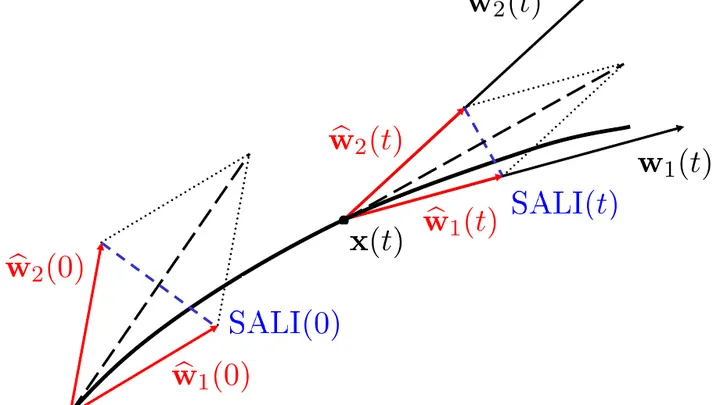
Think of two points in a system's state space, separated by a tiny distance. As time evolves, that distance changes roughly as the initial distance times e^(λt), where λ is the Lyapunov exponent. A positive λ means the separation grows without bound (until it saturates), a negative λ means it shrinks, and a zero λ means it stays constant. In practice, you compute λ by tracking the average logarithmic growth rate over many steps, often using a linearization of the system's equations.
In practice
Lyapunov exponents are used to diagnose chaos in weather models, financial time series, and mechanical systems, helping engineers decide when a system is predictable or needs control.
Fun fact
The largest Lyapunov exponent for the Earth's atmosphere is positive, which is why weather forecasts become unreliable beyond about two weeks.
A handful of sand falls onto a table: each grain rolls down until it rests in a hollow. That's how a potential works: the table's surface tells the grains where to go. But in a river with whirlpools, there's no single basin everything flows into. Water swirls, returns, and meanders. For such systems, the usual map of 'pits and hills' doesn't apply.
Toss a dozen coins on a table. The number of heads-and-tails combinations is just over a thousand. For two dozen coins, it's already a million. The number grows as 2 to the power of the number of coins, and that's fast. But quantum systems are far richer.
Each particle here is not a coin with two sides but an arrow that can point in any direction.
Drop two identical pebbles from a mountain peak: one lands a centimeter to the left, and a minute later they end up in different valleys. A galaxy is the same mountain, only with billions of pebbles and a slope that stretches over millions of years. The authors of a new study simulated a disk of 40 million point-like stars and tested how quickly it forgets where it started.
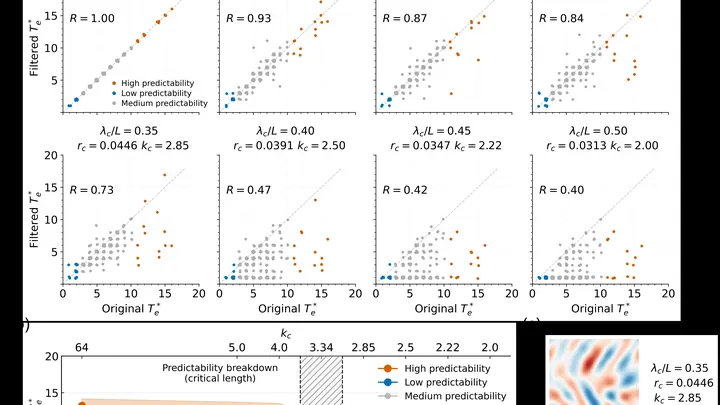
In a turbulent flow, like a raging river, energy constantly cascades from large whirlpools to small ones. Occasionally, particularly powerful bursts occur, resembling sudden waves crashing against the shore. Scientists asked: can we know in advance when such a "wave" will strike? It turns out the answer depends on which vortices are present in the flow at that moment.
Drop a stone into a calm pond — the ripples spread evenly. Drop it into a churning stream — the water swirls unpredictably. Scientists have long wrestled with a similar question: how can you tell from a single particle's path whether its motion is chaotic? Previously, this meant comparing the particle's path with neighboring ones, which is complicated and time-consuming.
A neural network can be compared to a dormitory where each resident gets their own room. Usually, each feature in the data occupies a separate neuron, and learning proceeds sequentially: first one feature, then another. This is slow and depends on which data you happen to get.
But if you allow several features to share a room, overlap them, the picture changes.
A traveler in the desert sees a lake. It shimmers, beckons with coolness, but as you approach, the water recedes. So it is in mathematics: the computer draws chaos, lines dart across the screen, and it seems we are witnessing a real storm. But if you wait long enough, the storm subsides, and the trajectory settles into a simple equilibrium.
A warm current off the coast of South America shifts weather across the planet every few years. This is El Niño, and its behavior resembles a pendulum that sometimes swings too far. In 1986, meteorologist John Vallis described the process with three equations in which the ocean and atmosphere exchange heat and momentum.