How Noise Can Supercharge Quantum Chaos
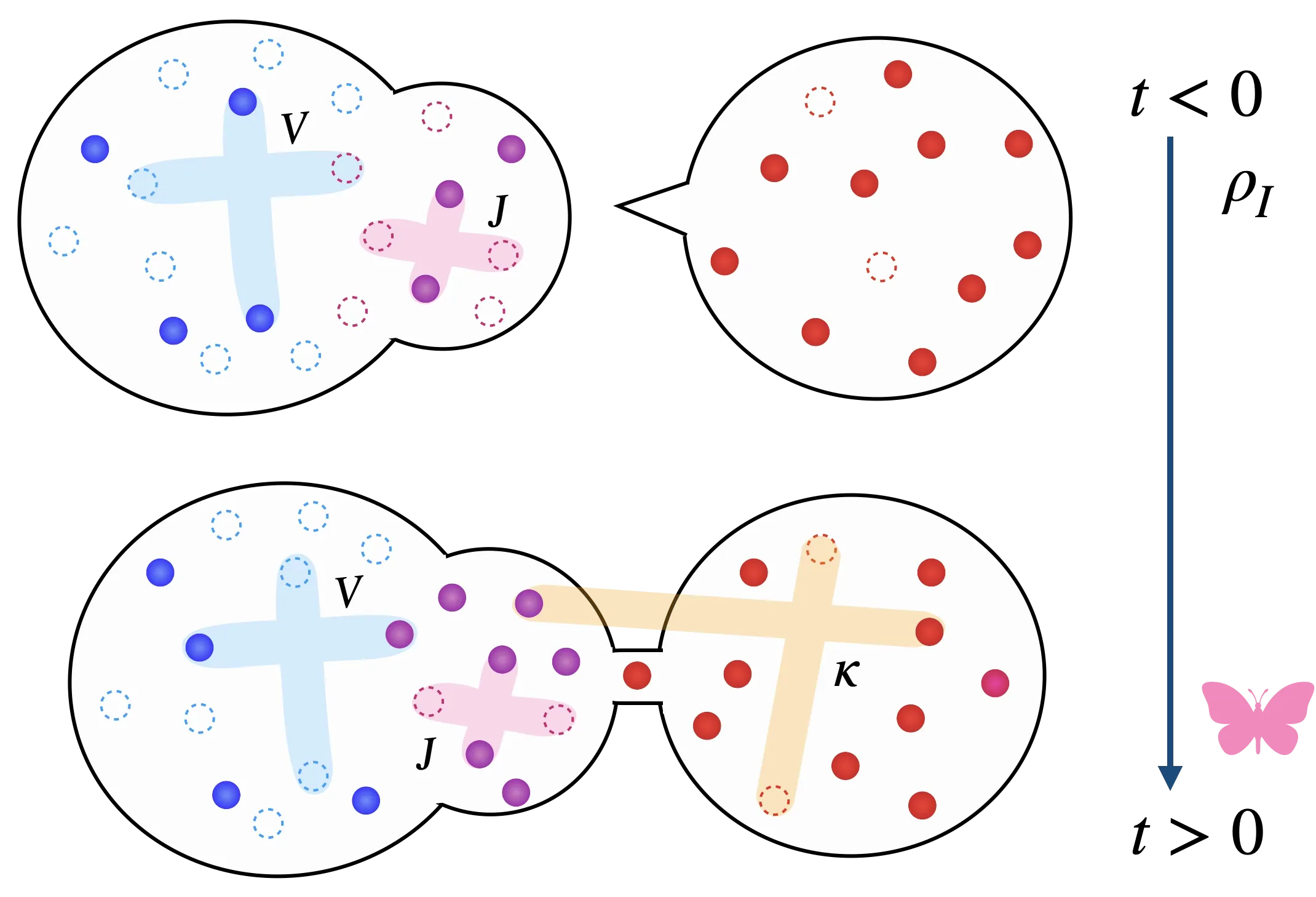
An interpreter sits in a noisy hall, translating a meeting. Side conversations get in the way, words get jumbled, meaning is lost. Similarly, a quantum system coupled to an environment usually loses its quantum chaos: information leaks out, and mixing fades. But physicists have devised a different scenario: they gave the interpreter a second dictionary with new words, tossed in by the noise. It turned out that such an injection of entropy can strengthen chaos rather than weaken it.
The scientists took the SYK model, a set of particles with random interactions. Initially, the system was in equilibrium with the first environment. Then they switched on coupling to a second environment, where particles had a different energy per particle (chemical potential). Particles flowed, and the available state space expanded. It's as if the interpreter were given more words: more translation options became available. But at the same time, some information escapes into the environments, and that slows down chaos.
Physicists calculated this exponent and saw a competition: entropy injection increases it, while information leakage decreases it. If the coupling to the second environment is weak and the energy difference is large, chaos is amplified. If the coupling is strong, leakage wins. It's like with the interpreter: a little background noise with useful words helps, but loud noise hinders. The main takeaway: the environment can be used to control quantum chaos, not just suppress it. This can now be applied in quantum simulators where controlled chaos is needed.
In the model with pair-hopping interaction, it is possible to enhance chaos without any dissipation, reminiscent of a situation where a translator is not distracted by background conversations but still gains extra vocabulary.