The area law is a fundamental principle in quantum information and gravity stating that the entanglement entropy of a region of space scales with the area of its boundary, not its volume. This is famously true for black holes, where the entropy is proportional to the horizon area (the Bekenstein-Hawking entropy). The area law also appears in condensed matter systems, such as gapped spin chains, where ground-state entanglement follows a similar boundary-scaling behavior.
History
The area law for black hole entropy was proposed by Jacob Bekenstein in 1972 and refined by Stephen Hawking in 1974. The connection to entanglement entropy was made in the 1990s, notably by Luca Bombelli and collaborators, and later formalized in the holographic context by Shinsei Ryu and Tadashi Takayanagi in 2006.
How it works
For a quantum system in its ground state, correlations typically decay with distance. The entanglement between a region and its complement is dominated by degrees of freedom near the boundary, because that's where the strongest correlations live. In a black hole, the horizon acts as a boundary, and the entropy counts the microstates that give rise to the macroscopic geometry. The area law emerges from the holographic principle, which posits that the information content of a volume is encoded on its boundary.
In practice
The area law guides numerical simulations of quantum many-body systems, such as tensor network algorithms (e.g., matrix product states), which efficiently represent states that obey area-law entanglement.
Fun fact
In one-dimensional quantum systems, the area law reduces to a constant entanglement entropy, meaning that even an infinitely long chain has a finite amount of entanglement between its halves.
Two dancers on the same stage mirror each other's moves even when a curtain separates them. In the quantum world, such pairs are called entangled, and physicists have spent half a century probing how far this connection reaches. Until now, all tests with massive particles concerned their internal properties, such as spin, but not their motion itself.
When a heavy atomic nucleus splits into two fragments, an invisible quantum thread remains between them. This thread is entanglement: the state of one fragment is instantly linked to the state of the other, as if they were still a single whole. For the first time, physicists have precisely calculated how long and strong such a thread can be, tracing the fission process step by step.
A black hole is not just a dark spot in space. It has a temperature, and it radiates. It has entropy — a measure of hidden information encoded on its horizon's surface, like a pattern on a soap bubble.
A black hole has three laws, just like an ideal gas. The first: energy is conserved. The second: the horizon area never decreases. And the third, the most finicky, demands that at zero temperature the entropy (a measure of disorder) tend to zero or a universal constant.
A fussy thermometer shows different temperatures depending on who is looking at it. A black hole behaves much the same way: its thermal properties, entropy and temperature, depend on how we describe the information hidden inside.
A hunter sets snares in the woods. They know the animal's habits but not whether it will ever show up. In much the same way, physicists set up detectors in hopes of catching particles of dark matter — the invisible substance thought to make up most of the Universe's mass.
A new study offers hunters an unusual tool: not a trap, but a measuring tape.
The quantum vacuum is not empty: it is permeated by entanglement linking distant regions. But when physicists tried to compute this entanglement, it turned out to be infinite. The culprit: particles with very low energy that can smear out over arbitrarily large volumes. They are like waves with no shores to contain them.
A quantum chain is like a string of lights, where the bulbs are the spins of particles. Ideally, all bulbs glow in sync, following a common rhythm: that's symmetry. But if you cut off a piece of the string, the rhythm can get out of step: within that segment, symmetry is broken.
Physicists study a chain of strongly interacting particles (the XYZ model).
In the quiet of the quantum world, there is no emptiness. Particles are intertwined by invisible threads — entanglement. The authors of the work proposed that the very fabric of spacetime is woven from these threads. This is not just a metaphor: they built a mathematical framework where the distance between points is determined by how much shared information they hold.
A climber on a ridge notices something strange: the horizon around them seems to freeze. No forward, no backward — only emptiness and silence. This is roughly the picture painted by new calculations for our Universe. At some point in its expansion, the invisible boundary, the future event horizon, stopped growing.
Hot tea cools down, a pendulum comes to rest — nature loves equilibrium. But a charged black hole can reach a special, extreme state: the mass becomes minimal, and the temperature drops to zero.
A light ray skimming along a black hole horizon doesn't just move: it carries heat and information. Physicists have long suspected that the geometry of such rays obeys strict rules, but the details remained blurry. The new work turns these rules into a sharp inequality.
Gravity in our world is curved spacetime. That's how Einstein's general theory of relativity describes it. But what happens to gravity at the level of atoms and particles, where quantum mechanics rules? This question has remained unanswered for nearly a century.
Imagine a pot of boiling water. Toss in a handful of pasta, and it quickly overcooks and clumps into a sticky mess. But in a huge restaurant kettle where the pasta floats freely, each piece stays separate.
At the center of many galaxies lurks a black hole, wrapped in an invisible cloud — the halo of dark matter. This is not just a featureless mass: its density changes from the edge to the center, and the degree of this "compression" is called compactness.
A quantum computer relies on two forces: entanglement (particles behaving as a single whole) and "magic"—a measure of how far a state is from familiar classical physics. But how these two resources relate as a many-particle system evolves in time has remained a puzzle.
The authors approached the problem through time.
A superfluid flows without friction, like water that never stops. But when you spin it, it doesn't just rotate: each tiny vortex remembers exactly how it was spun. This 'trace' is not a metaphor but a real geometric imprint, which physicists call the Berry phase (the phase acquired by a wave as it travels along a closed path).
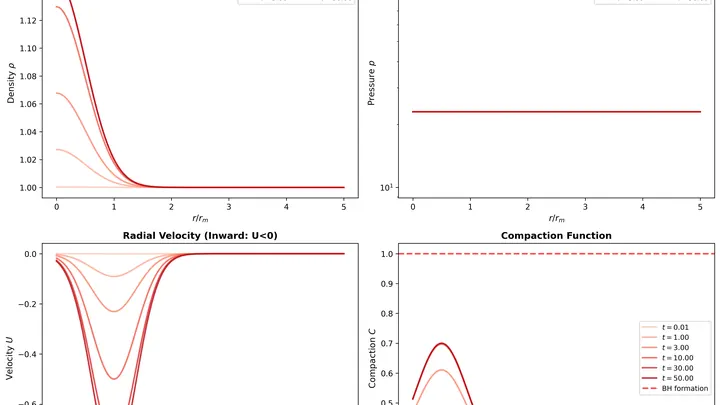
In the first moments after the Big Bang, the universe was filled with a hot, nearly uniform plasma. But in some places, the density could randomly be slightly higher. If such a clump gained critical mass, it collapsed into a black hole: this is how primordial black holes were born.
A translator hears not just words, but intonation, pauses, the tremor in a voice. Ordinary entropy analysis of cosmic perturbations is like meeting minutes: it records facts but loses the nuances. Pseudoentropy entropy is a new tool that captures the hidden "music" of the early universe.
A black hole is not just a cosmic vacuum cleaner. It is a region with such strong gravity that even light cannot escape it. But place it in a perfect fluid of dark matter and add a cloud of strings, thin filaments stretched across all of space, and the picture gets more complicated.
Two particles separated by kilometers change their states in concert, as if there were no distance between them. This is called quantum entanglement, and since its discovery it has baffled physicists: no known carrier can travel faster than light, yet correlations appear instantaneously.
Hot water sometimes freezes before cold: this is the Mpemba effect. In the quantum realm, a similar paradox appears: the more the equilibrium is disrupted, the faster it recovers. It's like fleeing from disorder (entropy) in reverse: the system rushes toward order, and a large initial imbalance only helps.
Spacetime is like a giant sheet of paper. Fold it, and distant corners come together. Poke a pencil through, and you get a wormhole, a short tunnel through the folds. But the paper wants to spring back flat, snapping the passage shut. To keep it open, you need a rare “gasket”—matter with negative energy.
An acoustic black hole is a fluid flow faster than sound, so sound waves can't escape. The boundary, the surface where the flow speed reaches the speed of sound, spawns pairs of phonons: sound quanta, one flying away, the other plunging inward.
A soap bubble hangs in the air, and its shape already contains everything needed to calculate the internal tension. A similar principle worked in a new study on quantum gravity. Physicists took a closed surface, an analog of such a bubble, and specified a few numbers on it: for example, the electric field strength and the curvature.
The gravity of a black hole creates a curvature of spacetime, acting like a lens: light from a distant galaxy splits in two, stretching into arcs. Dark matter around the hole barely changes the picture, as if a transparent curtain was added to a window pane.
A black hole is like a perfect safe: anything that goes in seems lost forever. But at the microscopic level, it doesn't destroy information: it shuffles it with its internal degrees of freedom, much like a deck of cards after a thorough shuffle.
Light falling into a black hole carries information — for instance, the path a photon took. The horizon (the surface from which nothing returns) responds by changing its entropy — a measure of disorder, akin to the number of shuffled pages in a book.
Neutrinos are nearly elusive particles that permeate everything around us. In a dense cloud, such as during a star explosion, they begin to collectively change their type, or 'flavor.' This process is like a crowd of people synchronously changing the color of their clothes, but not all at once — rather in waves.
Spacetime isn't a flat sheet, but a crumpled fabric: stars and planets leave creases on it. Information is written into every crease, and to erase it, heat would have to be released — that's how Landauer's principle works. Thus, the 'crumpledness' of space can be measured through entropy — the universal measure of disorder.
A quantum particle can be in two states at once, like a coin spinning, both heads and tails. Near a black hole, the event horizon, where spacetime curvature bends space and time to the extreme, acts as a one-way gate.
Drop a pebble into a well, and the sound tells you its depth. That's roughly how astrophysicists listen to black holes: after a merger or other disturbance, the hole vibrates, emitting gravitational waves. The frequency and damping of this 'ring' depend on what's inside the hole.
Throw a stone into a pond, and ripples spread across the water. Throw two stones nearby, and the ripples intersect, creating a pattern of reinforced and canceled waves. That's interference.
An ice cube in a glass of water doesn't just float: it gets pushed. Water molecules bombard it from all sides, and this bombardment gives rise to a force you can measure. In physics, there's a similar force, but it acts not on ice but on anything with mass, and it arises not from molecular jostling but from information. It's called entropic force.
A black hole is usually depicted as an abyss with a point of no return. To save information, which quantum laws forbid from disappearing, physicists replaced that boundary with a fluffy tangle of microscopic strings. Infalling data gets permanently imprinted into its intertwined threads.
Holography is the idea that everything happening inside a volume can be encoded on its boundary, like an image on a hologram. In physics, this helps connect gravity to the quantum world. But sometimes, the holographic rules fail to assemble familiar spacetime, and scientists are looking for where exactly the mechanism breaks down.
A stone falls to the ground along the most economical route — the one that expends the least time and energy. This principle of least action governs all of classical physics. But in the microworld, everything jitters: fields fluctuate, and you can't say precisely where anything is.
A top spun to its limit changes the air flow around it — the air swirls differently than around a barely spinning top. Black holes in some extended theories of gravity behave similarly. When a hole spins fast enough, the curved spacetime near its poles acquires new properties.
A black hole doesn't just swallow everything around it: it also slowly evaporates, like a chunk of ice in the sun. As the hole shrinks, the quantum fields around it start behaving unusually. In a new study, physicists traced how entanglement, a special kinship between particles that persists even when they are far apart, changes.
A broken guitar string doesn't just go silent. It still vibrates for a while, and by the character of that vibration, a luthier can tell what kind of string it was — thick or thin, tightly wound or loose. In much the same way, physicists listen to the "vibration" of quantum systems when they want to understand their structure.