Water in a Vise: Two Views of Melting express
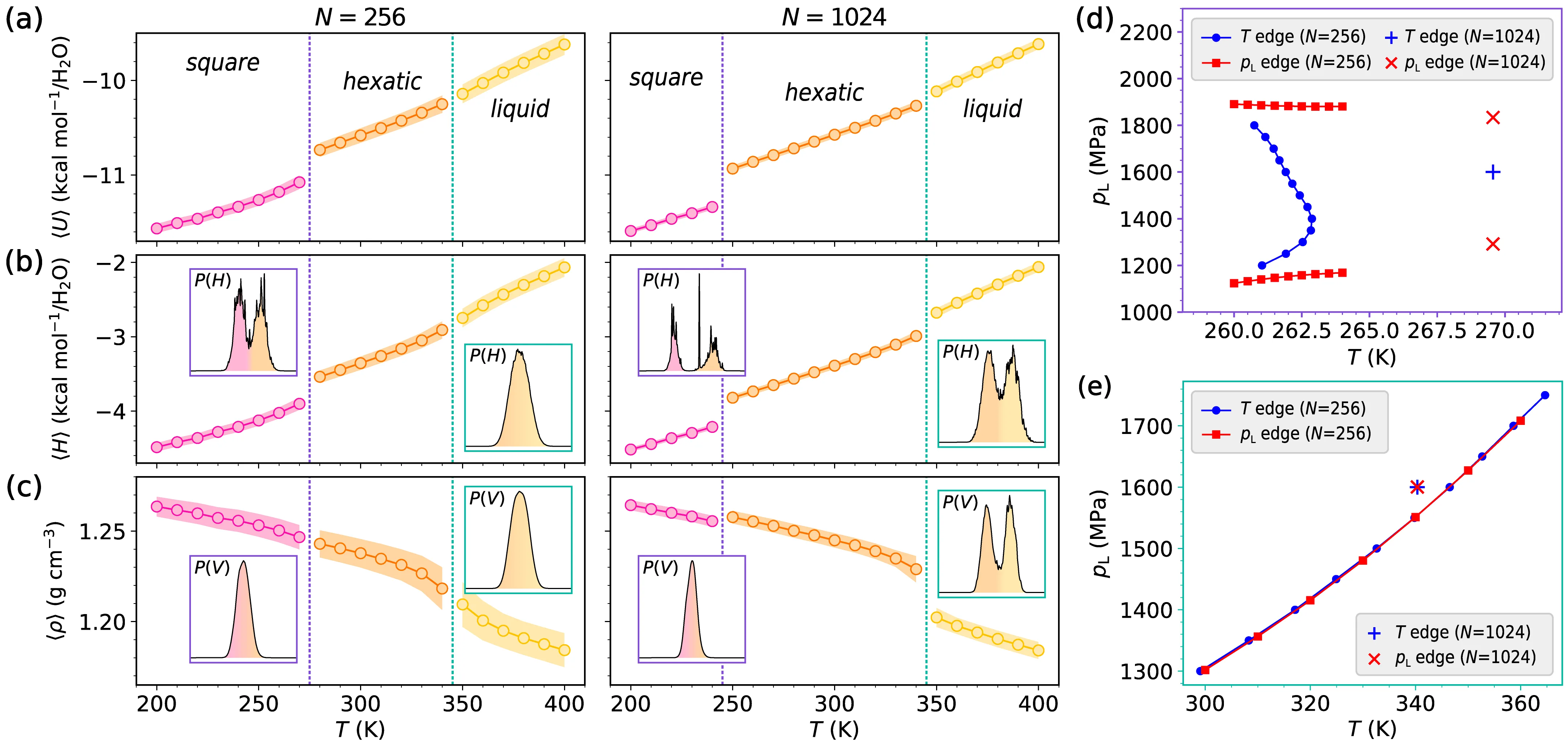
If you squeeze water between two glass plates so that only two layers of molecules fit, it becomes something between a liquid and ice. At room temperature, molecules in such a trap still move but arrange themselves into a semblance of a crystal lattice. For sixty years, scientists have debated how this system melts when heated: smoothly, like butter in a pan, or abruptly, like an ice cube in a glass.
In the new study, the authors didn't just look for the melting temperature; they tracked two different 'thermometers'—density (how tightly molecules are packed) and stiffness (how ordered their rows are). It turned out that in the first stage of melting, when crystalline order disappears, density changes very smoothly, like rubber being slowly stretched. But stiffness itself vanishes abruptly, like a snapped string. In the second stage, when the remnants of order finally give way to liquid chaos, both parameters jump simultaneously: this is a familiar phase transition, like water boiling in a kettle.
This discrepancy is not just a quirk of the microscopic world. It explains why previous experiments and computer models so often contradicted each other. Some instruments are sensitive primarily to density, others to order. Seeing the same melting, they give different readings. The authors used a clever mathematical trick, the so-called Lee-Yang zeros, which allow a peek into the very essence of the transition without waiting for it to complete. With their help, they proved that in the nanoworld, the concept of a 'melting point' splits: each property has its own.
It turns out that the six-decade-long dispute wasn't about who was right, but that everyone was looking at the same phenomenon with different eyes. Only now, by distinguishing two channels, density and order, have the scattered pieces been assembled into a unified picture.
The water layer in the experiment is less than two nanometers thick — about a hundred thousand times thinner than a human hair.
In Kurt Vonnegut's novel Cat's Cradle, there's ice-nine, which makes water freeze at room temperature. Here, the challenge is the opposite: making water melt in parts by tweaking conditions in a nanoscopic gap.