A saddle-node bifurcation is a point where two equilibriumstates — one stable and one unstable — collide and annihilate each other. Picture a landscape with a valley (stable state) and a hilltop (unstable state) next to each other. As a parameter changes, the valley shallows and the hilltop lowers until they merge into a flat inflection point, and then both disappear, leaving the system to jump to a distant state.
History
The concept is part of the general theory of bifurcations developed in the 20th century, with key contributions by Henri Poincaré in his qualitative theory of differential equations and later formalized by René Thom in catastrophe theory.
How it works
Near the bifurcation, the system's dynamics slow down dramatically because the stable equilibrium is becoming less stable and the unstable one is approaching. This 'critical slowing down' means that after a small perturbation, the system takes an increasingly long time to return to equilibrium. Mathematically, a stable and an unstable fixed point merge when a parameter reaches a critical value, and the local dynamics follow a simple quadratic form.
In practice
It explains sudden regime shifts in ecosystems, such as a lake flipping from clear to turbid, and the onset of 'canard' oscillations in electronic circuits.
Fun fact
The 'fold' in catastrophe theory is exactly the saddle-node bifurcation, and it is the simplest way a system can lose its equilibrium without any symmetry breaking.
A lone fish sees a shadow overhead. Should it flee? If it's just a leaf, it wastes energy and gives away its position to a predator. If it's a heron, hesitation is fatal. That's the eternal trade-off of the solitary individual: quick reactions mean many false alarms, while caution means risking being eaten.
In a school, it's different.
Two ropes glued along their length naturally twist into a double helix. That's how DNA works — except the glue is hydrogen bonds between bases, and the stiffness comes from the chains themselves.
A honeycomb made not of wax but of atoms is graphene — a flat crystal just one atom thick. Electrons in it are like runners at an intersection: they speed up here, slow down there, but never get stuck at the edge. Physicists call such a sheet "topologically trivial," meaning its edges are perfectly ordinary, with no special properties.
Now, let's knock out a single atom from the honeycomb.
The railway overhead contact line resembles a galaxy: energy flows through it like gravity, with trains becoming planets. The more trains draw current simultaneously, the stronger the voltage fluctuations — gravitational waves ripple through the system, threatening blackouts.
The railway's electrical network is like an orchestra: trains are musicians whose systems respond differently to current. When their 'electric voices' fall out of tune, disorder arises — a cacophony that can escalate into dangerous voltage rocking.
A neutron star is a city squeezed to the size of a metropolis, where matter is packed to the limit. At the very center of such a city, a redevelopment may begin: familiar neutrons and protons give way to quark plasma — free quarks, the building blocks of almost everything around us.
If you squeeze water between two glass plates so that only two layers of molecules fit, it becomes something between a liquid and ice. At room temperature, molecules in such a trap still move but arrange themselves into a semblance of a crystal lattice.
An atomic nucleus is like a crowded bus. To free up space, a group of two protons and two neutrons — a helium nucleus, an alpha particle — exits through the front door: this is alpha decay, described by George Gamow as tunneling under an energy barrier.
Two dice lie in different rooms. If they are 'entangled,' a roll of one instantly determines the outcome of the other — even at a distance. In the quantum world, such a link is called steering: one party, by performing measurements on their side, seems to dictate the state of the partner.
Drop a pebble into a pond, and ripples spread across the water. Strike a bell, and it rings at its own frequency. When a black hole collides with another, it too 'rings'—except instead of sound, it's the trembling of space itself.
Electric current in a wire is like a crowd of people hurrying down a corridor. Usually, each person bumps into walls and loses speed almost instantly: that's electrical resistance.
A ball on a slope with two pits usually rolls into the nearest one and comes to rest. But if the slope is slightly deformed and 'remembers' recent nudges, the ball can hang around halfway for a long time — in a narrow spot it doesn't want to leave. That's exactly the trick physicists played with light.
When hot soup cools, clumps form on the surface — similarly, as the early universe cooled, it gave birth to threadlike clumps of energy: cosmic strings. Some of them are like a stretched rubber band: as long as it's intact, it's stable. But if you nick the band, it snaps.
A flashlight beam in a dark room can hold a dust mote almost still: that's how optical tweezers work. But light doesn't just push the particle; it also jostles it with random kicks. Each absorbed photon strikes it like an invisible hammer. The authors of the new study have devised a light trap of a special shape.
Imagine a soap bubble with electricity trapped inside and walls made of an invisible field: that's roughly what a black hole with 'resonant hair' looks like. This isn't real hair, but a cloud of scalar field held around the hole by its own interactions.
A thrown stone arcs along a clean trajectory, but an electron's position in an atom is smeared out like fog. The transition from one to the other is a puzzle. New work shows that the fuzziness disappears not because of an observer, but because of the particle's own gravity.
A superconductor is a material that, when cooled sufficiently, conducts electricity without losses, like water flowing through a perfectly smooth pipe. But if you hit it with a brief flash of light, it quickly loses this property.
A uranium crystal the size of a grain of rice was cooled to one-fiftieth of a degree above absolute zero. At such temperatures, heat is not transported chaotically but strictly according to the rules of the quantum world.
In a chain of cold spins stretched along a single line, order and disorder can intertwine into a pattern that defies the usual rules. Two states of matter, two kinds of "order," are separated by a crossroads where the roads do not converge but diverge.
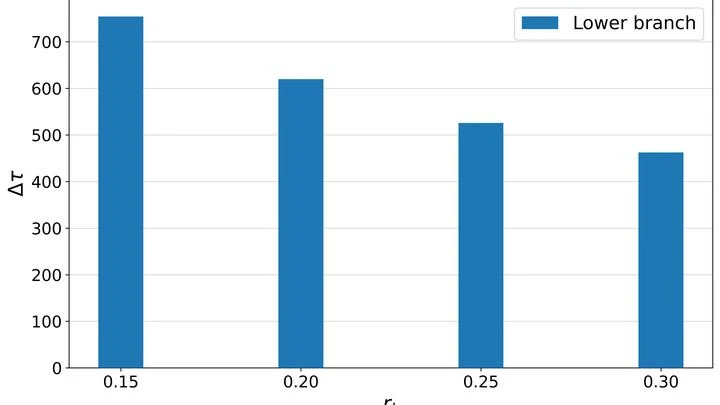
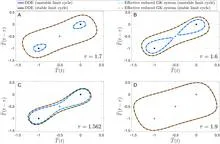
The Pacific Ocean remembers. Water warmed off the coast of Peru drifts slowly westward, and six months later its heat returns to South America. Scientists call this six-month journey the delay. It turns a simple climate model into a maze where the route depends not only on your current position but also on where you were half a year ago.
The ocean off Peru is not just warm: it pulses. Every few years, the winds die down, warm water creeps eastward, and fishermen are left empty-handed. This is El Niño, and its arrivals do not follow a simple schedule. Some researchers blamed random weather gusts, others sought chaos in the climate system itself.
Every few years, the Pacific Ocean off the coast of Peru warms up, and then fields dry out in Australia while deserts in Chile get drenched. This phenomenon is called El Niño.