Why Left- and Right-Handed Molecules Conduct Electricity Differently express
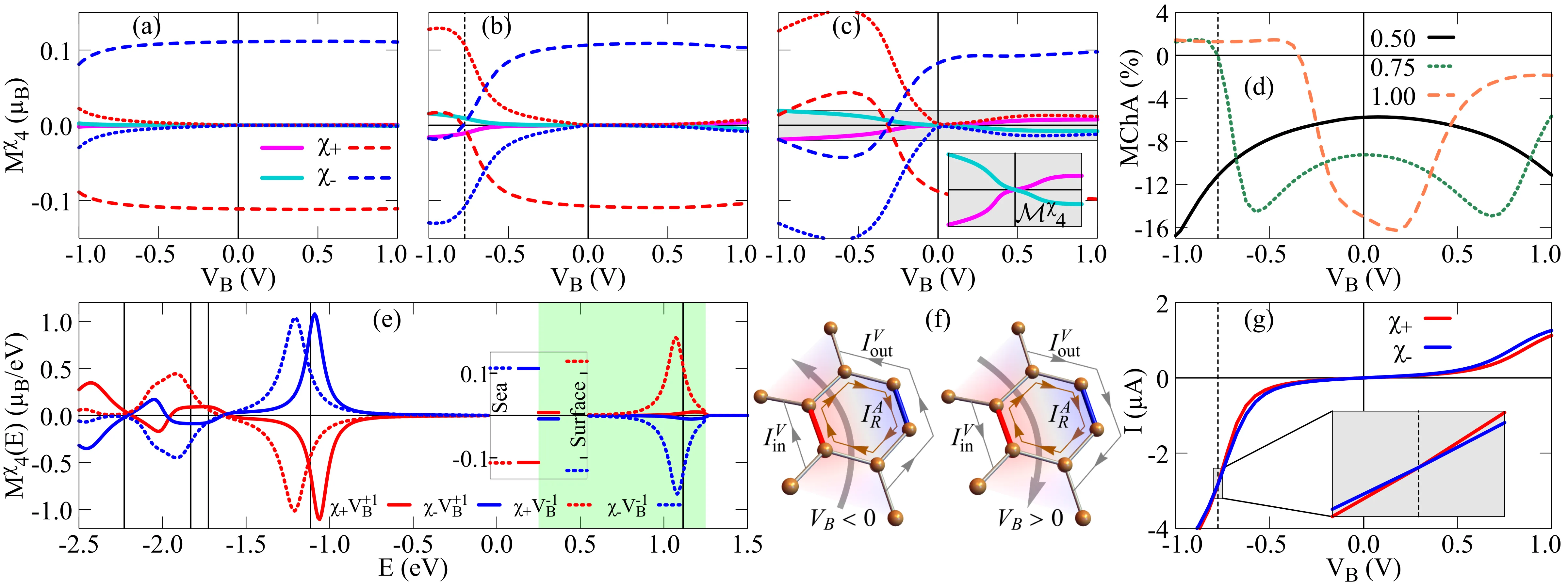
A spiral staircase sets the rhythm of footsteps: if a stream of people runs up it, their motion inevitably twists. Something similar happens in helical molecules — for example, in DNA or certain proteins. When an electric current is passed through such a molecule, electrons don't just fly straight. They curve around the bends of the molecular chain, and this circular motion generates a tiny magnetic field — a molecular orbital moment.
It is this internal magnetic vortex, as the authors of the new work show, that accounts for a long-standing puzzle in physics — the chirality-induced spin selectivity (CISS) effect. The essence of the effect is simple: a left-handed molecule transmits electrons with one spin direction (intrinsic rotation) better than with the other, and a right-handed molecule does the opposite. Previously, it was thought that the contacts between the molecule and the electrodes were responsible. But experiments hinted that the main 'filter' is the molecule itself.
The new theory links the direction of this moment to the molecule's chirality: its 'left-handedness' or 'right-handedness.' The moment arises because the electron's path is curved, like a riverbed. This curvature acts on the electron like a magnetic field. As a result, the molecule's resistance changes depending on the magnetization of the contacts — even if the voltage doesn't change sign. The theory doesn't violate fundamental symmetry laws and predicts new effects: for example, current-voltage curves for left- and right-handed molecules can intersect several times.
Thus, a model based on simple geometry and current explains a wide range of phenomena — from magnetoresistance to electrical magnetochiral anisotropy (the dependence of conductivity on the direction of current and magnetic field). The spiral staircase inside the molecule turns out to be the key to controlling spins without external magnets.
Original abstract
as written by the authors arXiv:2606.17865
The microscopic origin of the chirality-induced spin selectivity (CISS) in helical molecules remains an open question. Recent experiments suggest that a significant contribution to CISS arises from the molecule itself, which is disregarded in existing interfacial or scattering based theories. Here we present an alternative theory of CISS to address this molecular contribution. The mechanism is based on the circulation of charge current in molecular loops that generates a molecular orbital moment (MOM). The direction of the MOM is governed by the gauge field arising from the structural distortion of the molecule and is associated with the handedness of the molecule. Such a MOM can produce finite CISS magnetoresistance and magnetochiral conductance asymmetries that are even in bias voltage, without violating the Onsager-Casimir reciprocity relations. Depending on the Fermi level and bias voltage, the MOM can be controlled externally, which can result in additional crossings of the enantiomer $$I-V$$ curves. Finally we explain the origin of the electrical magnetochiral anisotropy within the same framework, which establishes its generic applicability.
The CISS effect is so strong that in some molecules, electron spin polarization can reach nearly 100 percent, like an ideal magnetic filter, but without bulky magnets.