How to Assemble a Brain Connectivity Map from Scattered Fragments express
A patchwork quilt where each patch is a recording of activity from a small brain region. One patch was stitched on Monday in London, another on Tuesday in New York, and a third a month ago in Tokyo. This mosaic covers the brain only partially, and there is no common seam to join them. Previously, mapping directed connections, who sends signals to whom, required all regions to be recorded simultaneously with a shared clock.
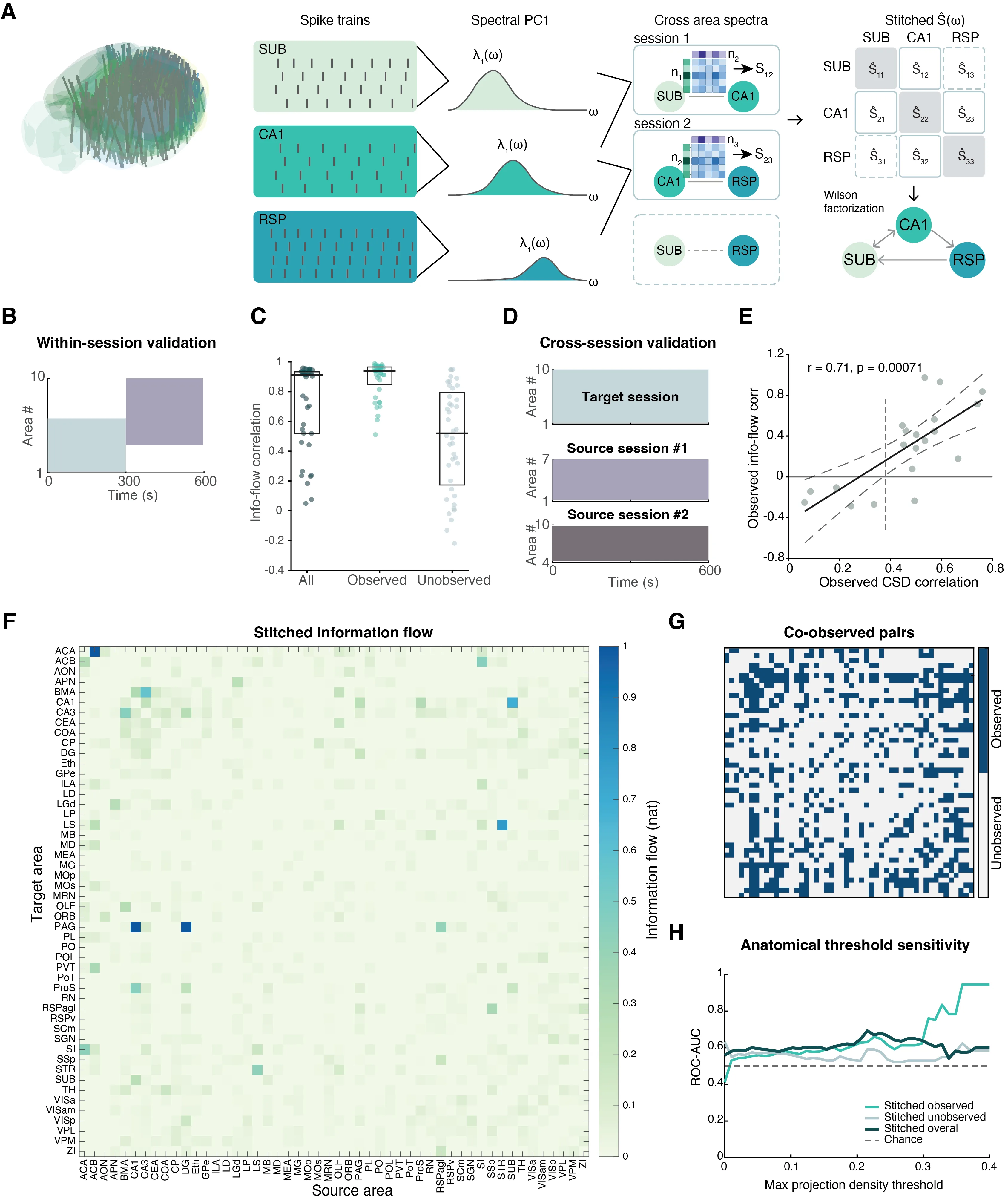
SPIDER works differently. It takes these scattered recordings and, like a skilled tailor, sews them into a single fabric. First, it estimates activity rhythms (power spectra) at each available location, then mathematically reconstructs the global connectivity matrix. Gaps between regions never recorded together are filled using the nuclear norm. Then, via canonical spectral factorization, directed interactions are computed — who influences whom and at which frequencies.
When tested on real data, a surprising picture emerged. In spontaneous activity of 50 mouse brain regions, connections were mostly recurrent, like echoes bouncing in a loop. But in the theta band (4–8 Hz), a clear hierarchy appeared: signals flowed forward, from the hippocampus to other areas. SPIDER found the same hierarchy in intracranial EEG data from 43 patients — now in humans. So this organizational principle is not random and does not depend on species.
Thus, from a pile of mismatched recordings, a coherent picture of the brain's orchestra emerges. The patchwork quilt becomes a road map along which thoughts travel.
Original abstract
as written by the authors arXiv:2606.22695
Mapping the directed flow of information between brain regions -- their effective connectivity -- is central to understanding brain function, yet large-scale recordings sample only a fraction of the brain at a time: sessions, animals, and laboratories cover different, partially overlapping regions, usually without a shared temporal reference. Established directed-connectivity methods (Granger causality, dynamic causal modeling, partial directed coherence, PDC) require all regions to be recorded simultaneously and with a common clock. We introduce SPIDER, a non-parametric, frequency-domain framework that recovers directed information flow from such incomplete, asynchronous recordings: it stitches local power-spectral estimates from overlapping channel subsets into a global spectral matrix and obtains frequency-resolved directed interactions by canonical spectral factorization and PDC, without temporal alignment, while nuclear-norm completion fills in never-co-observed region pairs. With consistency guarantees, we validate SPIDER on simulations, two-photon calcium imaging, and the International Brain Laboratory Neuropixels dataset, recovering directed flow among 50 areas from 43 sessions in 12 laboratories never recorded together. Beyond validation, SPIDER reveals what no single recording can: brain-wide spontaneous flow is largely recurrent, but in the theta band it forms a significant feedforward hierarchy with the hippocampal formation at its source. Applied to resting human intracranial EEG (43 patients, non-overlapping coverage), it recovers the same theta-band hierarchy across species and modality. SPIDER makes whole-brain effective-connectivity analysis tractable for multi-session, multi-animal datasets previously incompatible with directed-flow inference.
Theta rhythm (4–8 Hz) is often linked to navigation and memory, and now it's clear that it literally points the way for signals from the hippocampus — our internal cartographer.
The idea of assembling a mind from fragments echoes Lois McMaster Bujold's 'Memory,' where a personality is reconstructed from scattered memories.