A Fourier series is a representation of a periodic function f(x) with period T as a sum of trigonometric functions: f(x) = a0/2 + Σ[a_n cos(2π n x/T) + b_n sin(2π n x/T)]. The coefficients a_n and b_n are calculated as projections of the function onto the corresponding cosine and sine waves and show how strongly each harmonic is expressed in the original signal. The expansion is possible due to the orthogonality of sines and cosines. Fourier series are a powerful tool for solving differential equations (e.g., the heat equation) and underpin spectral analysis.
History
The origins of the idea go back to Daniel Bernoulli (1753), who represented string motion as a sum of harmonics. Jean-Baptiste Joseph Fourier in 1807, in his memoir on heat conduction, systematically used trigonometric series and proposed a method for computing coefficients. His work 'The Analytical Theory of Heat' (1822) established this apparatus, despite criticism from contemporaries for lack of rigor. A rigorous convergence theory was built by Peter Gustav Lejeune Dirichlet in 1829, and later developed by Riemann, Lebesgue, and others.
How it works
When expanding f(x), harmonics with numbers n form a spectrum. Low n correspond to slow changes, high n to fast details. The integrals for coefficients a_n and b_n are the scalar product of the function and the cosine/sine; thanks to the orthogonality of the basis ∫ cos(nx) cos(mx) = 0 for n≠m, each harmonic 'picks out' only its part of the signal. The sum of all harmonics gives the original function almost everywhere, and when truncated to a finite number, ensures minimum mean square error. The Fast Fourier Transform exploits the symmetry of complex roots of unity, recursively reducing the computation of an N-point DFT to two N/2-point ones, dramatically accelerating processing. In physics, harmonic decomposition is used for time series analysis (astronomy), mode composition of laser beams, plasma diagnostics, and solving Schrödinger equations.
In practice
Audio and image compression (MP3, JPEG), vibration analysis in structures, seismic data processing, and quantum computing.
Fun fact
When expanding a rectangular signal into a Fourier series, the sum of all odd harmonics yields a staircase that approaches a rectangle as the number of terms increases, but near the discontinuity, 'bumps' of about 9% of the signal amplitude remain — this is the Gibbs phenomenon, occurring in any series with discontinuities.
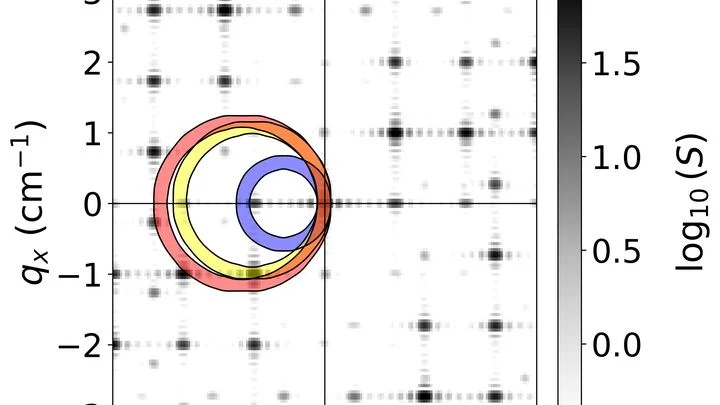
Waves on the water's surface usually break against any obstacle — a rock, a piling, an island. But what if you arrange obstacles so cleverly that the wave barely notices them? In a new study, scientists assembled a pattern of many points on the water, arranged according to special mathematical rules, and sent waves through them.
Data analysis on the internet or sensor systems has long resembled trying to conduct an orchestra where each musician is locked in their own booth, and the conductor cannot leave the podium.
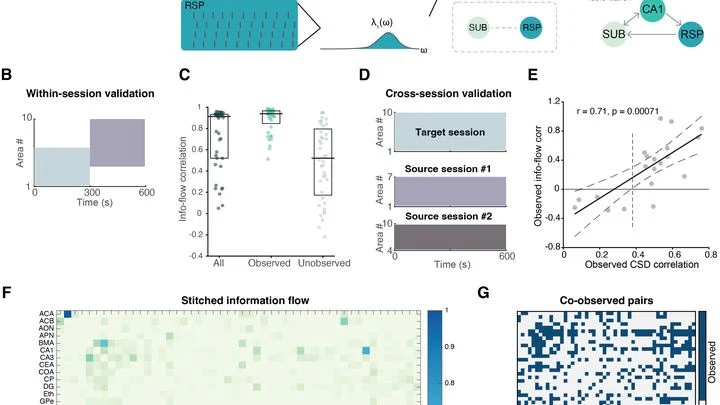
A patchwork quilt where each patch is a recording of activity from a small brain region. One patch was stitched on Monday in London, another on Tuesday in New York, and a third a month ago in Tokyo. This mosaic covers the brain only partially, and there is no common seam to join them.
An orchestra plays in a dark hall, and the listener hears only a hum: hundreds of instruments blend into a dense noise in which no melody can be discerned. That is roughly what spectra extracted from climate data by methods like the Koopman operator look like: hundreds of components, each with its own frequency, and it is unclear which ones are true musicians and which are the rattling of chairs.
Astronomers listen to the cosmos like an old radio: they twist the knob not to find a particular station, but to catch any unusual noise. This approach breaks the mold: instead of hunting for gravitational waves using memorized patterns, they catch everything — without bias.
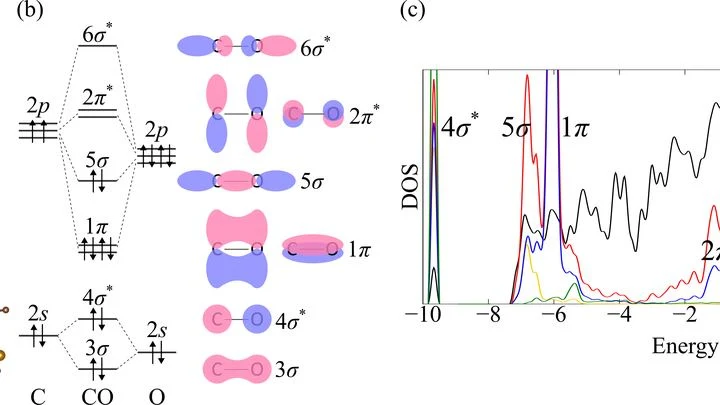
A quantum computer measures a molecule's energy much like an old tape measure that only has markings every meter. If the actual length of a table is 2.37 meters, the tape shows “two and a bit,” and you can't do better. Physicists call this resolution: the step of the grid, finer than which you cannot go.
The authors of the new work turn this flaw into an advantage.
Light passing through ripples on a water surface paints dancing patterns on the bottom of a pool. Engineers have used a similar idea to make light compute. They fabricated a tiny plate with a wavy relief: each ridge and groove deflects rays in its own way. When an image falls on such a surface, the light transmitted through it converges at different points behind it.
The ocean is like a layered cake: warm, light water on top, cold, heavy water below. Between the layers, at the interface, invisible waves roam. They don't lift crests like a storm; instead, they slowly rock the entire water column, as if someone were shaking a giant aquarium from within.
The Pacific Ocean, ten thousand kilometers wide, breathes: warm water shifts eastward, cold water retreats, and this in-and-out repeats every few years. A model that captures this breathing takes weeks of computation even on a supercomputer.