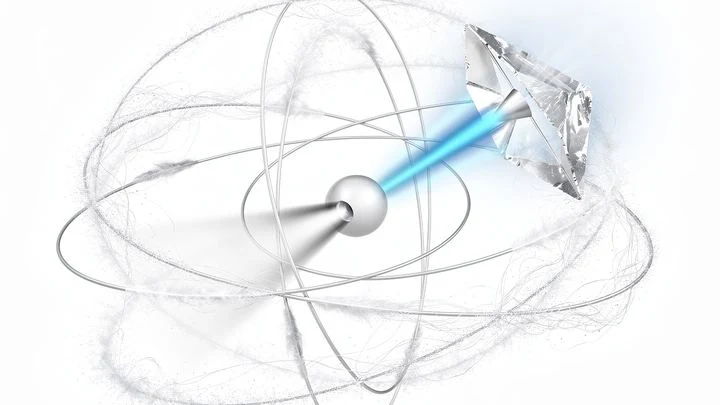
The Swiftsatellite is a space observatorydesigned to detect and rapidly localize gamma-ray bursts (GRBs) — the most violent explosions in the universe, thought to signal the birth of black holes or the collision of neutron stars. Its key instrument is the Burst Alert Telescope (BAT), which scans a wide field of the sky for sudden flashes of high-energy gamma rays. Once BAT detects a burst, Swift autonomously slews its X-ray and optical telescopes to the same spot within seconds, capturing the afterglow while it is still bright. This rapid response has made Swift the workhorse of GRB astronomy since its launch in 2004.
History
Swift was developed by NASA with international partners (UK and Italy) and launched on November 20, 2004. It was proposed by Neil Gehrels and his team, building on the legacy of earlier GRB missions like BATSE and BeppoSAX.
How it works
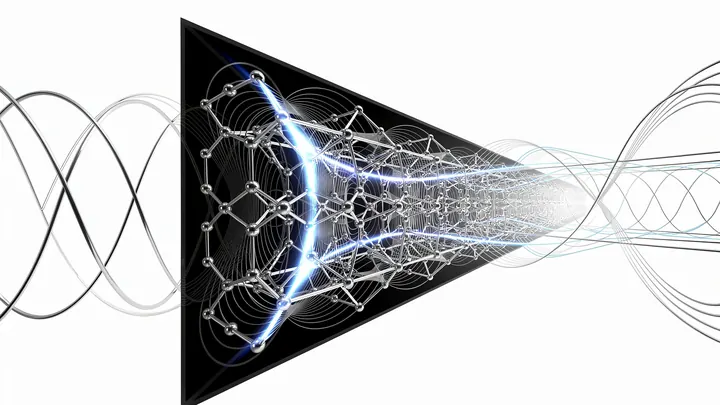
BAT uses a coded aperture mask: a lead plate with a random pattern of holes placed above a detector array. Gamma rays from a burst pass through the holes and cast a shadow pattern on the detector. By cross-correlating that pattern with the known mask, the satellite's computer reconstructs the burst's direction to within a few arcminutes. Swift then automatically reorients itself so that its narrow-field X-ray and ultraviolet/optical telescopes can observe the fading afterglow, measuring its position precisely and tracking its evolution over days.
In practice
Beyond GRB science, Swift's rapid slewing and multi-wavelength observations are used to study supernovae, tidal disruption events, active galactic nuclei, and even comets in our solar system, providing a rapid-response platform for transient astronomy.
Fun fact
Swift has detected over 1,500 gamma-ray bursts and can pinpoint a burst's location to within 3 arcminutes in under 20 seconds, faster than any previous observatory.
A beacon at the edge of the galaxy blinks without a schedule: sometimes silent for years, sometimes emitting hundreds of flares in a single day. Such a beacon needs a watchman who never sleeps and never gets distracted.
In active galactic nuclei, supermassive black holes are surrounded by a dense ring of dust that acts like a curtain: it hides everything happening at the center. If a star ventures too close to the black hole, tidal forces tear it apart, and the resulting flare is usually visible in optical and X-ray light.
An avalanche in a sandpile starts with a single grain. No one knows exactly where it will slip or how big the slide will be. But if you keep pouring sand, the pile itself reaches a state where avalanches of all sizes, from tiny trickles to massive collapses, follow the same law.
The night sky looks smooth, but it's actually clumpy — vast communities of galaxies that bend light from distant objects like lenses. When a short, powerful radio burst goes off somewhere in the universe, its path to an Earth telescope can pass near such a clump.
Imagine a lottery where instead of money, you win black holes. Each ticket is a random spot on the sky, and the prize is a gravitational wave from the merger of two giants. The chance of hitting the jackpot is minuscule, but if you do, the wave is heard across the entire universe.
Pulsars are rapidly spinning neutron stars that emit radio pulses like a lighthouse. But some of them stay silent almost all the time, occasionally emitting a single pulse. Such objects are called rotating radio transients (RRATs). They were discovered nearly twenty years ago, but they remain a mystery.
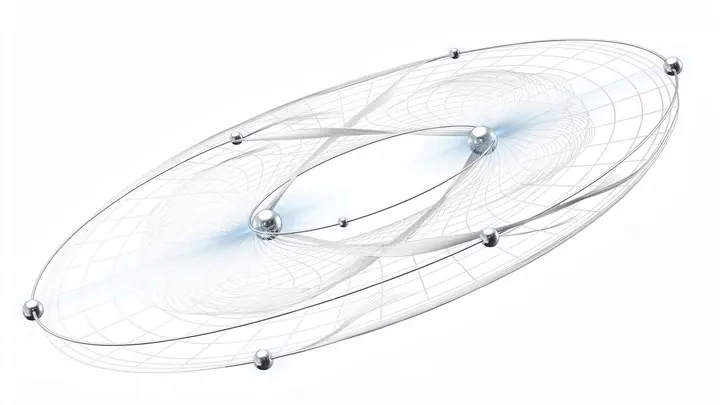
Somewhere in the depths of space, two supermassive black holes are circling each other. Their dance is not smooth — the orbit is stretched, like a rubber band that alternately tightens and relaxes. Each revolution sends ripples through the fabric of spacetime — gravitational waves.
The calm surface of a lake suddenly ripples — somewhere in the depths, an underwater cliff has collapsed. The water trembles almost imperceptibly, and the circles spread wider and wider until they reach a bobber near the shore.
A flashlight beam cuts through fog. The denser the fog, the more the light scatters and the later it reaches your eye. A similar principle works with fast radio bursts — mysterious, super-powerful pulses from distant galaxies. As their radio waves travel through space, they interact with free electrons — particles stripped from atoms.
The night sky is like an ocean: the longer you stare, the more faint lights you notice in the depths. That's how astronomers, peering into the outskirts of the Milky Way, found Aquarius IV — a tiny stellar system that had been hiding in the dark until now.
The system was spotted in images from an early survey by the future Vera Rubin Observatory.
In a dark room, a whisper is barely audible. To make out the words, you need to get close, or set up many sensitive microphones. That's roughly the reasoning behind the new work: the authors place quantum "ears" right inside a resonator, where a high-frequency gravitational wave turns into an electromagnetic echo.
At the heart of our Galaxy lives the supermassive black hole Sagittarius A*. If an invisible companion orbits nearby, their dance can be spotted through the light of other stars. The pair's gravity works like a lens: as the black holes pass in front of a background star, its light briefly brightens and splits into two.
The universe is like a vast invisible scaffold. We don't see it directly, but we know it's there: galaxies and clusters hold together thanks to it. This scaffold is dark matter. The most popular version says it is "cold," made of heavy, slow-moving particles.
A fast radio burst is a short but powerful flash of radio waves from deep space. As it travels to us, the signal passes through clouds of tenuous gas, and the more gas it encounters, the more the signal is smeared across frequencies. Astronomers call this delay the dispersion measure — essentially, it's a "weighing" of all the matter along the line of sight.
In the first moments of its life, the universe resembled a boiling cauldron. Matter wasn't spread evenly — clumps and voids were brewing within it, and their violent motion gave rise to a trembling of space itself: gravitational waves.
A huge bowl of water. Drop a stone into it — ripples spread across the surface. The fabric of spacetime works much the same way: when two massive stars merge, they create ripples — gravitational waves. These waves travel to Earth and are picked up by giant detectors like LIGO and Virgo.
In 2034, a rocket leaves a spaceport with an unusual payload: two spheres the size of a large globe, each weighing nearly a ton. No engines, no electronics. Just a mirrored surface of hundreds of corner-cube reflectors — tiny prisms that return light exactly to where it came from. This is the future space tuning fork.
The Universe is humming, but our ears catch only the bass. LIGO hears the rumble of black hole mergers — the infrasound of space. Higher up, in the gigahertz range, the flutes and violins of primordial gravity ring out.
A regular radar works like an amateur photographer: it takes a series of blurry snapshots and tries to stitch them into a panorama. Details are smeared, and in a long corridor or crowd, the robot easily gets lost.
The principle is simple: like a bat, the radar emits a wave and catches the echo.
In the depths of the Universe, when a massive star collapses into a black hole or a magnetar is born, a gamma-ray burst flares up — for an instant, it outshines all the stars in the observable Universe.
Gravitational-wave detectors are like sensitive microphones, listening for the whispers of distant cataclysms. But every now and then, a sharp crack bursts in — a brief noise spike known as a glitch.
Two neutron stars spiral closer and collide. The result: a gravitational wave, a ripple in spacetime, a short gamma-ray burst, and a faint glow astronomers call a kilonova. But sometimes the signal passes by a massive galaxy.
In the ocean of space, every storm of birth or merger of supermassive black holes generates ripples — gravitational waves traveling at the speed of light. Over billions of years, these waves superimpose, merging into a low-frequency hum, like a distant surf.
Two neutron stars, ultra-dense remnants of massive stars, merge into one, and the space around them shudders: a gravitational wave is born, a ripple in the very fabric of spacetime. Almost simultaneously, a narrow stream of matter, the jet, erupts from the scene.
Two dead stars circle in a final dance. Their approach creates ripples in space — gravitational waves. But there may be a third, invisible partner in this dance. Its gravity accelerates the pair, and the signal changes pitch slightly, like the siren of a passing car.
Somewhere deep in space, a radio beacon flashes for a fraction of a second, and then goes dark. Such signals are called fast radio bursts. They come from other galaxies and last from microseconds to milliseconds.
Imagine two neutron stars, compressed to the size of a metropolis yet weighing one and a half Suns each. They whirl in an unrestrained gravitational dance, drawing together and flying apart every 4.4 hours. At periastron — the point of closest approach — only a couple of light-seconds separate them, and their speed reaches three and a half million kilometers per hour.
The universe is a vast orchestra playing the score of expansion. Galaxies race apart to the beat of inaudible music of dark energy. But here's the trouble: the conductor's baton held by Edwin Hubble, Adam Riess, and Vera Rubin sets two incompatible tempos.
A hum resonates across the universe. It is not sound, but a trembling of space itself — the gravitational wave background. It is produced by pairs of supermassive black holes circling each other at the centers of distant galaxies. Each pair is like a bass instrument in a vast orchestra.
At the heart of nearly every large galaxy lives a supermassive black hole — a silent giant around which stars, gas, and other, smaller black holes orbit. From time to time, one of these objects breaks free from its orbit and begins to fall toward the central monster in a tightening spiral.
A radio telescope is not just an antenna, but a computing machine that builds an image from millions of equations. This mathematical prism is as fragile as glass: one wrong digit in the calibration, and the real sky splits, spawning phantom sources.
Imagine an orchestra where each musician plays their own part, and the conductor tries to catch a faint rhythm common to all. That's roughly how astronomers search for gravitational waves from pairs of supermassive black holes (weighing billions of suns) circling each other in distant galaxies.
It was Edwin Hubble who discovered that galaxies are rushing apart, and Georges Lemaître linked this to the expansion of space. Today, the ΛCDM model, relying on dark energy and dark matter, asserts that the Universe is flat as a perfectly stretched canvas.
Spacetime is not a passive void but a dynamic membrane capable of elastic deformation. When neutron stars (ultra-dense objects the size of a city, where matter is compressed to nuclear density or black holes) regions with gravity so strong that even light cannot escape their bounds collide, the membrane shudders, generating…
A flashlight doesn't cast a uniform circle of light; it has a bright spot in the center and a blurred halo at the edges. If you switch it off quickly, the edges are the last to fade, and by how the light dies, you can guess the shape of the reflector.
In 2017, detectors picked up a tremor in space — gravitational waves from the merger of two neutron stars. At the same moment, telescopes saw a flash. For the first time, one event spoke in two languages at once: light and gravity.
For decades, the search for extraterrestrial intelligence has waited for quiet, coherent signals from space — a kind of 'whistle' in the radio silence. However, our own technosphere has created a continuous radio background — the hum of a vast metropolis, emitted by all communications, radars, and broadcasting stations.