Simple

A Neutron Star Lighthouse in the Cosmic Fog

Original: "FRB20250613A: a remarkable repeating FRB with apparent millisecond-timescale scattering variations"
arXiv:2607.00505v1 · 2026-07-01 · CC BY 4.0 · ⏱ 1 min · High Energy
Astronomers picked up radio signals from a neutron star that change faster than any predictions.
Abstract

Astronomers studied a repeating cosmic radio burst, FRB 20250613A, from a dwarf galaxy. Its signal seems to travel through a turbulent plasma sea: the environment around the source constantly changes, scattering and twisting the waves. Inside the burst, rhythmic pulses and effects resembling nonlinear distortions were noticed. The source is likely hidden in the dense wind of a companion star, like a lighthouse in the fog.

Links in the knowledge graph 1

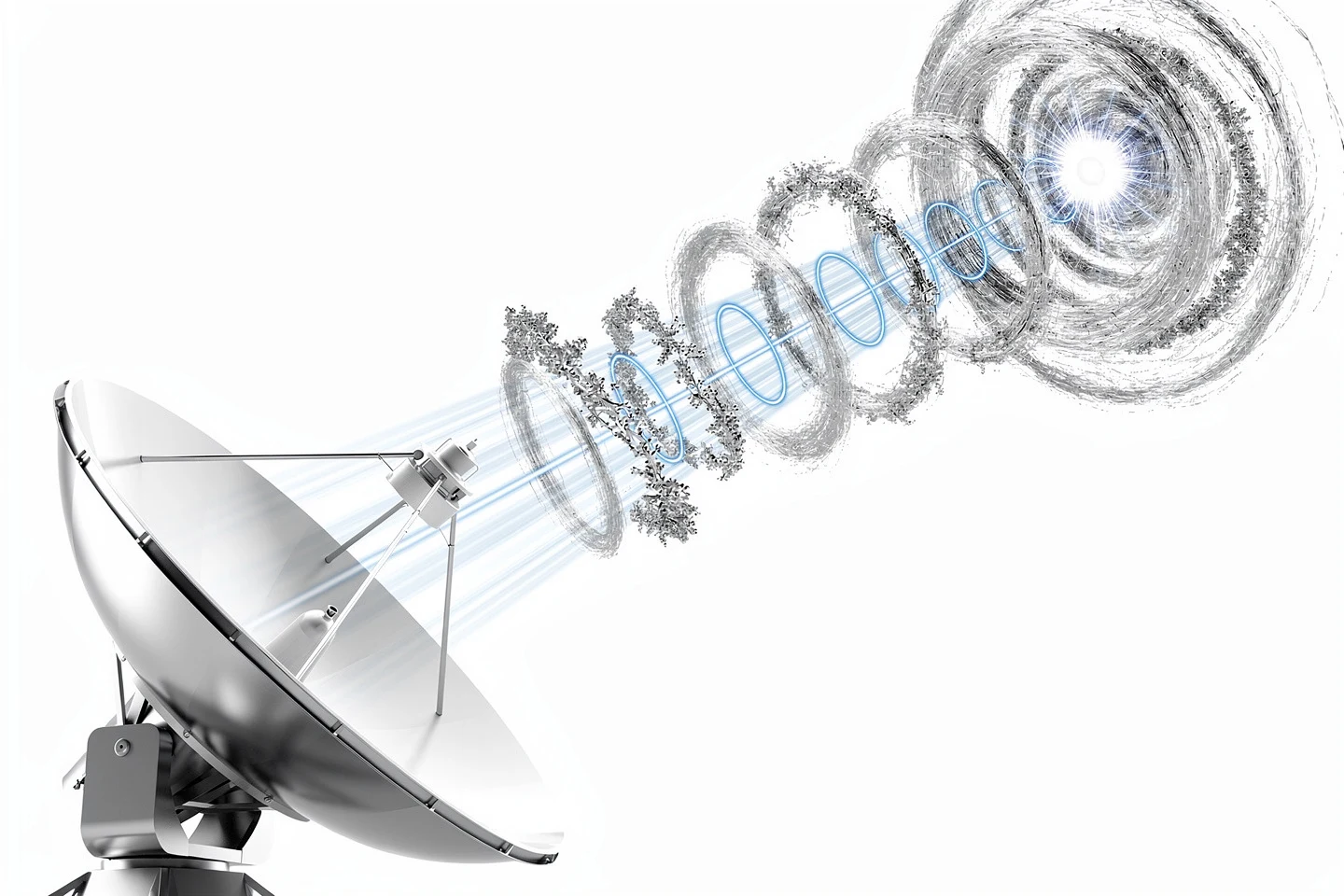
A lighthouse in thick fog: the denser the haze, the blurrier the beam. That's how a neutron star behaves—an ultra-dense nugget the size of a city, whose radiation punches through clouds of interstellar gas. Recently astronomers found an especially moody such lighthouse in a distant galaxy. Its radio signals, traveling to us at the speed of light, change faster than any model predicts. Sometimes a burst splits in two: only 7 milliseconds separate the parts, and the second one arrives sharp, as if the first one cleared the way. Likely, the radiation is so powerful it pushes the gas aside—like a gust of wind scattering fog, leaving a tunnel of transparency. The star itself apparently orbits an ordinary companion and occasionally emits regular pulses—a pulsar, first spotted by Jocelyn Bell Burnell. Its magnetic field twists the radio waves so much that the polarization (the direction of oscillation) dances unpredictably.

These bursts—cosmic clicks lasting thousandths of a second—carry a day's worth of solar energy.
The birth of neutron stars in supernova explosions was predicted by Fritz Zwicky, while distances in space are measured using the law of Edwin Hubble. With spectroscopy (splitting light into colors), scientists found hydrogen lines in a distant galaxy.

Once we understand the mechanics of these lighthouses, we'll be able to use them to probe the invisible gas between galaxies. For now, this object reminds us: even a tiny star, one that could fit within a small city's downtown, can burn brighter than an entire Sun.

🎯 Each burst is a click lasting a thousandth of a second, but equal in energy to a whole day's output of the Sun.

p_m = p \exp(-2\sigma_{RM}^2 \lambda^4)
Polarization fades with wavelength, like picture sharpness through the shimmering air above hot asphalt.
a_0 = \frac{e E_0}{m_e c \omega}
Dimensionless field amplitude: when it exceeds unity, electrons become relativistic and the plasma opens up like gates — the beam burns through the fog.
Scientists
Adam RiessBrian SchmidtEdwin HubbleGeorges LemaîtreMaarten SchmidtSaul Perlmutter
Tags
neutron star pulsar spectroscopy galaxy supernova hydrogen speed of light Hubble Space Telescope
Laws
Hubble's lawDoppler effectprinciple of constancy of the speed of lightmass–energy equivalenceCoulomb's lawMaxwell's equations
Original: arXiv:2607.00505v1 · CC BY 4.0 · bridge42worlds