Dancing Dispersion: The Millisecond Life of a Neutron Star ✛ ✦
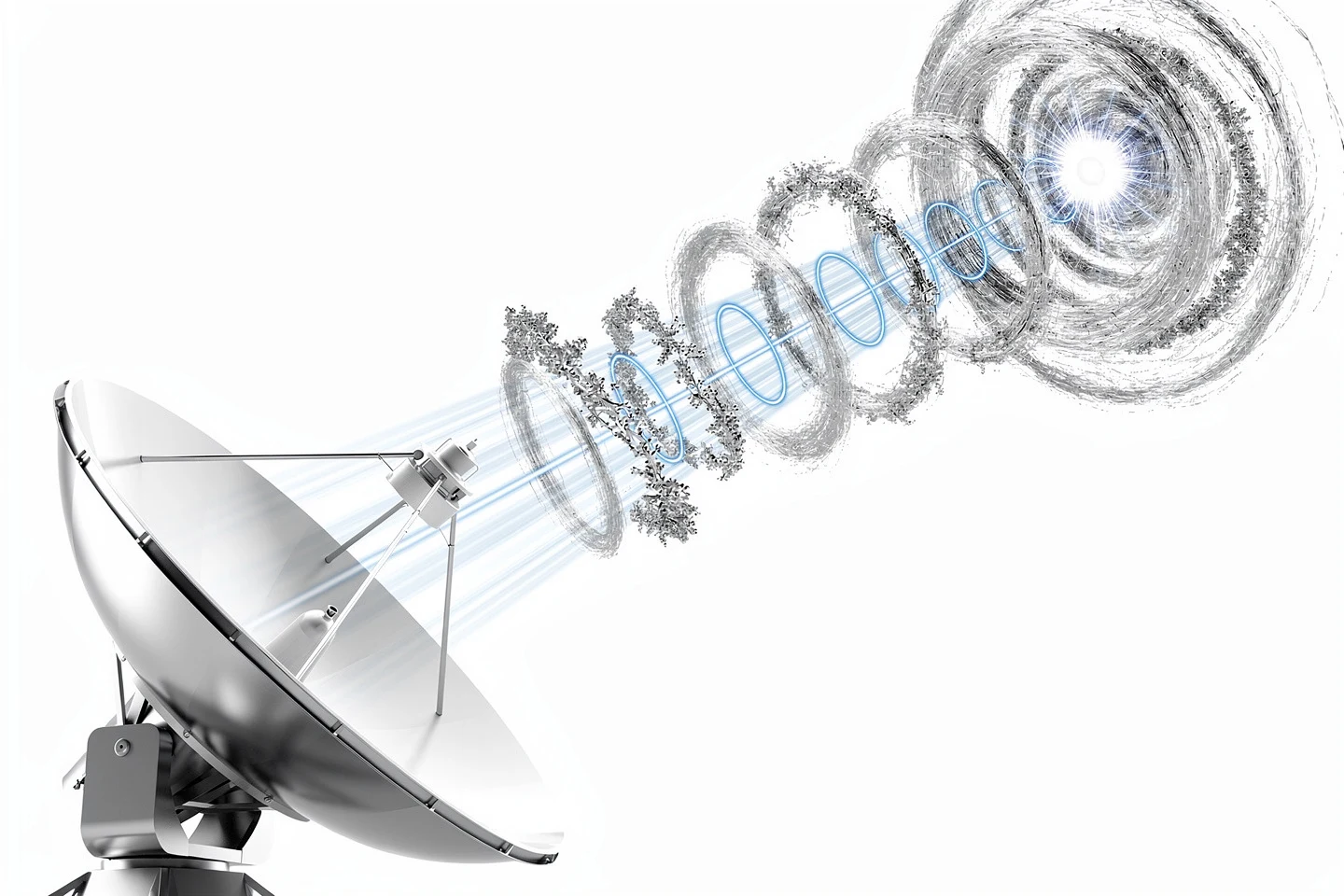
In 2007, astronomers heard a mysterious millisecond click from space — that's how fast radio bursts, or FRBs, were discovered. Since then, they've become a cosmic-scale detective story: as bright as an entire galaxy and compressed into an instant, these signals race through the Universe at the speed of light. Their nature is still hotly debated, but a new repeating source, FRB 20250613A, sheds light on physics beyond the edge. The burst was caught by the ASKAP, MeerKAT, and Parkes radio telescopes. Its host galaxy — tiny, with a redshift of z=0.0987, perfectly fitting the Hubble law discovered by Edwin Hubble — was identified by optical spectroscopy at Gemini South, where hydrogen lines appeared. The path to these stars was paved by Jocelyn Bell Burnell, who discovered the first pulsar in 1967, and Fritz Zwicky, who predicted neutron stars long before they were detected. And now FRB 20250613A forces us to rethink how radio waves dance with plasma.
Imagine a cosmic lighthouse. A neutron star — the ultra-dense remnant of a supernova — spins madly, hurling a narrow beam. Paired with a massive Be-star, this beam pierces a dense plasma wind — FRB 20250613A is just such a duo. Its 'clicks' repeat every 6.8 milliseconds, like flickers of a searchlight, which makes it kin to pulsars. But this is no steady beacon: the surrounding plasma is twisted by magnetic fields and churns, sometimes smearing the signal into thick jelly, sometimes barely hindering it. Dispersion varied from 0.14 to 7.2 ms within minutes, and between components of a single burst, the difference was 30-fold. A dance of chaos.
Polarization synthesis showed that the waves travel through a swirling magnetic cocktail. But the most astonishing thing is that the medium's properties depend on the burst's brightness. A powerful pulse shoves the plasma electrons so hard that they accelerate to near-light speeds and cease to be an obstacle. The first bright peak literally clears the way for the next ones, like a plasma plow. This effect, parameter a0, had been predicted theoretically but never before observed so vividly.
For physics, this is a gold mine. FRB 20250613A is a testing ground for studying coherent emission in ultra-strong magnetic fields and plasma turbulence. We no longer just clean the signal of dispersion — we use the dispersion itself as a probe. In this way, we can feel out the invisible web of hot gas between galaxies — the very 'hidden baryonic matter' that ordinary telescopes miss. Long-term observations are already planned to pin down the periodicity and properties of the stellar wind. Perhaps these pulses will become our universal ruler for mapping the Universe — and every click will turn into a key to the mystery, like a dance step frozen in a millisecond.
Each click of FRB 20250613A packs the energy of an entire day of the Sun into a thousandth of a second. If you blink, you'll miss about two hundred spins of the neutron star.