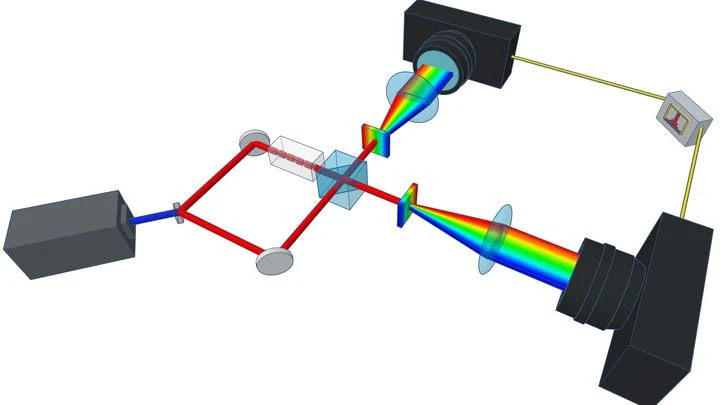
The Mach-Zehnder interferometer is an optical device that splits a beam of light into two separate paths, then recombines them to create an interference pattern. It is a fundamental tool in physics for measuring tiny changes in path length, refractive index, or any effect that alters the phase of light traveling along one arm relative to the other. The device is central to quantum optics experiments, where it demonstrates wave-particle duality and the behavior of single photons.
History
The interferometer was independently described by Ludwig Mach (grandson of Ernst Mach) and Ludwig Zehnder in the early 1890s, building on earlier work by Albert Michelson.
How it works
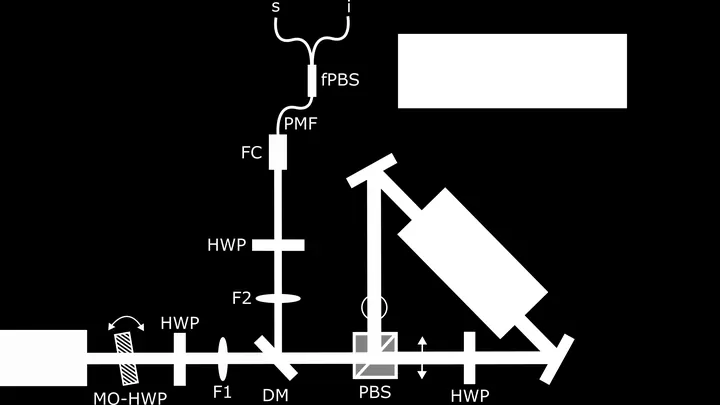
A beam splitter divides the incoming light into two beams that travel along different paths, reflect off mirrors, and then meet at a second beam splitter. The two beams recombine and interfere, with the output intensity depending on the phase difference accumulated along the two paths. If the phase difference is an integer multiple of the wavelength, constructive interference occurs; if it is a half-integer, destructive interference occurs. This sensitivity allows detection of extremely small changes in the optical path, such as those caused by a tiny displacement of a mirror or a change in the medium's refractive index.
In practice
It is used in quantum cryptography, optical coherence tomography, and as a sensor for gravitational waves, where it detects minute changes in the relative lengths of its arms caused by passing gravitational waves.
Fun fact
In quantum mechanics, a single photon entering a Mach-Zehnder interferometer can interfere with itself, and by adjusting the phase, the photon can be deterministically routed to one output port or the other.
The two states of a strontium atom are like twins running down the same track, but one is slightly higher than the other. Usually, the light used to manipulate atoms pushes one twin harder and the other more weakly. Here, they chose a wavelength of 813 nanometers—'magic'—where both get the same kick.
Light in a gravitational-wave detector races through multi-kilometer tunnels, bouncing off mirrors. A perfectly uniform beam resembles a smooth sheet held by its corners. But if one mirror tilts by the width of an atom, the sheet develops wrinkles: 'parasitic' patterns, more complex light spots, awaken in the beam.
Previously, such wrinkles were dismissed as noise.
Two photons meet at a half-silvered mirror. If they arrive at exactly the same time, they always leave together — side by side, like twins who refuse to be parted. This effect, discovered in 1987, became the basis of a quantum ruler for measuring tiny delays.
A laser is like a tuning fork that rings at a single note. But even in complete silence, its sound trembles slightly. Previously, it was thought that this tremor, random kicks from spontaneous emission of light by atoms inside the laser, was the main limit to precision.
A beam of light enters frosted glass and fades — nothing unusual. But physicists have long known how to make light pass through without losing a single photon. This trick is called electromagnetically induced transparency: two light waves cancel each other at the right point, and absorption disappears. Now a similar feat has been pulled off with atoms.
Drop two pebbles into a pond at the same time — the ripples will spread evenly and in sync. The same happens in a quantum interferometer: a particle is split into two waves that travel along different paths and then meet. Ideally, their crests align.
Light loves symmetry: in an open channel, it flows equally both ways. To steer it one way, physicists often use magnets. A new approach does without, using rotation — just the speed of a vinyl record — and interference from two atoms. Rotation changes the “pitch” of light for different directions, just as a siren’s tone shifts when a car approaches or recedes.
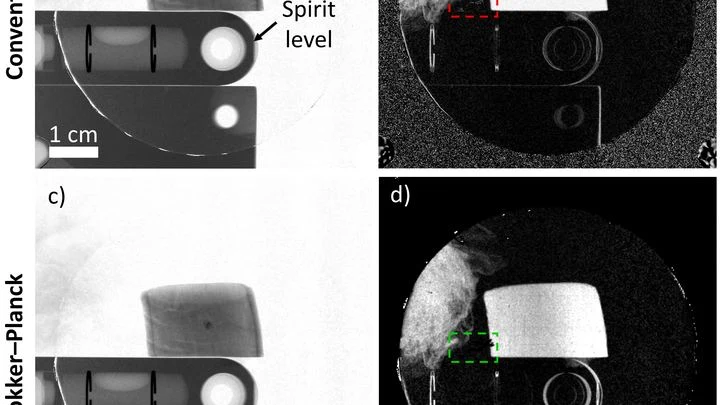
An X-ray machine with gratings takes not one but three pictures at once: a regular image, a map of beam deflections invisible to the eye, and an image of tiny structures that scatter light. Together, they help spot, for example, emphysema or pulmonary fibrosis. But there's a catch: to separate these three layers, you need a clever mathematical trick.
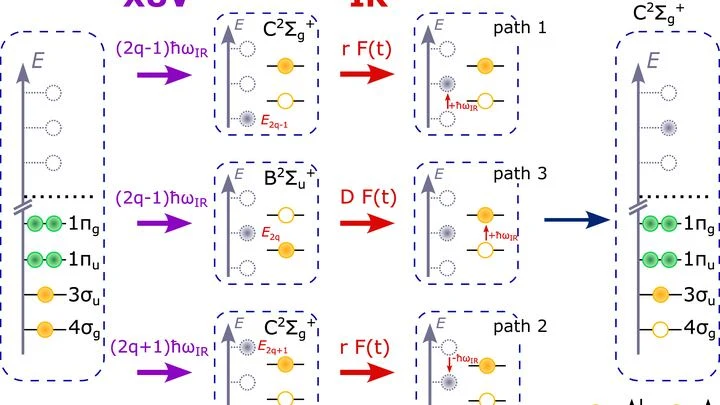
A high-speed camera capable of capturing the motion of electrons is an attosecond interferometer. It sends two laser pulses at a substance with a tiny delay. The first, ultraviolet, acts like a flash, knocking an electron out of the molecule. The second, infrared, like an invisible hand, gently nudges or slows this electron in flight.
Inside every cell, there are tiny power stations — mitochondria. They burn nutrients and store energy. Two helper molecules, NADH and FAD, oversee this process. Previously, they were detected by their faint glow, but it was dim, and signals from different molecules overlapped.
The new microscope works differently.
Atoms in a beam travel at different speeds, like runners on a track. A regular laser pulse only pushes those moving at one speed, but the new one acts like a coach giving commands to the whole group at once. This approach involves more atoms in the measurement.
Quantum computers and sensors operate at microwave frequencies, but transmitting their signals over long distances is conveniently done via optical fibers, which use light.
A quantum dot is like a tiny lamp that turns on and off at the command of a laser, emitting exactly one photon at a time. But this light has a quirk: the photons don't interact with each other; they fly independently, like random drops from a faucet.
Dark matter is an invisible mass holding galaxies together. Its nature remains unknown, but one likely candidate is the axion — an ultra-light particle that barely interacts with matter. To catch it, physicists built a hybrid trap.
Infrared light with a wavelength of about three micrometers is the working range for identifying molecules: each molecule absorbs light at its own characteristic frequencies, leaving behind "fingerprints." But until now, instruments for this range could not simultaneously provide broad frequency coverage, sufficient power, and…
A laser pointer shines a neat spot: all its light waves march in step, like soldiers on parade. Such light is called coherent. But nature and technology also feature another kind of light—'messy' light, where waves are out of sync, like a crowd at a market. It's called partially coherent.
In a dark room, two flashlights shine on a wall. Usually, their beams simply add up, and the spot becomes brighter. But if the flashlights emit light in special packets, photons, then under certain conditions they can behave differently. Instead of independently hitting different spots, two photons 'agree' and only come out together, as a pair, from a single output.
Light from a single source can be made to 'meet' itself, and then fringes appear on the screen, like ripples from two pebbles dropped into water. Physicists have long known how to do this with two photons, but making four particles of light merge at once was tricky: single-photon sources lost too many particles along the way.
The theory of gravity by Einstein — general relativity — rarely intersects with quantum physics in direct experiments. Here, scientists built a 50-kilometer glass labyrinth on a table and sent single photons through it.
We’re used to time flowing only forward. But quantum laws let it become like a coin showing heads and tails at once.
Take a particle with its own spin — its intrinsic rotation. In a magnetic field, it spins like a top. Send this particle through a device where two opposing magnetic flows fight each other — and it will start moving into the future and the past at the same time.
In photometry (the measurement of light), catching individual microwave photons was long impossible: their energy is on par with the thermal jitter of atoms.